Digitisation accelerated among consumers as well as independent hotel owners
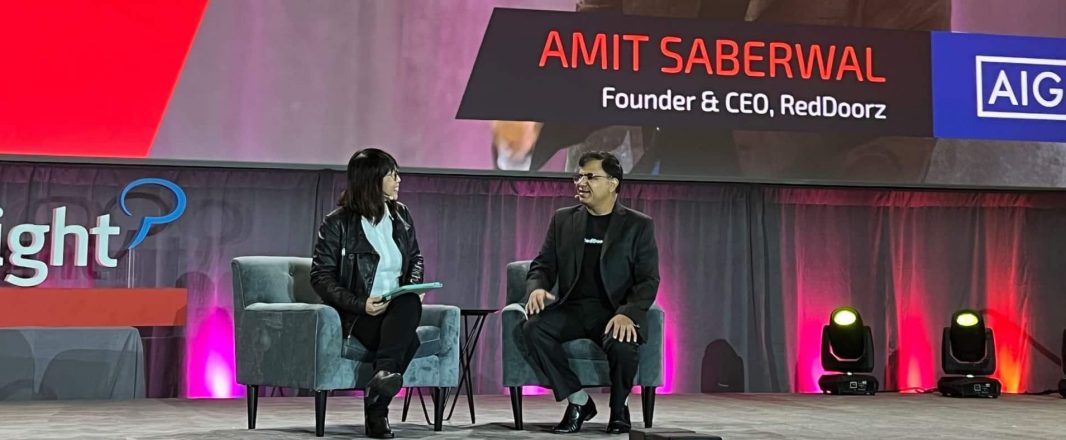
YEOH Siew Hoon interviewed Amit Saberwal, CEO of RedDoorz, Southeast Asia’s largest technology-driven hotel management & booking platform at the Phocuswright Conference 2021, where they spoke about the breakout region of South-east Asia during Covid and how the pandemic made entrepreneurs like him think differently about customer acquisition, profitability and fund raising.
Q: Good to meet you in Fort Lauderdale all the way from Singapore. Why did you bother to make the trip amid a pandemic?
I represent the huge South-east Asia market that is often overshadowed by India and China. It is a phenomenal opportunity from the tourism and travel standpoint. The addressable market is bigger, the hotel supply is available – you need good supply to create a good business. I also wanted to pay tribute to my good friend and board member Philip Wolf and remember him through this event. This would be the first Phocuswright without him.

Q: Yes, South-east Asia has certainly become the breakout region during Covid. Facebook’s 2021 Digital Consumer report says 70m people – equivalent to the entire population of the United Kingdom – have become digital consumers in the region. And its online retail penetration is projected to grow 85% year-on-year by end-2021, and is now larger than India’s or Brazil’s.
Yes, there’s been rapid digitisation. Customers no longer want to meet people, they want seamless experiences, as touchless as possible. What’s interesting is that full digitisation is also happening in the 25-room properties – so it’s accelerated from both consumer and supplier side, and it’s paying off for hotel owners. Hotel owners – who were part of RedDoorz brand – report 15% higher occupancy than unbranded similar products.
Q: It can’t have been easy the past 20 months though. I know RedDoorz takes pride in being a “honey badger” (your mascot), and its key characteristic is fearlessness. But you must have been afraid at some point at the height of the pandemic in markets like Indonesia, Thailand and Philippines – you’ve raised US$150m in total (latest round was Series C) and were on your way to becoming a unicorn, so there must have been investor pressure?
Yes, it’s been challenging but we are proud of the fact that we are an undoubted survivor – we were just rated the 6th best workplace to work in in Indonesia and there’s no travel company on the list. The company has a soul – our partners, employees, investors, stood with us in the worst of times and we have come out much stronger.
I recall early on, all the investors were trying to be helpful by giving us the bad news until we told them we read the same papers and we said, “let us execute”, and we reassured them, we would not cut down on the growth function – that means technology and business development. And we executed our way out of it.
Q: What was the secret execution sauce?
The key trigger was, we moved very quickly and took decisive actions early on. This included removing minimum guarantees, shutting down Thailand and cutting down 40% of our workforce. We are a leaner company now.
One positive outcome is the competition has died off, there’s been rationalisation. Indonesia and the Philippines, our revenues are higher today than pre-pandemic, 96% of our business is domestic there. What happens in Bali, which is foreign dependent, does not apply to us. Our business in Vietnam was affected because of the lockdowns but we remain fully committed to the market. Singapore – we have reduced from 13 to 3 properties – we have no intention of growing the business in Singapore.
We have 2,900 properties across four countries now – we were 1,600-1,700 before the pandemic. We adopted a multi-brand strategy and grew supply.
Q: You now have five brands, RedDoorz, your bread and butter; Urbanview, SANS and Sunerra – which is 3.5 stars, and KoolKost for remote workers – aren’t you in danger of going the same way as traditional hospitality companies of having so many brands, it’s hard for consumers to differentiate and it gets complex for you to distribute?
They are all shades of the same type of budget accommodation. We are technology first, we have no GM on property, so we don’t have an issue with differentiation. What’s interesting is during Covid, we were scared that if we shut down Google or Facebook, we would lose our business and we didn’t have money to spend. But our customers kept coming back to us directly.
We will likely never go back to performance marketing on Facebook or Google. We are a hyperlocal business and we have found that brand marketing works well on TV and you have to customise the offering.
Sunerra – we are still working things out. We like to experiment and we believe the business has a different rhythm. Our ambition is to be the largest new age hospitality company in South-east Asia. We don’t want a heavy asset model.
The doubts about Sunerra are scalability – it takes effort to design and requires multi-owners. We love to be where onboarding is easy, catering to the travelling salesman. There’s a fortune to be made at the bottom end of the pyramid.
Q: Competition has died off but there are also new well-funded competitors coming into the market – Yanolja, the South Korean hospitality giant, which just raised $1.7 billion and VN LIFE in Vietnam which raised US$250 million, will put some of those funds into VN Travel.
Every region would have a hyperlocal player who would win. Yanolja has done a great job but in a different market. It is a huge opportunity for multiple players.
The way I see the evolution of the hospitality industry – Hospitality 1.0 – Taj owns and runs the properties; Hospitality 2.0 – Marriott manages other properties. Hospitality 3.0 which is us – using technology to manage other businesses and assets, the way Airbnb uses technology to run other people’s assets.
Q: What was the best tech investment you made?
The best investments made were in improving our algorithms around supply sufficiency, matching what customers are asking for in that square foot area, improved by leaps and bounds – hyper-localised recommendations. In our market, one side of the street vs the other side, can mean a 20 minute travel time difference
Q: You were Employee #28 at MakeMyTrip – and I believe when you started RedDoorz, it was called something else, you started in India. Why did you not stay on to take on India?
India is like an elephant that threatens to dance but never dances but lately has started to dance. We are focused on South-east Asia.
Yes, when we started, we had a B2B product but we learnt that in India, you can give the technology, but if they don’t have the ability or intention or bandwidth to do it, you’re stuck.
Q: What does domination in South-east Asia look like?
15-20,000 real hotels under our brand. Empty hotels are like empty calories, they don’t make sense. Every hotel has to make a certain amount of money every month.
Q: You have declared your ambition to be a unicorn, that remains?
Covid has delayed us by two years. Our revenue profile is much better. Every dollar that is made on the core business, we make 50 cents on ancillaries, that was zero pre-pandemic. Our take rate is above 20%. We are making more money on half the room nights today.
Q: It’s interesting how some companies, which were chasing unprofitable growth before, are now profitable. We had Eric Gnock Fah of Klook speak at WiT and he said how they were now profitable in markets like Hong Kong and Taiwan.
Yes, profitability is a choice for us now and that is a powerful position for us to be.. The revenue profile of RedDoorz is so much more sustainable. Chasing unprofitable growth – including us – those days are over. Covid was a wake-up call and we were made to grow up fast.
Now the new metric for the company is MIB – Money In Bank.
Q: What was the old metric?
ORM – Occupied Room Nights. There are so many ways to present revenue. It’s time to cut the bulls…
Q: When’s IPO?
2023-24 perhaps, and I don’t see that as the exit but the starting point for RedDoorz. It’s an event in a long journey.
Q: There’s lots of talk about superapps in South-east Asia and fintech. You interested in any of those areas?
I think the superapp story is not as straightforward as it’s made out to be. Wallets, I think you have to think core vs non core in every business. If you address the core well, everything will fall in place.
If I have to raise a billion dollars, then I have to create a story. What we want to do is create value. Not everything can be solved with money. If that were the case, Google would run everything.
We will focus on what we are doing and keep on executing. And perhaps we will raise money next year.