ALTERNATIVE accommodation providers were the beneficiaries of changing traveller trends during the pandemic and within Japan, Airbnb and Rakuten LIFULL STAY certainly rode the Covid-induced trend well.
Speaking at WiT Japan & North Asia 2022, Atsuo Mori, territory manager for Airbnb Japan, recalled how the company lost about 80% of its business globally and a quarter of the staff had to leave the company at the start of the pandemic. “And people even wondered if Airbnb would exist after that.”
But some good came out of that, he said. “The pandemic actually forced us to focus on what we are and what makes Airbnb unique, special and different – which is the hosts and the communities. So we drastically changed our directions. We basically focused our entire resources, people, power and attention to what we are, which is community, and then we changed the product, adapting to the needs of the host and hosting.”
A few months after making these changes, Airbnb saw a recovery in business that led to the home rental going public on December 9, 2020, and its shares began trading a day later. It recorded the biggest US initial public offering (IPO) of 2020 at over $100 billion.
In Japan, Airbnb shifted its focus to the domestic market. Boosted by the improvement to the product in which Airbnb added 150 new functionalities to meet changing customer needs, Mori said its Japanese business was able to adapt to new trends such as “spontaneous travel with nearby stays, long term stays, as well as stays outside of the cities”.

Both Airbnb Japan’s Atsuo Mori (left) and Rakuten LIFULL Stay’s Munekatsu Ota are optimistic about the future in the alternative accommodation sector.
For Rakuten LIFULL Stay, which was formed through a strategic partnership between Rakuten and real estate platform LIFULL, the pandemic has also led to tweaks in the company’s operations, said Munekatsu Ota, representative director.
Beyond being a booking platform, it has strengthened its property management system and grown its inventory in quantity as well as variety, making it stronger for the uptick to come.
“We focused on increasing our inventory and providing various property types and, at the same time, we’re enhancing our property management business. This business has huge potential, not only as a booking platform but also as property management business. So for us we found huge potential in the pandemic.”
Both executives are optimistic about the future. A global consumer survey of 7,500 respondents carried out by Airbnb showed that more than 30% are opting for long-term stays of over a month in Airbnb due to remote work and lifestyle changes, said Mori.
He noted one interesting finding from the survey – the ratio of longer term stays on Airbnb is skewed towards people aged 60 and above, more than any other demographic. “It’s a surprising and interesting trend,” said Mori.
Bookings at Rakuten LIFULL STAY are about the same as pre-Covid, with stays of around four weeks. But stays are increasing gradually to about 10 months, said Ota, who also noted a shift in accommodation preference from apartments to private homes which account for almost 60% of bookings.
* Watch the full panel conversation here.
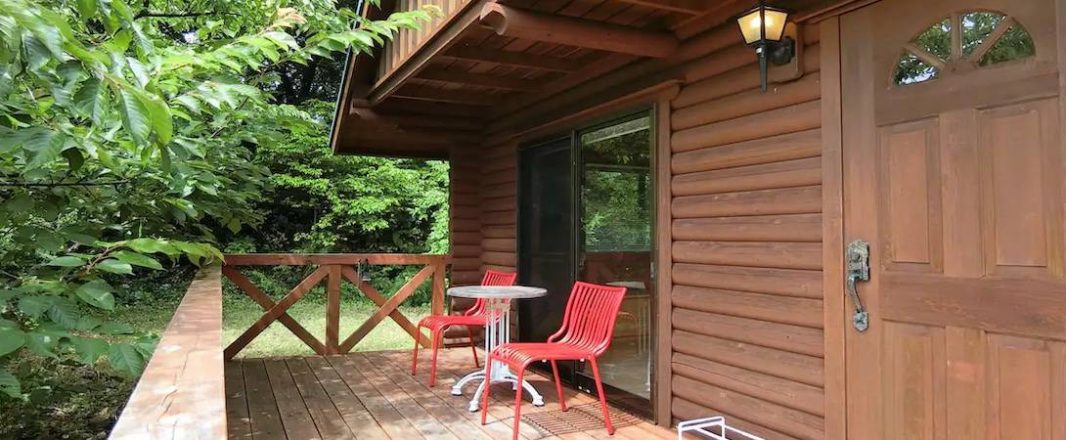
• Featured image credit (Log cabin at Minamiizu in Kamo District, Shizuoka Prefecture, Japan): Airbnb