
On pace to double revenues second year running, says Tim Hentschel
ON February 11, a rocket mishap by a company named Astra Space led Astrea Acquisition Corp to issue a press statement clarifying that it wasn’t the same company when its stocks took a hit.
On February 14, the day before the three-way merger between Astrea, HotelPanner and Reservations.com was due to go before a shareholders vote, the trio issued a press statement saying “the companies have mutually agreed to terminate their previously announced business combination agreement. The termination is effective immediately. All three companies believe that terminating the business combination is the best path forward for all parties.”
The merger was to have paved the way for a SPAC listing to fuel global expansion. When the merger was announced in August 2021, it was reported that “the combined company has a forecasted 2022 revenue of approximately $170 million and is expecting a three-year revenue CAGR (2020 to 2023) of approximately 42%. The transaction values the combined company at an enterprise value of $567.1 million, plus additional consideration should it achieve market-based milestones.”
The unfortunate ending to a much-anticipated seven-month journey must have been a blow to all parties concerned but Tim Hentschel, co-founder and CEO of HotelPlanner.com, whom I caught up with in Singapore, is putting on a brave face.
On the day the deal was called off, he told WiT, “We are very excited about this year as we are on pace to have our second year in a row of 100% revenue growth YOY. We believe this exploding growth will open lots of new exciting opportunities in the near future.”
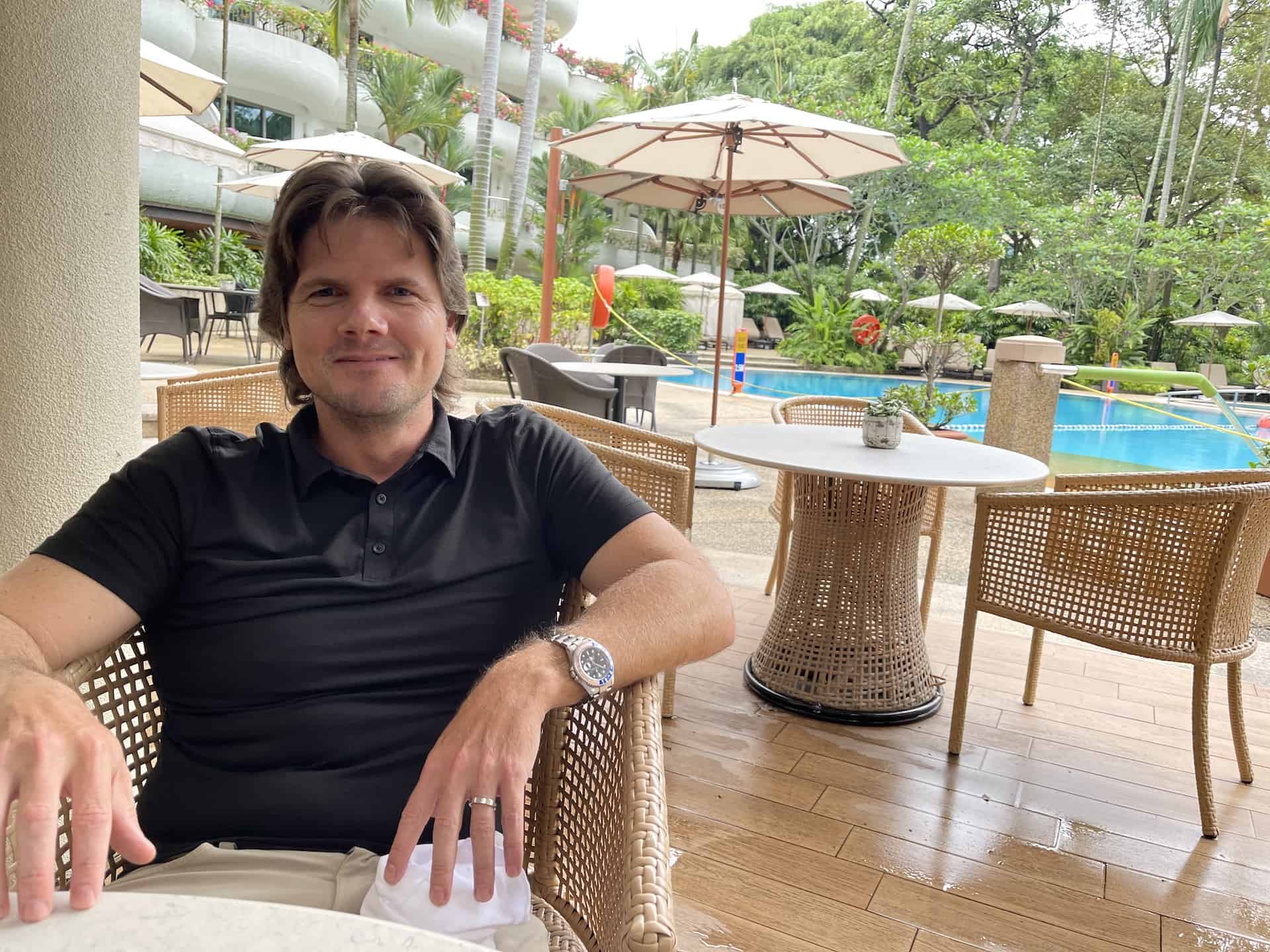
Tim Hentschel: “We’ve been through one tech bubble burst; we are in it for the longhaul.”
Pivot to “gig economy call centre” turned the ship around
Hentschel, you see, is a fighter. He and his co-founder John Prince founded the business in 2003 when he was aged 24 and when you’ve built a company over 18 years with no external funding (as he keeps emphasising), you’ve shown grit, resilience and resourcefulness.
“My family is in hospitality and I could see there was a problem with group bookings,” said Hentschel of how HotelPlanner came about, during our interview by the poolside at Shangri-La Hotel, Singapore, which has acted as his defacto “remote office” through the pandemic.
Resourcefulness is what HotelPlanner has shown the last two years as it pivoted its group hotel booking business to take advantage of the gig economy. In early 2020, it ended its partnership with global call centre WNS and started recruiting its own pool of call centre employees, which currently stands at 3,000.
In a way, what led to this pivot has roots in Hentschel’s childhood in south central Los Angeles. As an adopted child – his single mother lost custody to the state – and raised by a wealthy and connected family, Hentschel said he never felt he fitted in and so was caught between two worlds – that of the “little guys” and the “rich guys”.
“It was like being in the club but not being part of it,” he said.
When the gig economy emerged and accelerated during the pandemic, Hentschel saw the opportunity to address two passions – champion the “little guys” and control the customer service process to make his company stronger and more profitable.
Hentschel, who moved to Singapore about two years ago, from London to grow the Asia business, calls this “gig economy call centre” pivot HotelPlanner 5.0.
“It was definitely Covid-induced. It was launched through Alexa, then we saw the natural extension of voice to a human-powered call centre. We call it high automation with high touch. We invested in next gen technology that allows our employees to recognise each caller and what they are looking for personally so that agents can make more money with more efficiency.
“About 40% of bookings are done over the phone and we have 30,000 1-800 numbers rotated among sessions. “Gig” enables us to localise the service. There were lots of questions about specific local areas and conversions were higher when there was localisation.”
The majority of its call centre agents are US-based given 90% of its revenues come from the US and demand has been high from the workplace. “Through our hiring sites, we get 800 applicants a day. The gig economy suits this period well, it pays $20-$30 an hour and it’s flexible work.”
He said the company was profitable in 2020, despite revenues being down by 23%. Its highest revenues was $98 million in 2019 but by 2021, it had grown revenues to $128.5 million.
“Imagine, we had people pick up the phone and asked questions of locals,” he laughed.
“The future of call centres will be gig-based”
And no, he has no interest in investing in chatbot tech. “When you can have real people answering the phone, why give to artificial chatbots which get a lot of stuff wrong anyway.”
He believes the future of call centres will be gig-based. “It doesn’t make sense to give money to a middle man who sits in a cubicle in India or Malaysia. “Gig” keeps the money local and it opens opportunities to groups of people such as mothers or retired women professionals who want flexibility as well as income.”
About 75% of its call centre employees are women.
Covid has created an even more unequal world and he believes hospitality offers the best opportunity to address the imbalance by its ability to give jobs to “the little guys”.
“A lot of entry level jobs are created in travel and tourism, governments look down on hospitality jobs as low wage earners but think of all the people who got their first jobs – I was a bartender, a waiter, concierge, kitchen help – it’s the first way to get into the job market and that’s big for any economy.”
The five stages of HotelPlanner’s journey and what lies ahead
Coming back to HotelPlanner and how he intends to grow the group booking business, you have to look back on its history and track how it’s grown organically.
As Hentschel describes it, HotelPlanner 1.0 was “electronic request for proposal”, digitising the RFP process. Then came 2.0 which was enabling “online negotiations”. 3.0 was about “e-contracting” and in 4.0, it moved to instant group bookings, a big leap forward, as well as closed user group bookings. According to Hentschel, the net rate merchant model now accounts for 30% of group revenues.
Its expansion in Asia has been achieved through acquisitions. It acquired Singapore-based business Venuexplorer, an event space listing business – the founder, Christopher Lee, heads up HotelPlanner in Singapore. To further expand into the meetings business, it bought Event Connect in Australia. The idea was to consolidate localised listings under one umbrella but Covid has crushed that business, said Hentschel.
Its first B2B client was Priceline, on the back of which it then launched an affiliate programme. But B2C accounts for 80% of its business, booked directly through HotelPlanner or one of its affiliate companies.
In Asia, it has partnerships with major travel brands such as Trip.com, Rakuten and Agoda, with Traveloka on its desired target list.
The key question facing HotelPlanner in rolling out its Asia plans is “how much do you invest in each area, giving the market fluctuations in different regions?”
“Right now, the US is subsidising Asia and Europe is breakeven. We need to prioritise where the recovery is.”
And the fact that most of Asia still remains closed to cross-border travel makes it tricky. Combined with that, he said, “hotel rates in Singapore have been very high. This is also what’s keeping travellers away – costs of hotels. But I believe this will change in March when government support programmes end.
“We have the distribution deals in place and we should recover in Asia quite quickly,” said Hentschel. Its top markets pre-Covid were China, Korea, Thailand and Australia.
It’s on a recruitment drive and will use Singapore as the main centre for hiring local gig economy workers. He’s also looking at acqui-hires. “We are interested in acquiring local companies that need bigger infrastructure and some scale so we can dominate local markets – venue search, group bookings, group tours.”
Looking back, he said HotelPlanner was launched towards the end of the first dot.com bubble burst. “We came in at the tail end, we had the advantage of first adopter, but we didn’t get the advantage of the big bucks.
“We have lived through one tech bubble burst, we are used to being the “common man”, the bootstrapped entrepreneur and have always grown organically. We are in it for the longhaul.”
Featured image credit: Getty Images