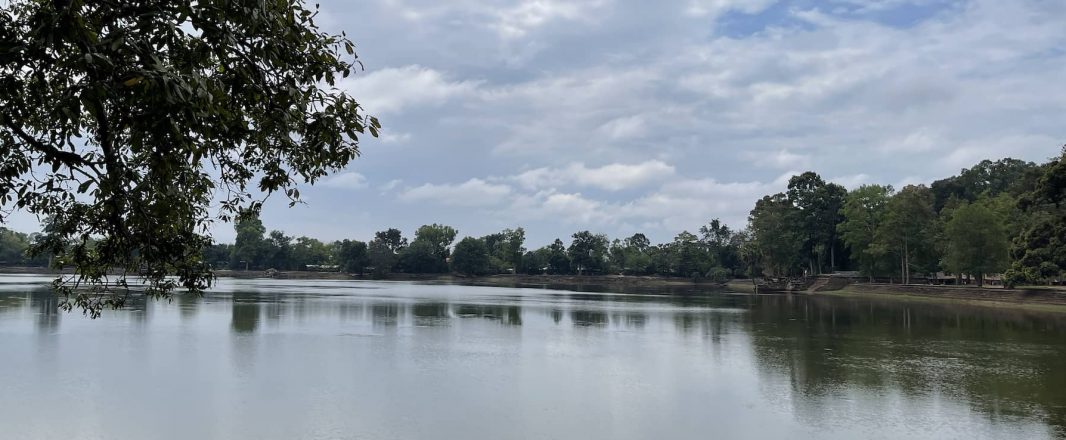
A return to quieter days and richer experiences
I FIRST visited Siem Reap circa 1995 when it had just opened to international tourism. Then, the best way to appreciate the scale and grandeur of the Angkor temples was by aerial view from a military helicopter because going by foot was still hazardous due to landmines and snakes. There were very few visitors then, only the intrepid, mostly from Europe and the US.
This visit, made possible after Cambodia reopened its borders with the lightest entry conditions among South-east Asian countries and a Vaccinated Travel Lane with Singapore, felt a bit like the return to those days – a quieter Siem Reap with very few visitors, only the intrepid and opportunistic like me who want to experience this special place before the return of mass tourism and in a selfish way, hoping those days do not return to the way it was.
And I don’t think I am alone in wanting a return to slower, better and more sustainable travel for a destination like Cambodia. Those in the industry, as much as they have suffered and struggled these past two years and, as much as they are welcoming back travellers with open arms (even circus performances by Phare Cambodian Circus at the airport), are desiring change because they feel Cambodia deserves better.
Cambodia deserves to be appreciated as a stand-alone destination, not just as an extension to Vietnam or Thailand and Siem Reap deserves to be experienced beyond the Angkor temples – just like Paris is appreciated beyond Eiffel or Egypt beyond Pyramids. And this is its moment of opportunity to forge a new path for its tourism.
As we drive through Siem Reap, it feels like a city newly woken up from a long slumber. It’s only in the past couple of months that life has returned to normal and the government has signaled it’s time to live with the virus, and locals are re-learning to welcome visitors as we are re-learning how to be guests.
The staff at Viroth’s Hotel was beyond welcoming and gracious. “We are so happy to have you back,” they say, as they show off with pride their hotel facilitles and services. In the evening, as we walk out, they spray us with natural insect repellant. “We don’t want anything to bite you,” they say.
Our local friends are proud to tell us how Siem Reap has changed for the better for them. New roads – it feels like a big, little town. Wide, multi-lane roads newly-paved. Bicycle paths have been introduced in the city and around the temples. There’s a new public park. “I know you in Singapore are used to this, but this is our first one,” said Dara Huot of Phare Cambodian Circus.
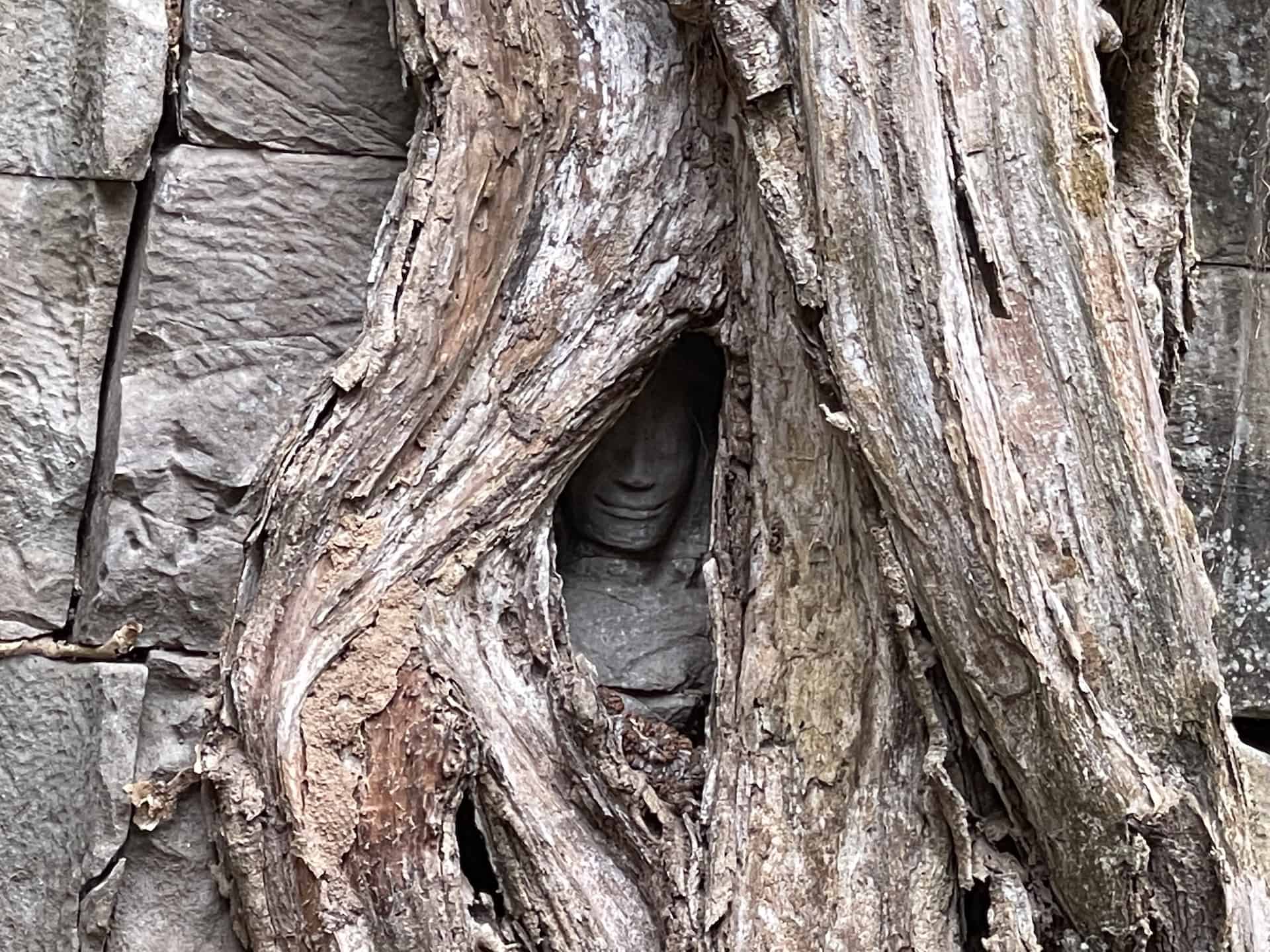
The hidden faces of Ta Phrom
At Ta Phrom, I see joss-sticks at an altar near one of the head carvings hidden within the roots (pictured above). Locals have come back to the temples for prayers and offerings. “Before they stayed away because of too many tourists. These past two years, locals have rediscovered their own temples,” said Dara. The temples have once again become part of daily lives, beyond being tourist attractions.
Ta Phrom is the temple made famous by Angelina Jolie in the movie, “Lara Croft: Tomb Raider”. The news that she’s in town is getting everyone excited and WhatsApp messages are flying. “She went to Battambang today, she has a house there.” “No, she’s still here, I saw her at Angkor.” And true enough, photos of her at Angkor do the social media rounds. “She’s staying at Phum Baitang, it’s her usual address,” reported another.
Phum Baitang, meaning “Green Village”, is a collection of 45 private villas nestled in 20 acres of lush gardens and rice fields. It’s where I am staying for the last two nights – apparently, I just missed her. She checked out the day I checked in. Oh well …
Siem Reap has moved way beyond Jolie, Lara and tomb raiders.
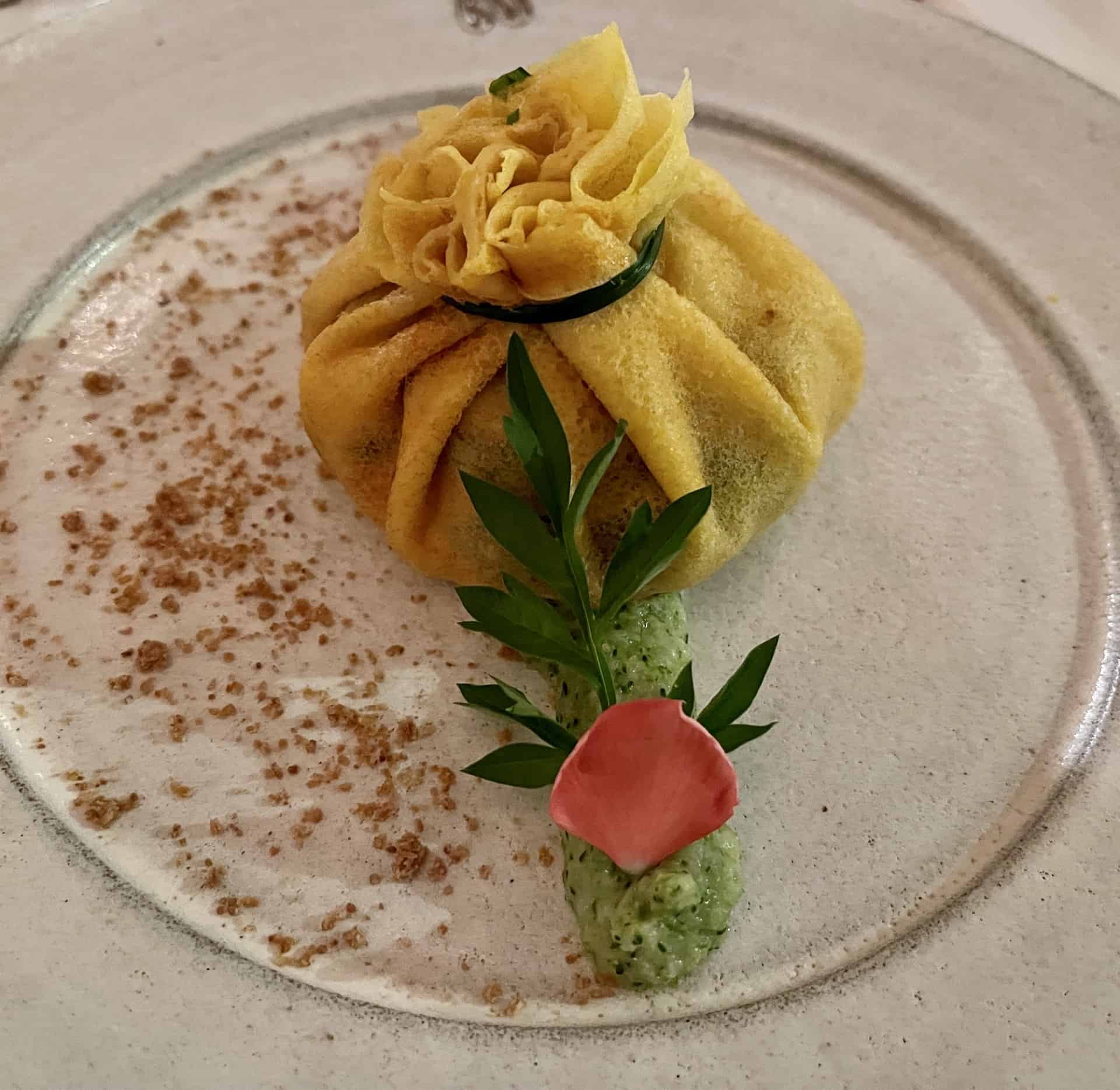
Khmer cuisine gets a modern twist at The Embassy Restaurant
For the foodie, Its culinary offerings have expanded. Local Khmer cuisine has taken on modern and contemporary interpretations – like at The Embassy Restaurant where we sat down to a seven-course menu created by two women chefs, known as the Kamsin twins, trained at the local Paul Dubrule and Sala Bai hospitality schools. The dishes are as good to eat as they are to look at.
The Sala Bai hospitality school runs its own restaurant where students cook and wait on you. Naively, I asked one of them why he chose to join hospitality and the harsh truth is, what other choice does she have? There are very few job opportunities outside tourism in Siem Reap and this period which saw the industry crushed has given rise to calls for Siem Reap to diversify its economy beyond tourism.
Speaking to someone working in executive search, he told me that this week, he had his first listing for hospitality since the pandemic – for a senior f&b role. Apparently, senior roles are really hard to fill because most of the expats working in hospitality left and have not returned, and locals in senior roles, who were laid off, have found alternative jobs. This is a common challenge that will face destinations in Asia as they reopen.
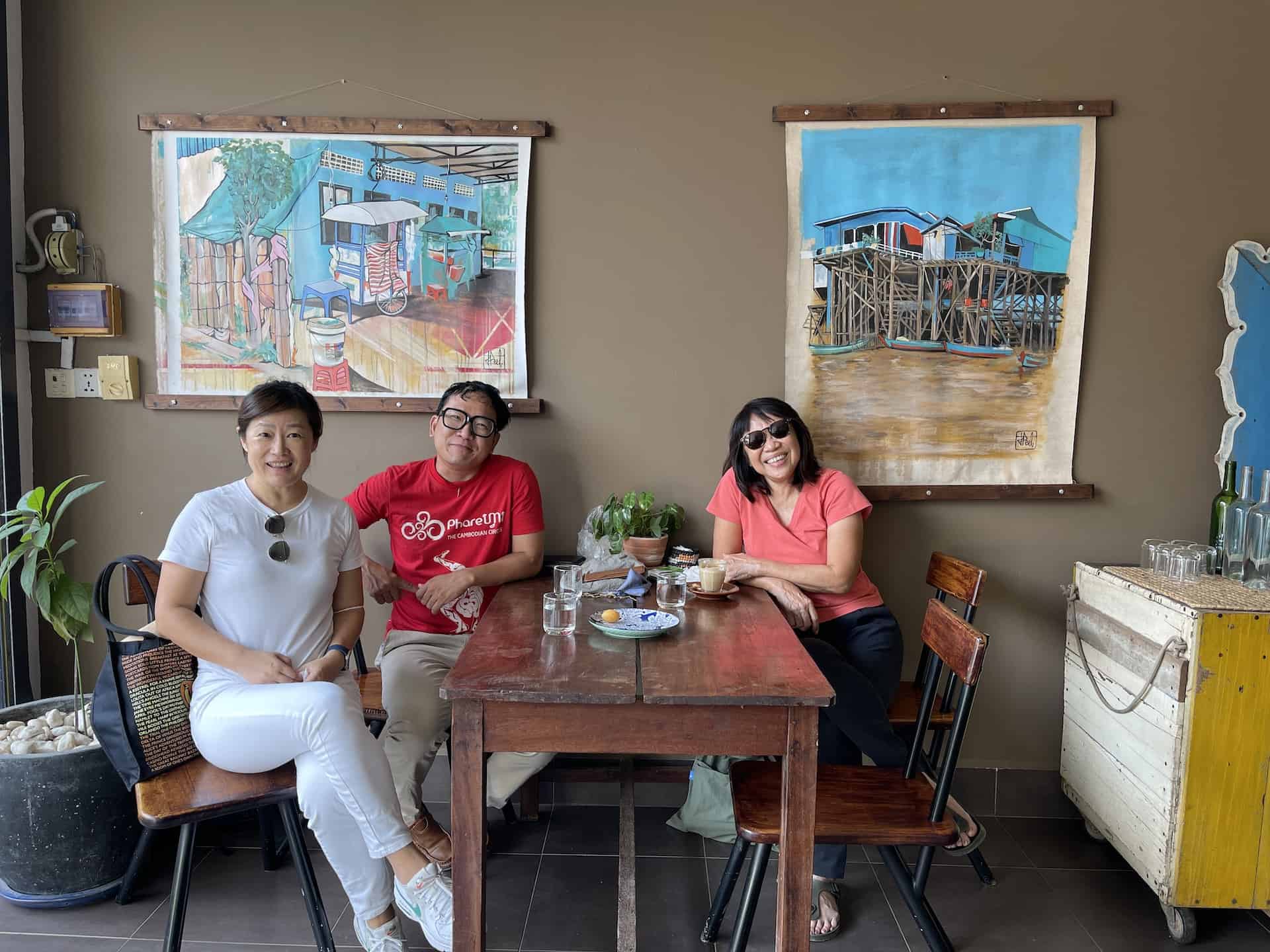
Hanging out at the Little Red Fox cafe with Dara Huot and intrepid traveller Mary Li
At Kandal Village, the street known for its artisan shops, cafes and restaurants, a few shops remain open, most remain closed. The Little Red Fox cafe remains the communal magnet for the handful of travellers who are in town. We had lunch at a little Chinese restaurant which served the most amazing “siau loong pau” and dumplings. The owner is from Wuxi and you eat what she prepares for the day. This was my first taste of Wuxi noodles – all I can say, super good.
One afternoon, I had a home-cooked lunch at a Khmer House, prepared by the wife of the village chief. It’s literally a farm-to-table experience because she cooks with what she picks from her garden and gets from the local market.
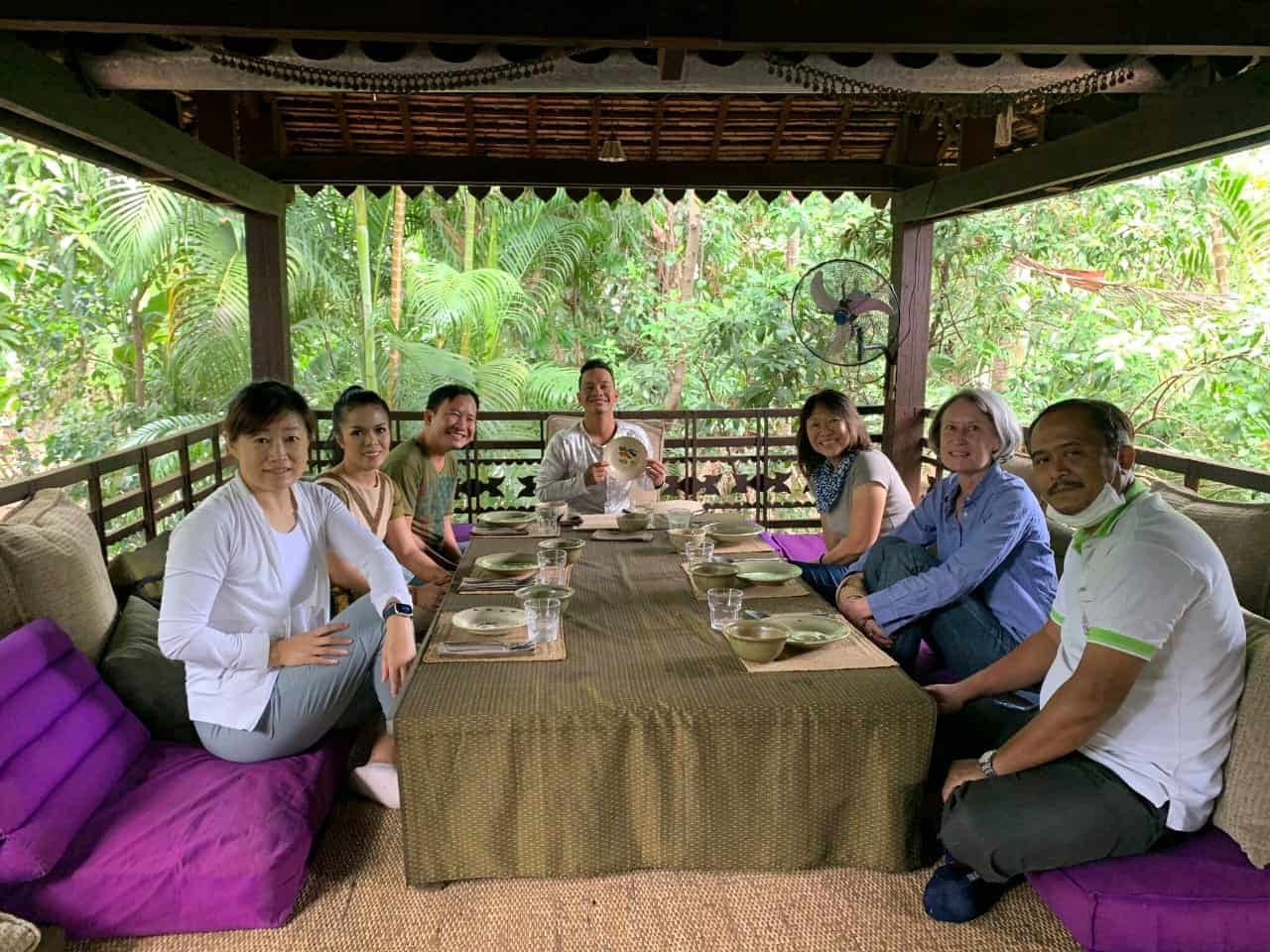
Lunch at a Khmer house with Fabienne Luco (right row, second from right)
The private lunch idea was created by anthropologist Fabienne Luco, who built the house within the village, when she was deep into her research and wanted to live it rather than study it – it’s only by reservation, one party at a time (even if it’s just two people) and all income goes to the village. “At first, it was only for friends, then we decided to offer it to visitors who would appreciate this kind of experience,” said Luco, who worked with All Dreams Cambodia’s Jacques Guichandut.
After the wholesome and delicious home cooking, guests are known to take a nap in the house. I was tempted but no, I also wanted to check out the Kulen Elephant Forest which I had heard about but not had the chance to visit because it was opened only in December 2019.
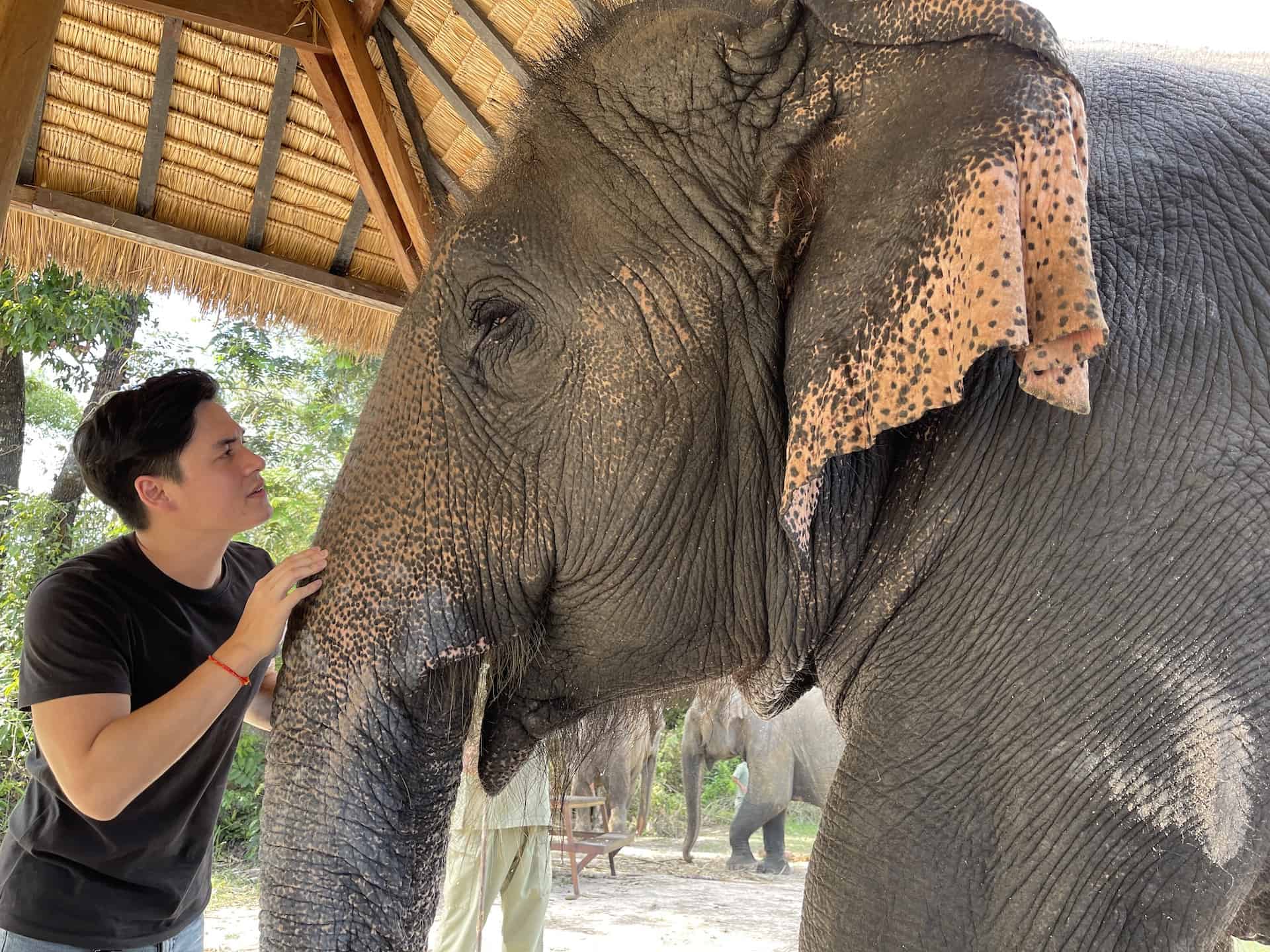
David Jaya-Piot with his elephant friend
“I know, bad timing, right?” laughed co-founder David Jaya-Piot, who met us at the entrance to the 400-hectare forest reserve. Piot’s family ran Angkor Elephant Company which used to offer elephant rides around the temples and when “the world moved on”, as David puts it, they started Kulen Elephant Forest as an ecotourism park to offer a different experience to visitors as well as a retirement home for their elephants, 11 of whom reside now in the reserve.
David, who’s also managing partner of the Angkor Village Group – his parents, Olivier Piot and Tep Vattho, founded Angkor Village Hotel and Angkor Village Resort – returned to Cambodia in 2017, to join the family business. “It’s been tough,” he said of the last two years. “We never thought we would have to keep it going with personal funds but tourism just stopped.”
But those three months it was opened at least proved Kulen Elephant Forest was the right model for its time. It often had to turn visitors away because it placed a daily cap. After all, this is the time for the elephants, aged between 45 and 55, to enjoy their golden years.
“We just them let be, do what they like, we don’t get them to perform for tourists, this is their time,” said David.
In fact, in the forest, the elephants, after having spent a lifetime working, they pretty much do nothing but eat, bathe and sleep all day. For US$40 per person, you get to spend a day just hanging out with these beautiful creatures, feeding them sugar cane and watching them bathe in the pond, while you have a light picnic.
David knows them by names and points out the prettiest one. By elephant standards, that means something like wide, non-droopy ears and straight back. Pretty or not, each eats around 300kg a day, roughly 10% of their body weight, so the food bills can be pretty hefty.
Visitors are slowly trickling back, says David. “Thanks to Singapore Airlines, we are getting visitors again. We are hopeful.”
Everyone I speak to is grateful to SIA – it was the first international airline to restart daily direct flights to Siem Reap – and with that, comes connecting passengers. The flight I was on was fairly full with 126 passengers and I heard a mix of Australian and European accents. That two-hour flight has literally opened up the world to Cambodia after a dark two years.
On arrival at the airport, you do a quick ART test and 48 hours before departure, you need to do an ART test. For the latter, only one clinic is authorised and we had to take a fairly long drive out of the city. It was around 11am when we got there and there were about five people waiting – all of us were on the same SIA flight departing on Friday. Each test costs US$30. You do the test and are told to return for the paper certificate at 2.30pm, even though with an ART test, you know the result in five minutes and surely, the certification process could be digitised. Better yet, remove the testing as the world moves on.
It is this part of the customer journey Siem Reap needs to improve, in my opinion. Cambodia has a brief window of opportunity to attract new travellers, the independent and the intrepid as well as residents in Singapore who just need to get out after having been trapped for two years.
When more of South-east Asia opens up, especially Thailand and Vietnam, Cambodia could well find itself once again playing a supporting role as an extension rather than a destination in its own right.
With all that Siem Reap has to offer today, even after the most traumatic two years in its tourism history, plus Phnom Penh’s unique urban offerings and a much-transformed Sihanoukville with its islands and beaches, Cambodia deserves its own leading role in tourism, much like Jolie in her movies or these elephants in the video below.
For me, it just felt really good to feel South-east Asia again as a traveller.