Supply gap, shift to online and cashless among changes sweeping through Japan’s travel market
Rakuten Travel strengthened its hold in the domestic market through the pandemic, increasing its share of domestic travel nights per month from around 15-16% to 20% in 2022, and that consolidation should hold it in good stead even as Japan reopens and global OTAs begin their march back into the market.
Speaking at WiT Singapore 2022, Yoshiyuki Takano, Head of Travel & Mobility Business, of Rakuten Group, said that the key to compete is in securing good inventory and during the pandemic, Japanese OTAs such as Rakuten not only expanded market share but tightened relationships with hotels. “Therefore, our power to secure inventory has increased.”
And even though its newly launched global website saw five times more transactions in August compared with July, as soon as news of eased restrictions were announced, he said the situation could be considered “still unstable” since the pandemic is still not over.
Therefore, “it’s important for hotels to keep the domestic demand, and therefore, domestic OTAs have a much greater advantage over global OTAs than before in terms of having competitive inventory”.
Much has also changed in Japan in the past two to three years while it remained closed to inbound tourism. One is the supply gap, he said, between hotels in the urban and leisure areas. “The urban area has become very competitive because supply is too much at this moment. Developers built a lot of hotels for future inbound demand and that hasn’t returned yet.
“On the other hand, the leisure areas, especially those close to big cities, are doing better than pre-Covid in Rakuten Travel.”
Another trend is luxury travel. Looking at bookings on Rakuten’s site, he said, growth rate in the luxury category is 1.3 times higher over 2019, thanks to wealthy Japanese travellers who could not travel overseas and thus spent at home.
The shift to online has also been phenomenal. “In fact, Japan was not that advanced a country in terms of internet service. Online share of all consumption was seven percent before the pandemic in Japan, which is very low compared with US/Europe. However, the pandemic accelerated the online shift.
“In Rakuten, e-commerce sites and fin-tech services have performed very well after the pandemic. As for the e-commerce site, its transaction volume became 1.5 times bigger than pre-Covid.”
And this plays to Rakuten Travel’s advantage, being part of the e-commerce giant. He said that Rakuten Group’s MAU has grown to 40 million and the fact that it offers 70 services makes it diversified and resilient.
“For instance, when restrictions ended and people could go out, travel got stronger but should we have the next pandemic and travel gets weaker, other e-commerce services will get stronger. In other words, some services grow regardless of the situation, and those services are increasing our customer base.”

“In Rakuten, e-commerce sites and fin-tech services have performed very well after the pandemic.” ~ Yoshiyuki Takano, Head of Travel & Mobility Business, of Rakuten Group
This increase in customer base is invaluable when it comes to the group’s loyalty and point programmes. “For example, if you buy something on our e-commerce site, you can get 1% worth point of your purchase, which you can use for travel, golf, e-book and so on.”
The group issued about US$4 billion worth of points last year.
As part of its membership programme, members are ranked according to their usage in group services, such as diamond or platinum member and hotels can offer special benefits to higher-ranked members.
“This means we can personalise at Rakuten Travel so that high-ranked members can see the benefit by hotels in the search results.”
Another big shift is to cashless. “Before the pandemic, Japan was not advanced in cashless transactions, but the pandemic has accelerated contactless payment methods, and QR code payments are increasing. QR payments such as Rakuten Pay, Paypay, LINEpay, and Melpay are available everywhere.”
One area that Rakuten Group is looking at is green tech. The group aims to achieve carbon neutrality by the end of 2023. “To achieve this goal, we intend to build power efficient data centres and actively utilise renewable energy. Rakuten Travel also recommends sustainable lodgings that are using renewable energy.”
As for a recommendation he has for travellers as they return to Japan, Yoshiyuki suggested a sauna experience. “Japan is currently experiencing a big sauna boom. There are 3,000 hotels with saunas on our site. Japanese sauna is very unique. The basic process is to take sauna, take a bath with cold water and take a rest. And we do that three times. Then you can revitalise yourself.”
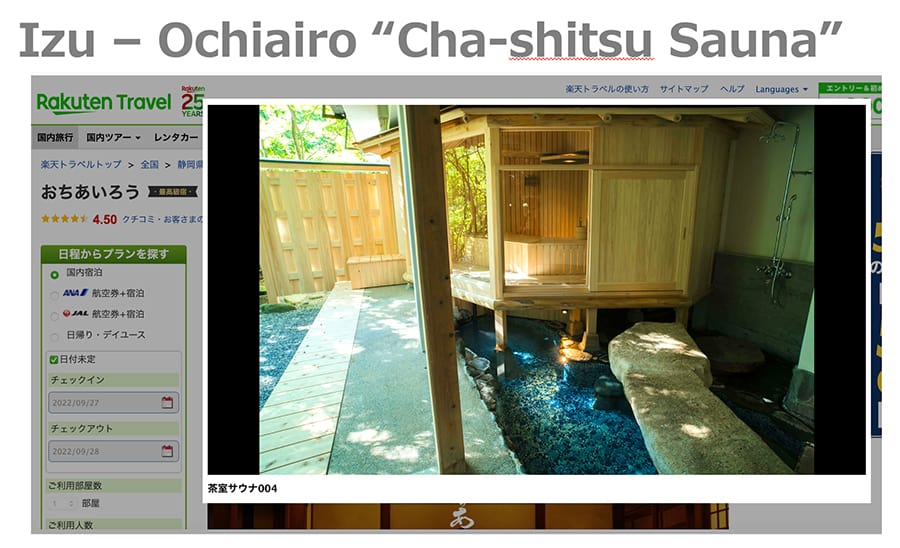
“Japan is currently experiencing a big sauna boom. There are 3,000 hotels with saunas on our site. Japanese sauna is very unique.” ~ Yoshiyuki Takano, Head of Travel & Mobility Business, of Rakuten Group