Last night, I headed to Jumbo at the East Coast Seafood Centre to have chilli crabs. It’s not a place I frequent often because well, as locals, we usually avoid places that are popular with tourists and having not had many visitors the last couple of years, I had almost forgotten it was there.
But having a visitor in town for the day, I decided to make my way there. It’s a good spot to have that instant sense and taste of “Singaporeana” – getting your hands dirty as you tear into the crabs and dunking bread into that rich, piquant sauce, while enjoying the sea breeze and looking out at the cargo ships dotting the coastline and planes flying overhead.

The quintessential Jumbo chilli crab – best to be relished while thinking of jumbo jets in the air
It’s a uniquely Singapore setting.
It’s often said that you know things are okay in Singapore when the cargo ships are back and last night, the line of ships was as far as the eye could see – all waiting for their turn to offload or board their cargo destined for who-knows-where around the world.
Through 2021 and 2022, despite the pandemic, Singapore retained its pole position as the world’s busiest container transhipment port. According to the Port of Singapore, its annual throughput for 2022 was 37.3 million TEU in 2022, compared to a total of 37.6 million TEU in 2021. A TEU, for your information, is a Twenty-foot Equivalent Unit.
Last night, the line of ships seemed particularly long, and they looked almost other-worldly out there with their twinkling lights. Above them, planes were criss-crossing the skies, looking like shooting stars. On the ground, people were walking their dogs, jogging and bicycling.
Inside, the restaurant was packed as I have always remembered it. Business executives gathered for their company dinners, conference delegates enjoying a local experience, tourists, families – the clinking of plates, the toasting of glasses, the cacophony of different accents.
It felt so normal I almost had to pinch myself. Have we really been through a pandemic, the worst in our generation?
I know, we’re always told not to dwell on the past, to move on, to forge ahead. But at moments like these, it’s hard not to think about what we went through the last two years and to now emerge into the light – I ate my crab with ever more gusto and gratitude.
I hope you’ll also forgive me for continuing to dwell on the past but looking at the planes overhead, and coincidentally feasting on Jumbo chilli crab, I was reminded that at the end of last year, we said goodbye to the jumbo aircraft that truly changed travel – the Boeing 747.
The last 747 to be manufactured was delivered to Atlas Air, an American cargo airline, in December and thousands of employees from Boeing gathered to say farewell. This was the first aircraft to earn the nickname, “jumbo jet” and it heralded the age of mass travel.
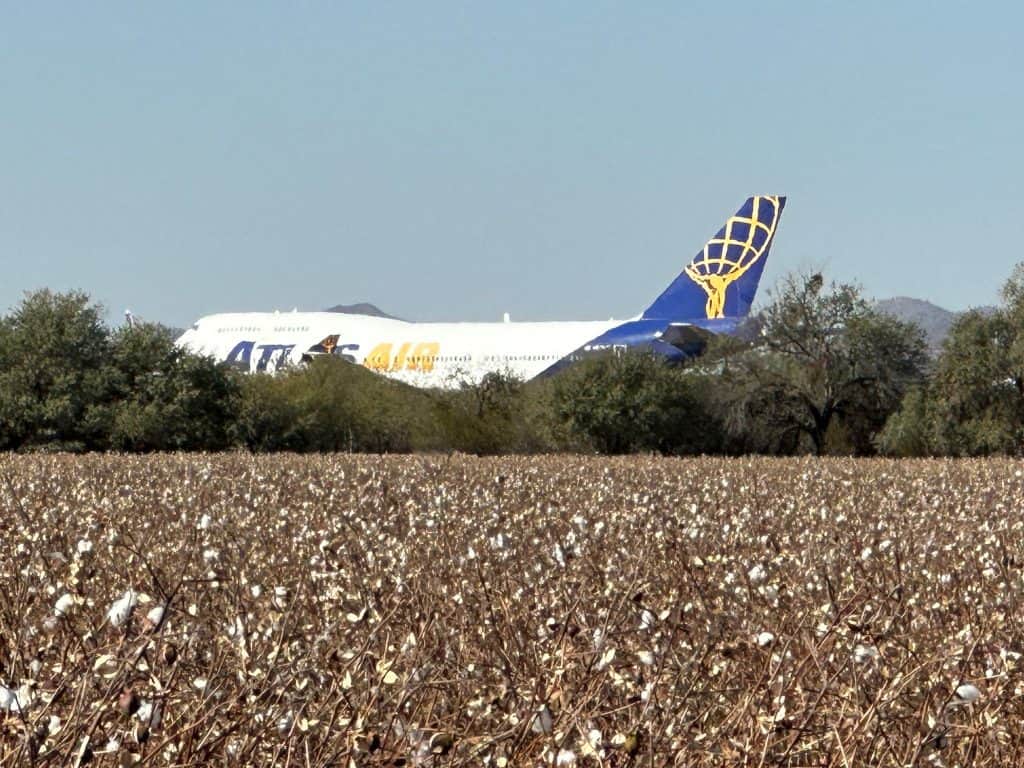
An Atlas Air B747-400BCF parked at the Boneyard, Tucson, Arizona
I will let Willem Loots, a travel industry friend who lives in Bali, to tell its story. (Loots shares his musings about life and occasionally, travel in a newsletter written for friends)
“Last Tuesday, Boeing handed over the very last seven-four-seven it will ever make. The 747 was the world’s first Jumbo Jet and this last one, number 1,574, has a depiction on its tail of Atlas holding the world atop his shoulders, as the logo of the cargo and charter carrier Atlas Air Worldwide. That is very appropriate since the 747 created a worldwide web long before there was a World Wide Web.
“The very first 747 made its maiden commercial flight in 1970, ferrying more than 300 Pan Am passengers from New York to London. It was nearly three times the size and capacity of any jet airliner at the time, and with its distinctive hump above the fuselage, the 747 became the most widely recognizable commercial airplane ever built. Nicknamed the “Queen of the Skies,” it was also the one that totally transformed air travel.
“I remember how in 1968 I walked into the KLM office in New Delhi. On the way back from the hippie trail to Kathmandu, I did not have a dime in my pocket but out of sheer curiosity I wanted to see what it would cost to fly home to Amsterdam. What I found out was that a one-way ticket was 6000 guilders, at the time the price of a Volkswagen bug.
“Back in those days flying was a luxury restricted to the well-to-do, but two years later the 747 started changing the world. Because it was a plane that could carry many more passengers in a single trip, airlines could sell tickets more cheaply, making air travel affordable to the masses. All told, 747s carried more than six billion passengers about 60 billion nautical miles, the rough equivalent of 144,000 trips to the moon and back. It did not just change but actually shrank the world.”
Of course, it wasn’t such a rosy picture for the airlines, as aviation veteran Peter Harbison was quick to remind me.
“For one thing,” he said, “it provoked the demise of Pan Am, who had asked Boeing to produce it. Suddenly the North Atlantic had twice as many seats as previously, because everyone needed to maintain the same frequency, but with an aircraft twice as large. Also it arrived just as the first oil crisis was beginning. Prices rose six-fold from $26 in 1970 to $146 in 1980.”
But while it wasn’t so rosy for the airlines, it was for us travellers because it made flying so much more affordable and accessible – imagine, six billion passengers …
I wish I could remember my first flight on a jumbo jet – it was probably my first longhaul flight to Europe, to Switzerland where I saw cuckoo clocks, bears and snow for the first time. For that, I thank you, B747.