2300 delegates, 623 buyers from 32 countries, and a whopping 45,000 meetings. Those were the numbers that painted the 43rd edition of Tourism Australia’s largest annual trade event, Australian Tourism Exchange 2023 (ATE23) last week.
Hosted on the Gold Coast, Queensland across 5 days, this year’s event was particularly important because of its return to form; for the first time since 2019, the Exchange was back to full capacity and done completely in-person. The tourism travel show has taken place in a condensed hybrid format over the past two years.
Tourism Australia Managing Director Phillipa Harrison said the first full ATE in years is an important milestone for the Australian tourism industry as it continues to rebuild off the back of the most challenging few years in its history.
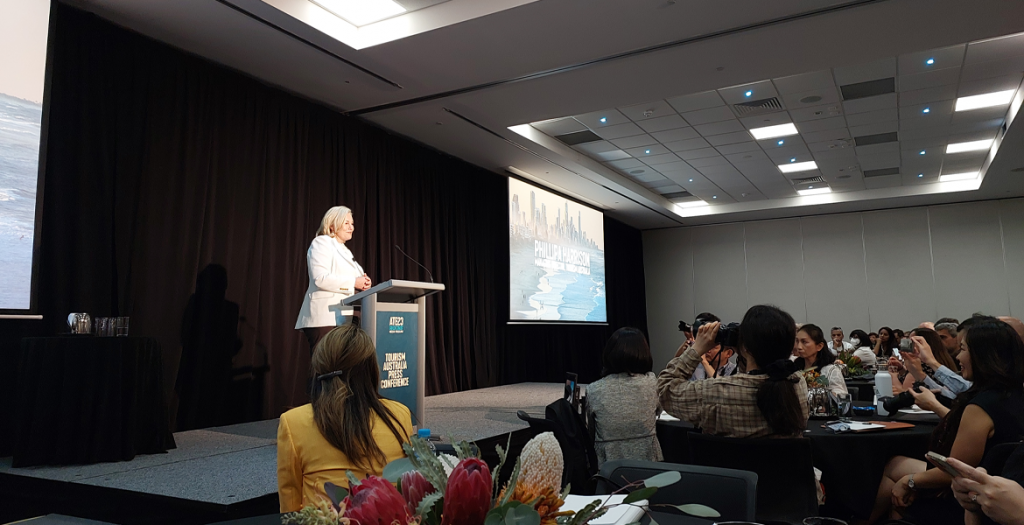
Tourism Australia Managing Director Phillipa (Pip) Harrison at the Tourism Australia ATE23 Press Conference
“International travellers are returning to our shores but the competition for the global tourism dollar is now greater than ever before which is why business-to-business events, such as ATE, are so important,” Ms Harrison said.
The spotlight is on Queensland
Although all of Australia was highlighted during ATE23, there’s no denying that choosing Queensland as the host state this year was strategic on many levels. Not only is it rich with natural attractions that range from iconic beaches on the Gold Coast to world-famous scenery on The Great Barrier Reef, it also caters to an increasing demand for ecotourism from key markets like India and China.
Tourism and Events Queensland CEO Patricia O’Callaghan said the whole state was ready to welcome ATE delegates in what is another important step forward in its international recovery.
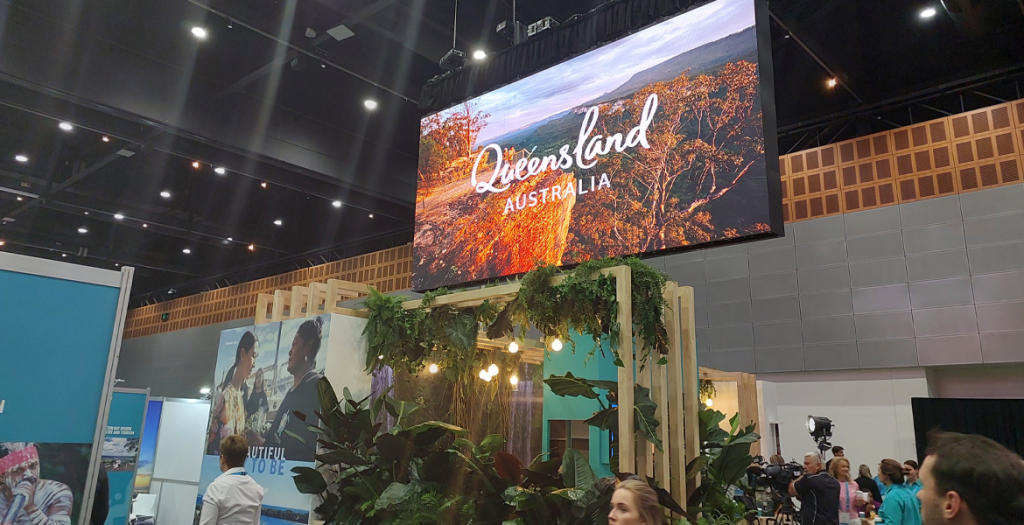
“The industry has continued to invest whilst borders were closed and as a result we have opened to the world with billions of dollars of new infrastructure, products and experiences that have been completed or under construction across the State.
Rebuilding Queensland’s $6 billion international market is critical to the future of tourism for this country.”
These efforts were bolstered by Tourism Australia’s comprehensive familiarisation program with nearly 500 people from more than 30 countries exploring everything from the reef to the rainforest, the ocean to the Outback and everything in between.
Arrivals are hitting 65% of 2019 numbers
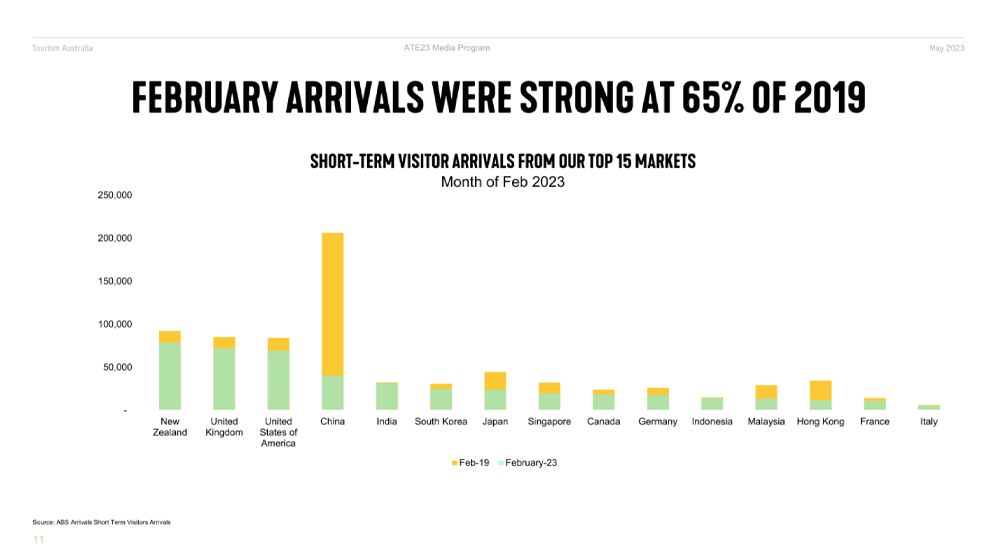
During her media conference, Harrison emphasised that February arrivals in Australia were strong at 65% of pre-pandemic numbers.
Of all 15 key markets, India’s inbound traffic has caught up to 2019 levels. New Zealand, United Kingdom, and the US all clocked larger numbers at just under 100,000 visitors, but are each a respective nudge away from 2019 numbers.
The anomaly, of course, is China.
Towering above all markets in 2019 with approximately 200,000 visitors, the market barely drove 50,000 incoming travellers in February this year due to its delayed reopening of borders and surprisingly sluggish return to international travel.
However, Harrison said Australia is optimistic about the Chinese market, which is projected to reach very positive numbers as their outbound picks up in time.
Additionally, the volume of holidaymakers entering the country is now higher than those visiting friends and family, marking the end of the post-pandemic “VFR” phase. This bodes well because it means that travellers are ready to explore and spend more in wider regions of the country, opening them up to more destinations.
Competition is good as international aviation capacity bounces back
One major obstacle during this recovery phase in travel and hospitality has been the average price of flight tickets across the board which are markedly higher than pre-pandemic times.
With more competition entering the scene and more low-cost carriers joining the fold, Tourism Australia expects pricing to improve by 2024.
Expensive air tickets and economic headwinds aren’t enough to stop travellers from packing their suitcases, though. International aviation capacity into Australia is returning with some standout markets and carriers.
For example, in May 2023, India’s capacity stands at a whopping 255% of seats scheduled. They’re followed by South Korea at 162%, Qatar at 112%, Indonesia at 110%, and Canada at 95%.
Singapore and Japan are tied at 92% of seats scheduled (87% of Singapore’s seats are driven by Singapore Airlines), while Malaysia’s capacity is at 76%.
China is at 42%.
Receiving feedback on visa applications
During the ATE23 media conference, a couple of questions about Australia’s visa applications were fielded. It’s no secret that applications for travel into the country have become quite stringent over the last few years, with an increased waiting period compared to 2019 and earlier.
O’Callaghan, alongside Minister for Tourism, Innovation and Sport and Minister Assisting the Premier on Olympics and Paralympics Sport and Engagement, Stirling Hinchliffe, said that there is a feedback mechanism in place for taking opinions from all around the world regarding visa application issues.
They also mentioned that the Federal Government and Home Affairs are looking into the issue of having quite a big backlog of applications, as well as potentially considering longer term visas.
Ruby the Roo proves casual marketing works
Last year, Tourism Australia launched its first global campaign since 2016 by unveiling Ruby the Roo – an adorable cartoon kangaroo voiced by Australian actor Rose Byrne. The campaign was spearheaded by a short film featuring Ruby visiting some of Australia’s most iconic destinations, accompanied by a toy unicorn voiced by Canadian actor Will Arnett (as well as an appearance by the real Rose Byrne herself).
The campaign is refreshingly soft, casual, and fun. It’s backboned by a recomposed version of the ever-popular Down Under song by Men At Work and features a reboot of the ‘Come and Say G’Day’ slogan that was made famous by Paul Hogan in the 80s. In many ways, Ruby is poised to be the Paul Hogan of a new generation and is leading the next installment of Tourism Australia’s ‘There’s Nothing Like Australia’ branding.
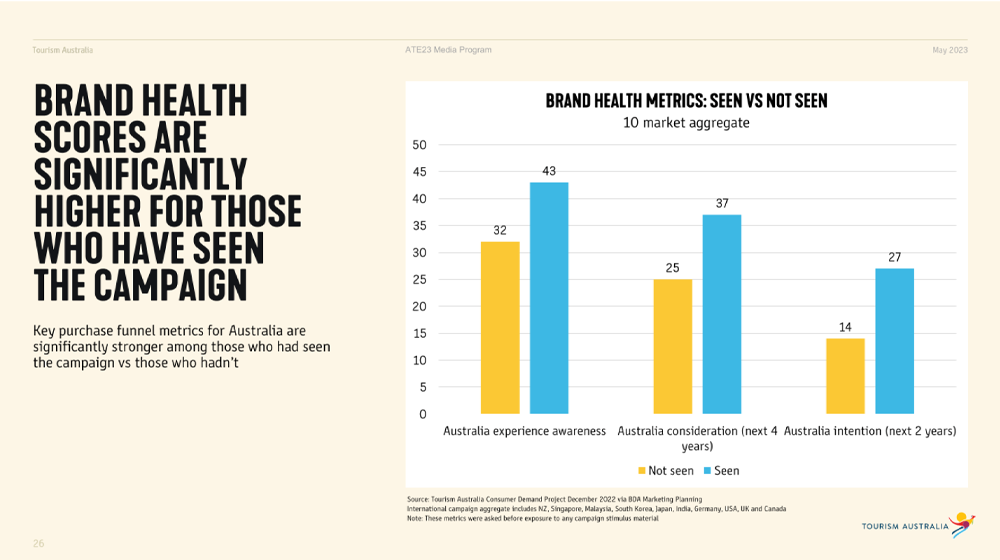
Looking at the results, brand health scores are significantly higher for those who have seen the campaign (see chart below), making a strong case for this type of marketing.
The decision to use a cartoon kangaroo was a strategic move to cut through the clutter of destination marketing internationally. The campaign also comes with TVCs and print ads that are translated in several languages across all of Australia’s key markets.
The 9-minute short film has 19 million views on YouTube, while the 1-minute TV spot has clocked 31 million views so far.
Accessibility and inclusive travel can be developed as a huge opportunity
According to the National Visitor Survey, travel groups including people with disability or long-term health conditions in Australia contributed $13.5B to the economy in 2021. That’s 17% of domestic day and overnight trips.
Then, Tourism Australia’s Future of Demand Accessibility Impact Survey highlighted that 24% of travellers considering Australia as a destination have an accessibility need.
The biggest opportunity for development and improvement lies with the whopping 86% of travellers who say that accessibility influences their choice of destination, activities, and experiences.
Australia continues to target high-yielding travellers
Tourism Australia is looking to attract big-spending travellers who stay longer, spend more money and value Australia’s unique offering. It’s safe to say that this has been the continent’s target market since 2018, when the massive ‘Dundee campaign’ was launched at the Super Bowl, speaking to big-spending American travellers.
While the US remains a key market, Tourism Australia is hoping to draw more attention from high-spending visitors in Europe and Asia.
Part of this focus is due to Australia’s unique geography – they’re a little further away from the rest of the world, making them a more premium destination. The journey to get to Australia takes longer and costs more, making quick trips a slightly less viable option.
High-spending travellers have also claimed to spend more during certain drops in consumer confidence and in spite of economic headwinds, making them a relatively stable market.

However, the search for ‘longer staying visitors’ also encompasses digital nomads, a trend that was highlighted during the ATE press conference. Digital nomads are settling in and putting their feet up, making Australia a desirable destination for this growing group.
Developing ecotourism and promoting cultural experiences
One aspect that was echoed throughout the ATE23 media run was the opportunity for travellers to connect with Australia’s indigenous culture, calling them the continent’s “original storytellers”.
This approach syncs with a rising trend in travel that has shifted to ‘Always On Discovery” – people want to learn authentically during their trips.
Another trend, of course, is sustainable travel and ecotourism. Tourism Australia’s Future of Travel deep dive found that travellers have many reasons to travel sustainably – from being “the right thing to do” at 49% to “it brings me personal joy and satisfaction” at 42%, and “it allows me no not feel guilty about my impact” at 30%.
These initiatives are assisted by a yearly baseline provided by the Strive 4 Sustainability scorecard, allowing businesses to measure where they are currently placed in four key areas – sustainable management, environmental impact and management, socio-economic impacts, and cultural impacts.
A bright future for tourism is on the horizon, but it won’t come easy
Overall, the future for tourism in Australia is resoundingly positive, but it’s not going to be a smooth trip getting there.
Harrison didn’t mince her words during the media conference, admitting that economic and wealth concerns, shaky consumer confidence, complicated flight issues, and the damage done by the pandemic will be hard-fought challenges to get over – but overcome them they will.
According to the Oxford Economics GTS report, Tourism Australia’s grow markets are currently driving arrivals 14% above the forecast rate. Everything at ATE23 pointed towards that percentage only growing in the coming months.
Between the country’s elaborate, extensive famil offerings and continued global marketing push, Australia seems ready to not only recover its tourism numbers from 2019, but potentially surpass those levels as well.