The International Air Transport Association (IATA) announced continued strong passenger traffic demand in April.
The revival of domestic travel has been nothing short of remarkable, with a substantial 42.6% surge in April compared to the previous year. In fact, domestic travel has now not only caught up but has exceeded April 2019 figures, boasting a 2.9% increase. This is a clear indication that people are eager to explore their own countries once again.
International travel has also witnessed a rebound with a 48.0% increase in traffic compared to April 2022. All markets have experienced robust growth, particularly the Asia-Pacific region, which has emerged as a frontrunner in the recovery. International revenue passenger kilometers (RPKs) have reached an impressive 83.6% of the levels seen in April 2019.
Willie Walsh, the Director General of IATA, expressed his optimism regarding the industry’s future, citing factors such as declining jet fuel prices, easing inflation, and rising consumer confidence in most OECD countries. These positive indicators suggest that the strong demand for air travel is set to continue, with cost pressures expected to stabilize.
Asia-Pacific airlines, in particular, have experienced an extraordinary surge, witnessing an astonishing 192.7% increase in April 2023 compared to the same month last year. The region’s capacity has also risen significantly by 145.3%, resulting in a commendable load factor of 81.6%.
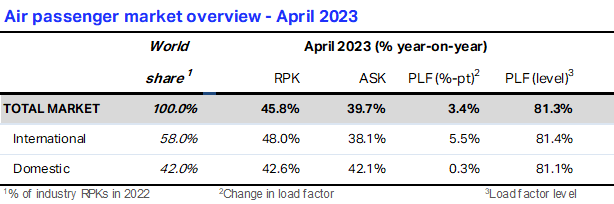
- Total traffic in April 2023 (measured in revenue passenger kilometers or RPKs) rose 45.8% compared to April 2022. Globally, traffic is now at 90.5% of pre-Covid levels. At 81.3%, industry load factor was only 1.8 percentage points below pre-pandemic level.
- Domestic traffic for April rose 42.6% compared to the year-ago period and has now fully recovered, posting a 2.9% increase over the April 2019 results.
- International traffic climbed 48.0% versus April 2022 with all markets recording healthy growth, with carriers in the Asia-Pacific region continuing to lead the recovery. International RPKs reached 83.6% of April 2019 levels.
“April continued the strong traffic trend we saw in the 2023 first quarter. The easing of inflation and rising consumer confidence in most OECD countries combined with declining jet fuel prices, suggests sustained strong air travel demand and moderating cost pressures,” said Willie Walsh, IATA’s Director General.
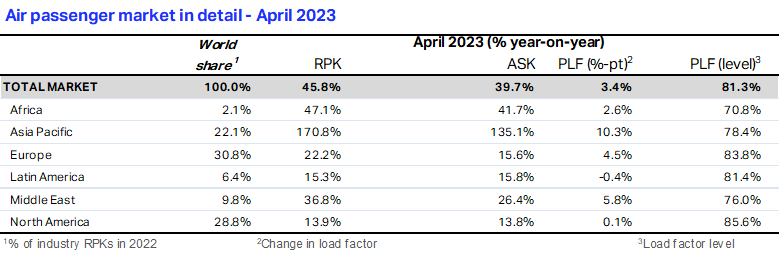
International Passenger Markets
Asia-Pacific airlines saw a192.7% increase inApril 2023 traffic compared to April 2022. Capacity climbed 145.3% and the load factor increased by 13.2 percentage points to 81.6%.
European carriers had a 22.6% traffic rise versus April 2022. Capacity rose 16.0%, and load factor climbed 4.5 percentage points to 83.3%, which was the second highest among the regions.
Middle Eastern airlines posted a 38.0% traffic increase compared to April a year ago. Capacity climbed 27.8% and load factor rose 5.6 percentage points to 76.2%.
North American carriers’ traffic climbed 34.8% in April 2023 versus the 2022 period. Capacity increased 26.5%, and load factor rose 5.2 percentage points to 83.8%, which was the highest among the regions. North American international traffic is now fully recovered, with RPKs 0.4% above April 2019 levels.
Latin American airlines saw a 25.8% traffic increase compared to the same month in 2022. April capacity climbed 26.4% and load factor slipped 0.4 percentage points to 83.1%.
African airlines’ traffic rose53.5% in April 2023 versus a year ago, the second highest among the regions. April capacity was up 50.0% and load factor climbed 1.6 percentage points to 69.8%, lowest among the regions.
Domestic Passenger Markets
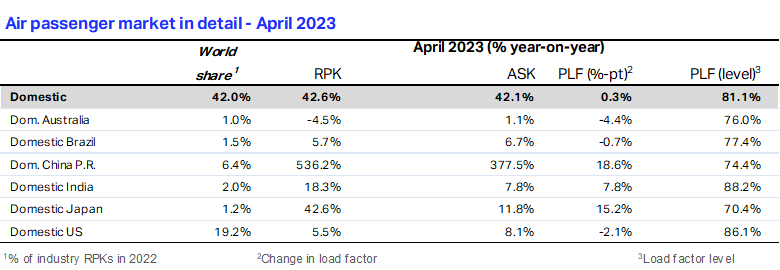
China’s domestic traffic rose 536.2% in April compared to a year ago and surpassing the April 2019 levels by 6.0%.
US airlines’domestic demand climbed 5.5% in April and was 3.3% above the April 2019 levels.
“Heading into the Northern Hemisphere peak travel season, aircraft and airports are full of people eager to make use of their travel freedoms. Airlines are working hard to accommodate them with a smooth travel experience despite continuing supply chain shortages and other operational challenges. Sadly, some governments appear more keen on punitive regulation than on doing their part to enable hassle-free travel. The Dutch Government’s high-handed effort to slash capacity at Schiphol airport is a prime example. And then we have a focus on EU-style passenger rights regulation that is spreading like a contagion. Proponents of this approach miss a key fact. EU 261 has not led to a reduction in delays. That’s because penalizing airlines raises airline costs but does not address delays caused by factors over which airlines have no control, such as inefficient air traffic management or staffing shortages at air navigation service providers. The single best thing that Europe could do to improve the travel experience is deliver the Single European Sky. As for other governments contemplating passenger rights regulations, avoiding a repeat of Europe’s mistake would be a helpful starting point.
“In just a few days, leaders of the global aviation community will gather in Istanbul at the 79th IATA Annual General Meeting (AGM) and World Air Transport Summit. Regulation and other key issues, including the critical topic of sustainability, will be on the agenda,” said Walsh.