
Wego, Expedia, Alibaba Fliggy share product roadmap
There is a Chinese saying, “When the wind of change blows, some build walls while others build windmills.” Well, travel tech brands around the world have certainly been busy building windmills when travel stopped for the time it did.
During the Bridge Series – Product & Tech panel at Phocuswright Europe, three travel tech leaders – Karen Bolda, SVP, Product and Technology, Expedia Group, Ross Veitch, CEO & Co-Founder, Wego Group and Philip Yan, Managing Director and Head of International Flights, Alibaba Fliggy – spoke about the product innovations they’ve been working on and the tech they’re keeping their eye on – take a guess but we’ll get to that at the end.
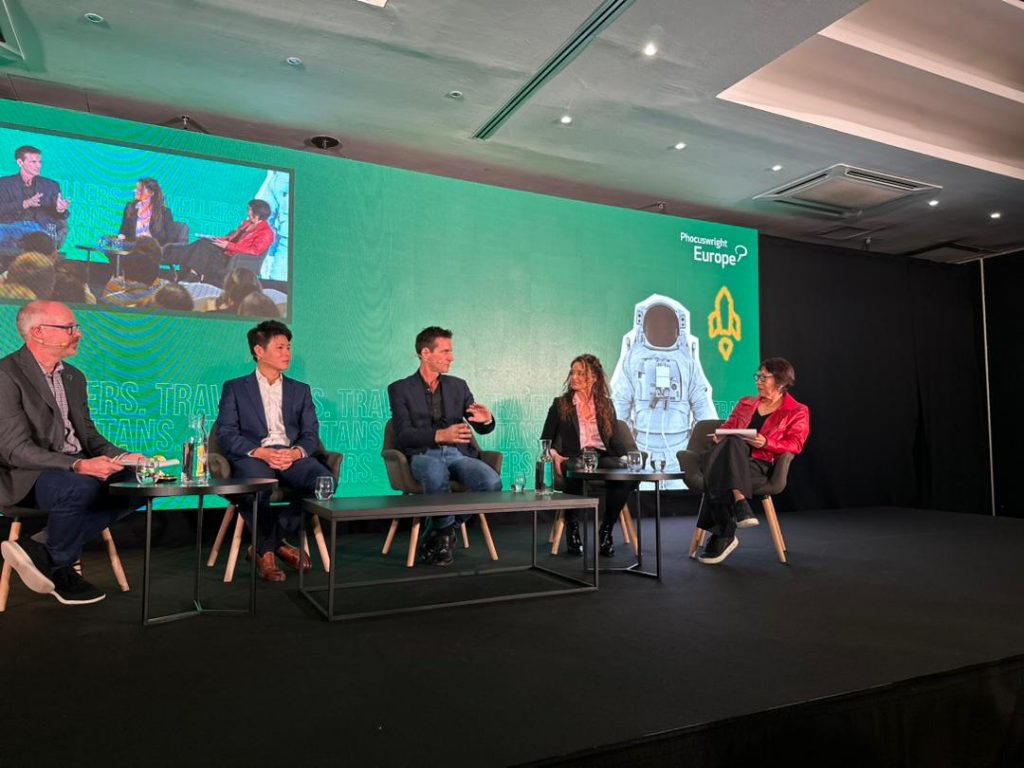
From left, Pete Comeau, Phocuswright; Philip Yan, Alibaba Fliggy; Ross Veitch, Wego; Karen Bolda, Expedia Group, and Yeoh Siew Hoon, WiT – talking product and tech at Phocuswright Europe.
Wego has been working on an A/B testing framework, said Veitch. “We built an in-house solution so we could get ultimate flexibility and scale front and back end experimentation for all devices using a single platform and analytical framework, which has enabled us to scale up experimentation across the company, not just limited to product features, but ad sales, commercial, algorithms, marketing etc.”
Then taking lessons from China and “the best ideas from Tencent, Alibaba and Baidu ”, it has developed a mini-app framework across Wego’s iOS and Android apps that enables it to make updates remotely while still having code compile and run at native speeds.
“We’re now making this framework and the core Wego APIs available to our partners to develop their own mini-apps to be added to the Wego app so we can offer more products and services to Wego users without having to build everything ourselves.”
At Fliggy, a key product innovation is the “flagship store”, providing airlines direct-to-consumer opportunities. Consumers can follow an airline to keep up with latest information and promotions, airlines have flexibility to run self-operated promotions and info display and it offers direct ticketing and servicing leveraging NDC, said Yan.
Yan also listed its “All You Can Fly” pass for domestic flights that offer flexible travel dates, multiple destinations and pricing flexibility. This helped particularly during the pandemic when airlines were running low load factors. “This offers passengers greater flexibility and freedom in their travel plans,” he said.
Its “Last Minute Seats” pass was also developed during the pandemic to offer discounted fares to less popular destinations on low-demand routes. It offers a “Mysterious box style product” where a traveller buys an opportunity to fly to an unknown destination that is only revealed and bookable two days before departure. For travellers, it offers a fixed price for last minute flights and for airlines, it gave them the opportunity to fill unsold seats without “spoiling inventory and pricing strategies”.
Bolda said Expedia Group has been hunkering down on B2B tech given the division’s 55% growth in revenues over 2022 and one key product innovation is its Rapid API end-to-end lodging bookings for airlines, OTAs, and loyalty and membership programmes. The latest rollout of Rapid 3 means lodging partners automatically get access to the new features, without needing to upgrade.
It has also developed new features for TAAP (Travel Agent Affiliate Program) which includes an extension of Expedia’s Live Agent Chat to advisors and an improved lodging quote process. The Live Agent Chat has now been rolled out beyond US and Canada to Australia, Belgium, Ireland, Netherlands, New Zealand, Philippines, Singapore and the United Kingdom.
On the topic of sustainability, Yan spoke of Alipay Ant Forest, the tree planting programme run by Alipay, and listed under “Champions of the Earth” by UN Environment Programme. Launched in August 2016, it has to date planted more than 300 million trees in China. Fliggy is integrating some airlines into the programme so that customers can earn energy points to plant trees, each with their unique ID. The programme has a gamification element in that your friends can steal your unused energy points, said Yan, thus encouraging consumer engagement.
Veitch spoke of its Payments-as-a-Service (PaaS) in which Wego has built a payment stack optimised for MENA markets to minimise costs, fraud and friction and to maximise acceptance and ease of use. “As part of our marketplace mission we would like to offer this as a service for our OTA partners to use and are working through the technical and legal issues,” he said.
It is also working on real-time Dynamic Pricing, “evolving its pricing from a rules based system, to predict the actual net margin we will make from a booking and use realtime price benchmarking to decide how to price, without needing a person to set rules. We will set tolerances for how much control is given to realtime pricing so that we can combine this with manual rules, where it matters.”
Wego is also working on “Product Personalisation”, building server-driven configuration for its apps and web such that the app is a “dumb client”. “We’re connecting this to our user profiles and a rules engine to drive personalised experiences. As an additional benefit it’s made it much easier and faster to introduce new features,” said Veitch.
Bolda said Expedia was working on revenue performance and future data products to help partners to “solve some of our partners’ thorniest challenges and unlock growth now and in the future”.

Karen Bolda: Digging deep into B2B tech with the rollout of new features for Expedia’s hotel and travel agent partners.
As for what tech they’re keeping their eye on, no surprises here with Bolda citing, “ChatGPT and how Expedia is using AI in the app”.
Expedia was one of the first to launch a new in-app travel planning experience powered by ChatGPT, to allow members to start an open-ended conversation in the app and get recommendations on places to go, where to stay, how to get around, and what to see and do based on the chat.
Similarly citing ChatGPT, Yan listed: Using ChatGPT to analyze fare rules for standardized display, provide customer service solutions as well as using feedback from ChatGPT to connect to existing APIs for instant refund/exchange and priming ChatGPT to output refund/change scenarios based on customer requests, then automating such requests into GDS commands for post-ticketing services.
Veitch said, “Neural nets generally & Large Language Models (LLMs) specifically are obviously the most interesting thing that’s happened in technology since the creation of the internet. These have lots of different applications across pretty much all functions and products at Wego from customer support, to pricing, to personalisation, to creative design, to coding and to making our white-collar workforce more efficient generally.
“On deck at the moment is a project to add a voice and natural language UI to our mobile apps that will work in any language and combine the broad knowledge of the LLM with the travel specific shopping and booking services provided by Wego.”
A quiz was run at the end of the panel to get the panellists and audience to guess which photos were fake or real. There were lots of wrong guesses which leads to the conclusion – yes, AI is hot right now but it’s hard to tell fake from real which means travel tech brands face the challenge of ensuring they don’t perpetuate the confusion by embracing it willy-nilly without some form of guardrails.
Here’s to building new windmills in travel product and tech.