
As in Fort Lauderdale, my room overlooks the ocean – only this time, it’s the North Sea and the air is decidedly colder and blustery.
I am told this is Holland’s finest beach and I haven’t dared venture out to the sand yet. I do like the contradiction of Christmas trees and beach huts though.
Water, I am told, is in Holland’s DNA – 26% of the their land is underwater. Juis Nijhuis, president and CEO of Amsterdam Schiphol airport, says the desire to explore the world is in Dutch blood and while the past it was about the sea, today it is about airports.
Schiphol handles 51 million passengers and in the next three years, will invest 1.5 billion euros, half a billion more than in the past five years, in ensuring the airport stays competitive and remains the gateway to Europe.
I have to say I was blown away by the premium service I was fortunate enough to receive. As soon as I left the plane, I was whisked off by a tall, dark, handsome stranger, driven to a lounge where coffee and cookies were waiting for me, where I waited while my passport was stamped, my baggage collected and whisked off again by another not-so-tall-this-time man in a black, gleaming limousine … a girl could get used to this kind of service very easily.
.jpg) Anyway, Nijhuis says Schiphol has its eye on travellers like me “from emerging markete” – that means the Middle East and Asia. I suppose for most of Europe, Asia is still emerging although according to most statistics, it is already the world’s largest travel market.
Anyway, Nijhuis says Schiphol has its eye on travellers like me “from emerging markete” – that means the Middle East and Asia. I suppose for most of Europe, Asia is still emerging although according to most statistics, it is already the world’s largest travel market.
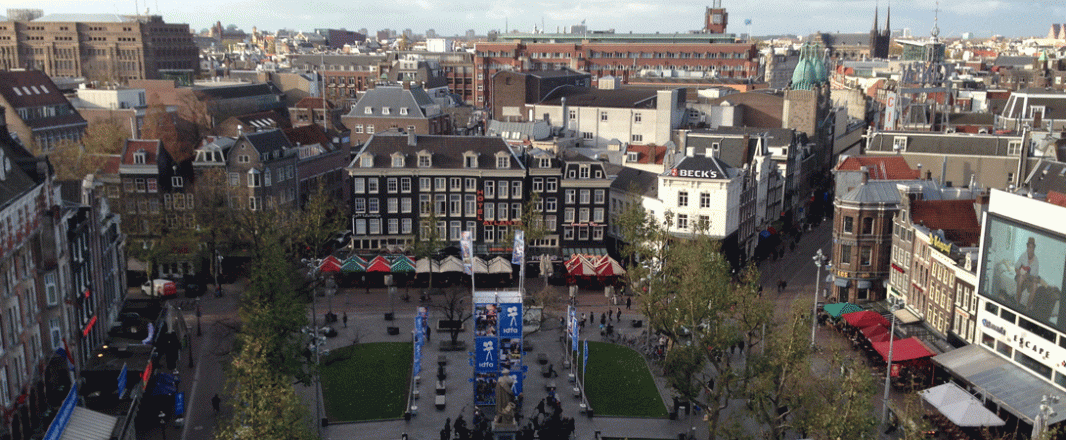
I took a trip to the city yesterday – how can I come to Amsterdam and not walk this city of canals and coffee shops? And I visited the booking.com office, located right on Rembrandt Square. Now here’s one company I think that does not see Asia as “emerging”, it just sees the world as one destination and one market.
I got a tour from the new Priceline group CEO Darren Huston – it is an impressive building and I like the open concept, especially the brainstorming room on the rooftop (right) – and as I walked around, the notion of “meta-national” came into my mind.
At the WIT Conference, global strategist Parag Khanna had spoken of a new wave of companies that would not be defined by their country of origin but just are …
I think booking.com could well become one of those companies. As a customer from Asia, I’ve never thought of them as Dutch and at the rate they’re expanding throughout the world – the US and China – I think even the Europe label will soon be forgotten.
It’s run by a Canadian (Huston) and the roughly 1,000 people working in the Amsterdam office come from 85 nationalities, all of them young, average age 30 – youths from all over the world working for Planet Earth’s #1 Accommodation Site.
It’s a sign of our times – today’s big technology-oriented companies no longer hire as many people as old companies and so I hope they recognize that and respect that they need to also create value and wealth in other ways.
On the wall of the café is a statement that says, “One’s destination is never a place, but a new way of seeing things.”
.jpg) Huston certainly has brought in a new way of seeing travel – he came from Starbucks and Microsoft. “Starbucks is all heart; Microsoft is all brains. We want to strike a balance between the two.”
Huston certainly has brought in a new way of seeing travel – he came from Starbucks and Microsoft. “Starbucks is all heart; Microsoft is all brains. We want to strike a balance between the two.”
booking.com’s destination is to be global and for that to happen, he knows it has to be domestically relevant to three major markets – US, Japan and China – and it will do so by its mantra of executing well and staying focused on the customer.
Having worked in Japan, he’s excited about the opportunities in Asia – the promise of China’s outbound market, the changing Japanese market and the potential of Asia with new destinations like Myanmar opening up.
Back at the CAPA conference, I spent most of the day listening to air men from around the world about their business – and the overwhelming thread seems to be more about cutting costs rather than creating top-line revenues.
So I had to ask Michael Cawley, deputy CEO and COO of Ryanair, whether he thought lessons could be learnt from the new travel companies such as Priceline or Expedia which have such high valuations and which seem to be good at creating top-line revenues while staying lean on costs.
Now Ryanair’s not so bad itself about creating revenues – it earns £400 million a year from ancillaries, selling third party products, and sees itself as a distribution platform. And it practises (in industry jargon) deterrent pricing “to change customer behaviour”. In other words, you are penalized if you don’t behave according to how the airline wants you to.
Cawley’s clearly a man who says it like it is – for example “the only bloggers out there are ignorant ones” (love his pithy quotes) – said Priceline’s high valuation was mainly due to “booking.com, the finest travel company in the world”..JPG)
“They run a phenomenal operation – we can all learn from them. They are a juggernaut for growth and killing everyone and worth every cent of their valuation.”
As of this morning Amsterdam time, Priceline’s market cap was valued at US$60.58 billion. In 2012, global airline profits were estimated to be US$4.1 billion.
See, contradiction just like the Christmas trees and beach huts on the beach in front of me.