
Travelstart builds new tech to fuel new dreams on back of recovery
You couldn’t pick a more challenging market than Nigeria to build an online travel business – poor economy for starters, 1.6% credit card penetration for another, currency issues etc, etc, – but therein lies the opportunity for those brave enough to take on this country of 221 million, 70% of whom are under the age of 30.

Philip Akesson: “With the right team and partners, it is a very important market on the continent with vast potential.”
Philip Akesson, group head, corporate development at Travelstart, is one such brave soul. Speaking to WiT on the sidelines of Phocuswright Europe in Barcelona, Akesson, said, “It’s an immature travel market with a multitude of challenges. There are endless stories of what makes the market so difficult to operate in. These challenges range from poor payment infrastructure, dual FX rates and regulatory hurdles, to limited access to local air content and adapting the product to suit local customer needs and preferences. Additionally, airlines don’t accept card payments on BSP which means you need a massive bank guarantee to scale.”
Having said all that, he smiled, “With the right team and partners, it is a very important market on the continent with vast potential.”
Akesson moved from Stockholm to Lagos in 2012 to assist Kinnevik, a Swedish VC, in developing its e-commerce portfolio in Nigeria. Previously, as a student/intern in Stockholm, he had worked for My City Deal, a Rocket Internet-backed company that was eventually acquired by Groupon and was part of Kinnevik’s portfolio.
“When the opportunity came, I couldn’t say no. Overnight, we launched Konga, an Amazon-style platform that competed against Jumia, another Rocket Internet-backed business that later went public. Both Konga and Jumia were pioneers in the local e-commerce landscape, which meant that we had to build much of the necessary infrastructure from scratch, including warehousing, logistics, and technology. After just two and a half years, Konga employed over 1,000 staff of which around 100 were developers. We were probably a bit early. It was a wild journey.”
In 2016, with online travel just taking off, Akesson joined Travelstart to grow its business in Nigeria, which he did steadily and surely until Covid-19 happened.

Philip Akesson with Travelstart Nigeria’s team: “Focus on profitability and bite-sized projects that deliver immediate results.”
The pandemic years have also been “wild” for Travelstart but with the business now more than recovered, he said the crisis gave the group an opportunity to rethink and reshape Travelstart as a brand and its role within the TLG group. The travel group has a portfolio of brands covering various travel and technology verticals, geographic markets, distribution models, customer segments, and travel products across Africa.
“We run a much tighter ship today. Significantly lower cost base, faster decision-making, and focus on profitability and bite-sized projects that deliver immediate results. Less of the glossy, large-scale strategic projects. These changes were necessitated by Covid but we’ve continued with the same mindset, largely thanks to the leadership of Stephan (Ekbergh, CEO).”
In Nigeria, staff count is down from 60 to 40, and while bookings haven’t grown much, profitability has never been better, said Akesson. “We achieved savings across the board – marketing, staff costs, every bill was renegotiated, but most importantly – we squeeze a lot more from each transaction today.”
With a 90% international business mix, Travelstart Nigeria was particularly vulnerable and it took the opportunity to grow its domestic business. Today, the international share is down to 75%.
One noticeable change in traveler behavior since pre-Covid is the surge in one-way bookings. “In 2019, 17% of our international bookings were one-way bookings, while in 2023, the share has increased to 50%. Challenging macro factors, compounded by the impact of Covid-19, have driven younger generations to seek opportunities overseas.”
The most popular routes from Nigeria are to the UK, with Manchester-Lagos being the top route, followed by Canada and the US.
“In terms of product development, Travelstart has recently launched a new booking tool tailored to subagents; a dominant segment that’s underserved from a technology standpoint. Pure-play OTAs represent a small portion of the Nigerian market, accounting for less than 10%. To grow in Nigeria, we have found it more effective to collaborate with subagents by providing them with tech solutions allowing them to do their offline trade more effectively than it would be for us to try to convert local offline customers to become OTA customers.”
Given the high percentage of youths and high mobile penetration – 87.7%, it is no surprise that Travelstart Nigeria sees 85% of traffic and 63% of bookings on mobile. “Across Africa, we see a higher percentage of mobile than in Europe,” he observed. Consequently, developing the Travelstart app, “Flapp”, has become a top priority for the company.

Lagos: “Nigeria has rebounded faster than other travel markets in Africa and is now larger than it was pre-Covid.”
Given the low trust of consumers in strictly online businesses, Travelstart has opened two retail outlets – one at the airport and one downtown. “These outlets are more about giving customers enough comfort to buy online than it is about offering an offline channel to book. The reassurance of knowing that there is a physical location where you can be assisted in person is an important trust factor, especially for new customers.”
While Akesson is as excited about generative AI and the gains achieved through their dynamic pricing engine, he said, “In Nigeria, we often have bigger, more foundational, issues to focus on such as the local payment infrastructure. For a period in Q1, we had a 23% success rate on online card transactions. Bank transfers sometimes don’t reflect until days after they were completed by the customer, etc. This of course has a negative impact on our automation ratio too.”
But there’s a lot of optimism in the market.

Amid the chaos, there’s opportunity for playtime on the beach. “If you can run a business successfully in Nigeria, you can make it anywhere.”
“Nigeria has rebounded faster than other travel markets in Africa and is now larger than it was pre-Covid. Customers skew younger and are more comfortable transacting online. A new government has implemented several positive initiatives. Nigerians are incredible –- no matter how gloomy the outlook is and the challenges they face, they always cheer up and power through. They’re incredibly resilient and entrepreneurial. In one of Y-Combinator’s recent cohorts, Nigeria had the second-highest number of represented entrepreneurs, surpassed only by the United States. That speaks volumes about the talent and entrepreneurial drive within the country.”
There’s a local saying, “If you can run a business successfully in Nigeria, you can make it anywhere” – as Travelstart and Akesson have proven, after more than a decade of working in Nigeria.
“It’s a very difficult market to crack without local expertise and adaptation. Many international players make the mistake of assuming that what works in their home markets will surely work in Nigeria too. It doesn’t. Both from a regulatory point of view and from a commercial point of view, you need local expertise on the ground to truly understand the local nuances to be successful in the market. Nigeria has a way of humbling you.”
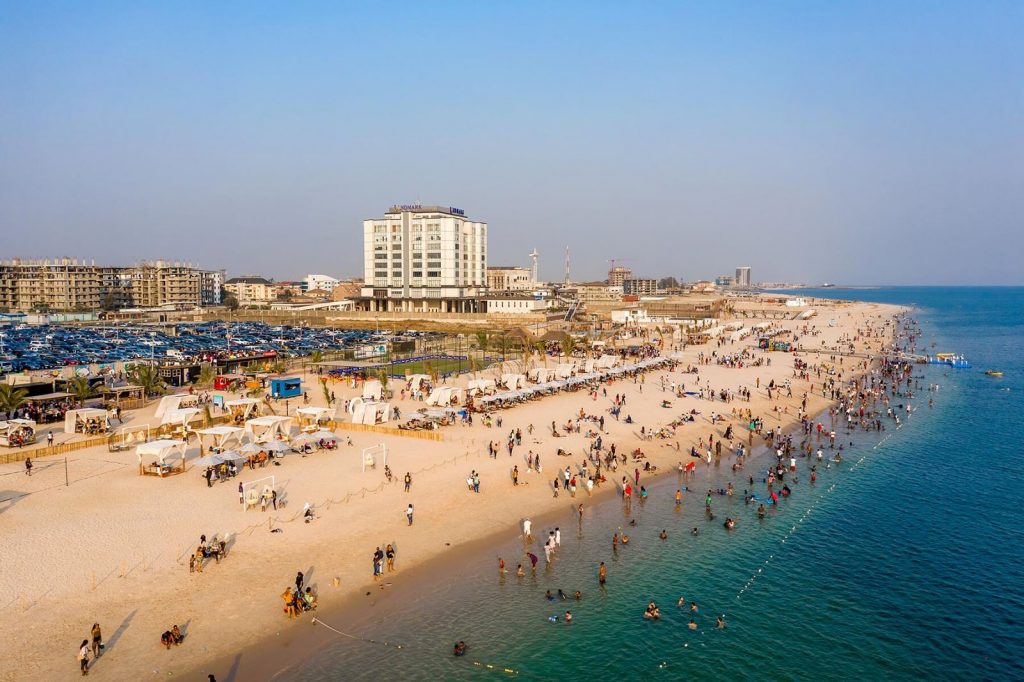
Beach time in Lagos.