
The Indian transport and mobility landscape is undergoing a transformation, powered by significant investments in both physical and digital infrastructure. Against the backdrop of a burgeoning transportation industry, the India Ground Transportation Market Sizing & OTA Benchmarking Study, FY20-FY26 by VIDEC Consultants delves into the rapid evolution of ground travel modes, with a strong focus on railways and intercity buses.
Here are the key findings and insights from the study, highlighting the integral role these modes play in catering to India’s diverse travel needs.
Key findings:
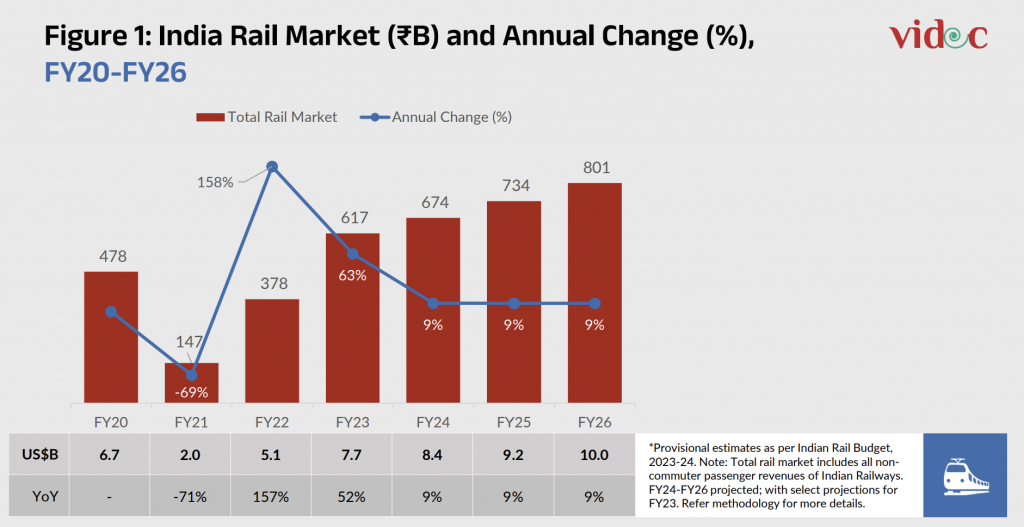
- The Indian rail market reached its life-time high GBV of ₹617 billion (US$7.7B) in FY23, up 63% from ₹378 billion ($5.1B) in FY22. It is projected to rise to ₹801 billion ($10B) by FY26, growing at a CAGR of 9% during FY23-FY26.
- The online channel accounted for 82% of total IRCTC bookings, valued at ₹393 billion ($4.9B) in FY23. It is projected to reach ₹597 billion ($7.5B) by FY26, or 87% of the total IRCTC rail bookings.
- Supplier-direct is the dominant online distribution channel, accounting for 76% or ₹298 billion ($3.7B) of all IRCTC rail bookings and is estimated to reach ₹421 billion ($5.3B) in FY26, growing at an CAGR of 12.3% during FY23-FY26.
- The share of supplier-direct online in rail is the highest across all travel categories. However, the OTA channel is gaining share in IRCTC’s online rail bookings – its share grew from 15% in FY20 to 24% in FY23.
- ixigo Group, which owns ConfirmTkt, is the market leader in indirect online rail distribution, cornering about half of the B2C rail GBV.
- The high share of supplier-direct online has saturated IRCTC’s growth prospects, ergo the potential inclusion of unreserved bookings in its fold could unravel next growth frontier for IRCTC.
- The intercity bus market is estimated at its life-time high of ₹539 billion ($6.7B) in FY23, more than double that in FY22. It is projected to reach ₹688 billion ($8.6B) by FY26, growing at an CAGR of 8.5% during FY23-FY26.
- The online channel accounted for just 19% of total bookings, valued at ₹100 billion ($1.2B) in FY23. It is projected to reach ₹176 billion ($2.2B) by FY26, or 26% of the total market.
- OTA is the dominant online distribution channel, accounting for 88% or ₹88 billion ($1.1B) of all online bus bookings in FY23 and is estimated to reach ₹153 billion ($1.9B) FY26, growing at an CAGR of 21% during FY23-FY26.
- MakeMyTrip Group, which owns redBus, has a commanding share of 75% in the OTA intercity bus market in FY23.
- The intercity bus market in India is about 85% of the rail category (₹617B) in FY23. However, it’s highly under-penetrated at 19% compared to rail at 82%. Bus category will provide the much-needed cushion for the growth in Indian online travel category, as domestic air and rail categories reaches saturation.
- The intercity bus category is hugely fragmented with a combined total of 100,000 services daily, operated by approximately 4,500 private bus operators and over 25 state road transport corporations (SRTCs).
Revolutionising ground transportation: Railways and Buses
Indian Railways: A catalyst for connectivity
With its unparalleled reach and extensive network, Indian Railways has been the linchpin of India’s transportation system for over a century. The study underscores the impressive growth trajectory of the Indian rail market, which achieved a remarkable Gross Booking Value (GBV) of ₹617 billion ($7.7 billion) in FY23, surging by 63% from ₹378 billion ($5.1 billion) in FY22. Projections indicate that this upward trend will continue, with the rail market expected to reach ₹801 billion ($10 billion) by FY26, representing a CAGR of 9% during FY23-FY26. The online channel has become a dominant force, accounting for 82% of total IRCTC bookings in FY23, projected to further rise to 87% by FY26.
Intercity Buses: A flourishing frontier
The intercity bus segment has emerged as a dynamic growth avenue within India’s ground transportation ecosystem. Reaching a pinnacle GBV of ₹539 billion ($6.7 billion) in FY23, this segment doubled its value from FY22 and is projected to reach ₹688 billion ($8.6 billion) by FY26, registering a CAGR of 8.5% during FY23-FY26. The online intercity bus market has been gaining traction rapidly, with a GBV of ₹100 billion ($1.2 billion) in FY23, a 2.5-fold increase from FY22. This online penetration is poised for further expansion, projected to reach 26% by FY26.
Role of Online Travel Agencies (OTAs)
Online Travel Agencies (OTAs) have played a pivotal role in reshaping rail travel experiences. The study reveals that the OTA rail market has been on a robust growth trajectory, attaining a GBV of ₹95 billion ($1.2 billion) in FY23, marking a substantial growth from FY20. With projections indicating a CAGR of 23% from FY23 to FY26, the OTA rail market is poised for significant expansion, accounting for 30% of total rail bookings by FY26.
Intercity buses, on the other hand, are an OTA haven for India’s ground transport scene. OTAs have been instrumental in propelling the intercity bus category to new heights. The OTA intercity bus market reached ₹88 billion ($1.1 billion) in FY23, exhibiting a 31% surge from its pre-pandemic level. With a projected CAGR of 21% during FY23-FY26, the OTA intercity bus market is set to nearly triple the growth rate of the total intercity bus market, positioning itself as a formidable growth driver.
Key Drivers of Growth
Infrastructure transformation and digital leapfrogging
India’s substantial investment in infrastructure, including road networks and railway electrification, has significantly contributed to the growth of ground transportation. Moreover, the digital leapfrogging observed in the country, with a staggering 6 billion digital transactions per month, has catalyzed the online adoption of ground travel booking platforms.
Market dynamics and opportunities
While the online rail market has shown remarkable growth, saturation is on the horizon. The inclusion of unreserved bookings in the Indian Railway Catering and Tourism Corporation’s (IRCTC) purview presents a new avenue for expansion. Leveraging their expertise, OTAs are poised to tap into this uncharted potential and further enhance their market share.