New features improve collaboration, check answers, and extend language support
Goolgle took a big step towards enhancing the capabilities of its generative AI chatbot, Bard, by unveiling a host of new features that enable users to double-check responses, collaborate seamlessly, and integrate with a range of Google apps and services.
So, what does this mean for travel?
It’s funny how the opening lines in Yury Pinsky’s (Director, Product Management, Bard) official Google blog post has the words “trip planner” in it. He says, “For instance, you could ask Bard to start a trip planning Doc for you and your friends, draft up your online marketplace listing, or help explain a science topic to your kids.” AI and chatbots, especially ChatGPT and to a lesser extent, Bard, have been so quickly adopted by travel and hospitality that “trip planner” seems to be a default job title for these evolving tech tools.
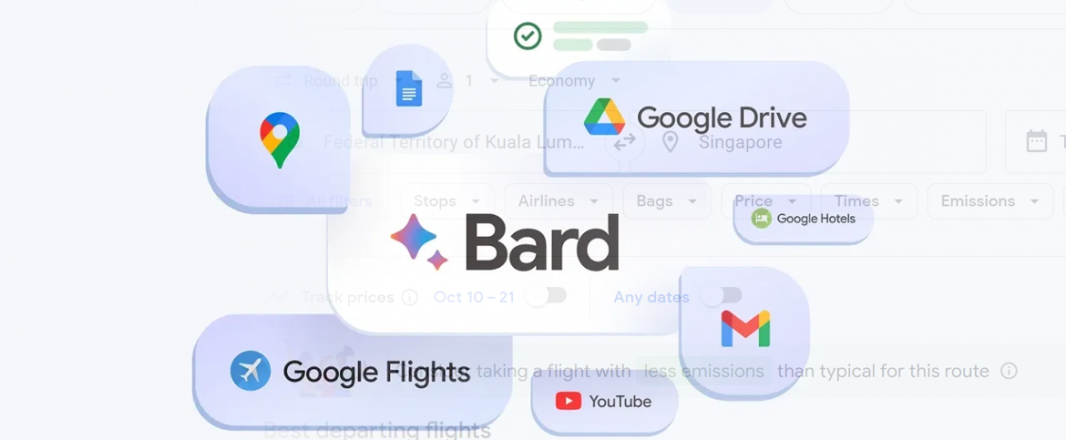
But what this really means is that Bard, being a Google baby, has the ability to tap into all your connected services under Google’s roof. The latest version of Bard introduces extensions and these extensions, currently available in English, facilitate deeper interactions and collaboration with Bard across various domains, including Gmail, Docs, Drive, Google Maps, YouTube, and Google Flights and hotels.
Those services, like personal calendars, flight bookings and itinerary confirmation emails can be pulled up by textually nudging Bard. Users can now seamlessly coordinate their trips with friends or family by instructing Bard to retrieve relevant information from Gmail, such as travel dates, real-time flight and hotel details, directions to airports, and even suggested activities at their destination, all through a single conversation. It’s not far-fetched to think that, like ChatGPT’s plugins, Bard could also connect to other apps, like booking platforms, in the near future.
However, I couldn’t help but feel uneasy about the prospect of Bard having access to all my personal accounts even though I know, logically, that my personal accounts are already being shared across Google’s suite. It’s nothing new, but telling a human-sounding chatbot to retrieve my personal information feels quite intrusive.
Jack Krawczyk, product lead for Bard, emphasises that user trust remains a top priority. Users have complete control over when and how Bard interacts with their Gmail, Drive, and Docs. The company ensures that personal data is neither used for reinforcement learning nor accessible by human reviewers. This approach aims to preserve user trust and privacy while harnessing the potential of AI.
It’s also essential to acknowledge that while Bard continues to evolve, it may encounter limitations. For instance, it may struggle to identify specific details like wine club memberships unless explicitly mentioned in emails. These shortcomings highlight the ongoing development of the feature.
The addition of a “Google it” feature ensures users can double-check Bard’s responses more conveniently. By clicking on the “G” icon, users can verify information provided by Bard against web-based sources. This feature promotes accuracy and trust in Bard’s responses. Moreover, users can now extend their conversations initiated by others. When a Bard chat is shared via a public link, recipients can continue the discussion, seek additional information, or use it as a starting point for their own inquiries.
In an effort to broaden Bard’s accessibility, Google is expanding support for additional languages, enabling more users worldwide to benefit from its advanced capabilities. This expansion includes features like image uploads with Lens, search images in responses, and the ability to modify Bard’s responses, now accessible in over 40 languages.
These enhancements are made possible through updates to the PaLM 2 model, which employs state-of-the-art reinforcement learning techniques to enhance Bard’s intuitive and imaginative responses. This ensures that Bard remains a versatile and reliable tool for users across various domains, languages, and creative endeavors.
After taking the new-and-enhanced Bard for a spin, I think I’m starting to get the appeal. While I still think there’s a simplicity and efficiency to ChatGPT that its competitors have yet to reach, Bard boasts a more modern aesthetic and appeal for the user. Plus, its secret weapon is really the ability to be a virtual assistant – shuffling through your unorganised Google Docs and sifting through thousands of unread emails to find that one receipt for a hotel booking you made months ago.
Image credit: Google