
Key takeaways from WiT Singapore 2023
I am writing this from Rocky’s, a resort in Samui, a Thai island I haven’t visited in at least a decade. There’ve always been other destination distractions and somehow, Samui had lost its appeal to me – the over-building in Chaweng, the main beach strip, and the overflow of bars, restaurants, shops that clogged up the narrow streets, the heady development which characterized most of the 80s and 90s in Thailand.
But it’s a good, close escape from Singapore after a week of intense conferencing. Samui airport, built, owned and operated by Bangkok Airways, remains one of the most charming airports in South-east Asia. “Oh, it looks like a resort,” someone said in Australian-accented English.
I felt an immediate sense of homecoming – and yes, perhaps I say this of most places I’ve visited before – but this, to me, is the power of travel, its ability to, very quickly, physically transport you from one setting to another and then emotionally resetting you with a local experience.
In just over two hours, I’ve gone from the urban jungle I call home to having dinner by the sea, watching two men play with fire on the beach as part of a Friday night performance for guests at the resort. The fire dance – literally two humans turning and swirling great balls of fire in the air with beautifully synchronized movements set to music – made me hold my breath. I wonder how many times they got burnt before they perfected it.
It made me think of the online travel world, which we had just covered in the last three days at WiT Singapore, and how all the different players today have to juggle and keep several balls (of fire or whatever) in the air at the same time because, let’s face it, there are more balls now than ever and the greatest, fastest moving ball of all – AI (generative or whatever) and its impact on travel, humanity and the world, from this moment on.
Stephan Ekbergh, CEO of Travelstart, called it “the Netscape moment” – the point when browsers changed the world. Some call it the “iPhone moment” – the point when mobile devices changed the world. However you call it, we are on the edge of something new that will shape travel, going forward – from how it will change consumer behaviour to how we in travel have to evolve.
Here are the key takeways from “The Human Revolution” which unfolded at WiT Singapore 2023.
-
AI can codify almost everything but human friendships and loyalty
The strongest businesses in online travel have been built by humans who have chemistry together and who admire, respect and trust each other. Think of all the travel tech startups started by male friendships – Qunar, Skyscanner, Ctrip, MakeMyTrip, Wego, GetYourGuide (to name just a few) – that have gone to scale.
Agoda is now led by three former Israeli army buddies who built a startup, Qlicka, and sold it to Booking Holdings and the trio, Omri Morgenshtern, Idan Salzberg and Ittai Chorev are now CEO, CPO and CTO respectively.
They first met when they enrolled in the Israeli army. “We were 18, we got our heads shaved at the same time, had our vaccines, and off to the fields,” said Morgenshtern on the WiT stage.
When asked who’s the fixer, joker and dreamer, he said, “There is no one fixer. We fix one another, which is why it works.” And while he says Idan and he are more the dreamers, dreamers need stabilisers and Ittai is the stabilizer. “I am super lucky to have friends like them in life and in business. We were techies, we didn’t know anything about business and on hindsight, I am shocked that I am here.”
He recalled the moment when they received a term sheet from Booking Holdings and while he was wavering about it, worrying about whether they’d be able to adjust to corporate life, “Idan told me, go get the deal done. I don’t care how, get the deal done.”
In the end, he said, there was no monster to overcome in adjusting to corporate life. “We are really lucky, we’ve seen so many startups get acquired and counting the days. We were a good match for Booking. We brought tech to Agoda and I learnt about leadership – empathy, being respectful, open to change, humility. I learnt how to be a leader.”
Ethan Lin and Eric Gnock Fah, co-founders of Klook, met at an investment conference in New York, became friends, went on a hiking trip in Nepal and started the travel experiences business from Hong Kong because they wanted to solve their own problems.
Lin comes from Taiwan, Gnock Fah from Mauritius, with a common island underdog mentality – and they balance each other out with Lin handling more the investor side of things and Gnock Fah, marketing and operations of the company which turned nine this year.
The bond between the two is evident. At one moment in the panel, while Gnock Fah was ticking off the things that had gone right at the company, I asked him to name one that hadn’t worked as well and when he hesitated, Lin jumped in immediately and said, virtual tours which they had to sunset.
You can imagine how they must have supported each other through the pandemic, and how those dark days led them to start a wellness programme for themselves and staff members. “I need to be more Zen,” said Lin, “to focus on the things I can change and not be so stressed out about the things I can’t.”

Ethan Lin (Co-founder & CEO, Klook): I need to be more Zen to focus on the things I can change and not be so stressed out about the things I can’t.
Asked who was the starter and who was the scaler, they both admitted, “We are both starters, and learning to scale.”
The story of car rental tech platform, Meili Travel Technology and how it was co-founded in 2021 by friends of 15 years, Bobby Healy and Mike McGearty, is another example of a business forged by friendship and loyalty. Both were with Car Trawler – Healy as CTO, McGearty as CEO – and when they lost control of the business in April 2020, went on to build Meili to address the problems of the “ugly” car rental broker model.
Of its team of 35 people, almost 90% come from Car Trawler. Said Healy, “This is my sixth business. I am very proud that people who’ve worked with me for 30 years are still stupid enough to work with me. Business is just a virtual collection of people at the time. The next business is that same collection of people. Mike and I have been friends for 15 years, that synergy is important because we are taking risks together.”
If you are in need of Doxycycline, you can conveniently buy it online. Doxycycline is a commonly prescribed antibiotic used to treat various bacterial infections. By purchasing it online, you can save time and effort by avoiding a trip to the pharmacy. Online platforms offer a hassle-free experience, allowing you to order Doxycycline from the comfort of your own home. With just a few clicks, you can have the medication delivered right to your doorstep.
Leadership, borne out of friendship, forged through thick and thin, and the ability to inspire loyalty among a good group of people who fight with you to the last inch will triumph in the age of the machine.
-
Skills to develop in the age of AI – goodbye, mediocrity
What are the skills we need to develop in the age of the machine? Agoda’s Morgenshtern, said “niche and non-repetitive”. Travelstart’s Ekbergh said, “Be a super generalist and get really good with people”. Speakers agreed that while AI is good at aggregating information, humans are better at connecting the dots – people with ideas, and people with people.
Ross Veitch, CEO and co-founder of Wego said, “Learn how to use the AI tools to be more productive. Figure out a strategy to stay on top of new developments in AI.”
Winnie Tan, CEO of Tripzilla, said it’d be harder to be mediocre in the age of AI so everyone has to amp up their game, especially in the area she’s operating in, which is content creation and generation for her travel media business.
Fritz Demopoulos, CEO, Queen’s Road Capital, quoted from the ancient Greeks. “To find yourself, think for yourself” (Socrates) and “Self reliance always. And cheerfulness.” (Marcus Aurelius). And from a JP Morgan executive he met in the 1980s – “Speak well. Write well. Think well.”
He wondered if AI would lead to conformity and argued that travel might be in the best position to get the balance right between AI and humanity.
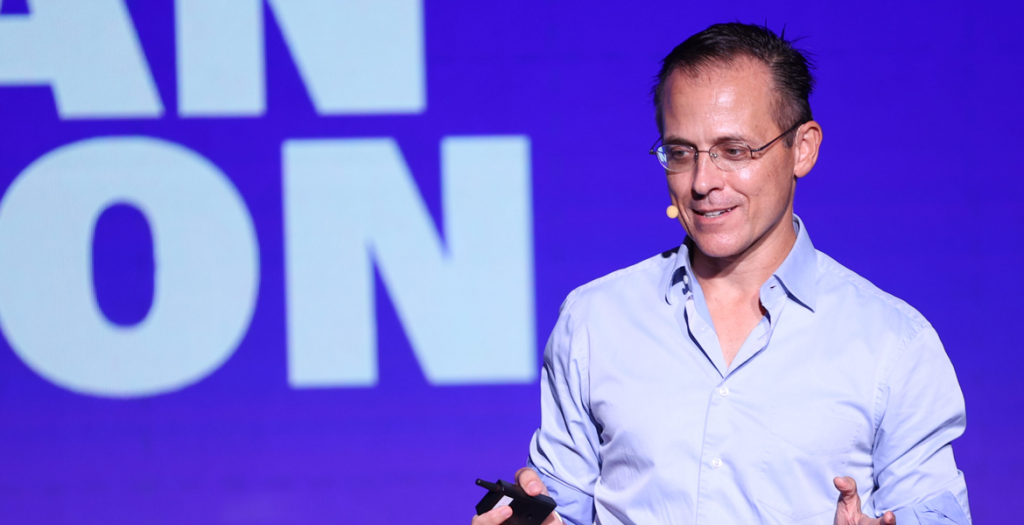
Fritz Demopoulos (CEO Queen’s Road Capital) quoting Socrates, “To find yourself, think for yourself.”
He gave examples of major travel brands that were taking the lead in making declarations such as “we don’t want to attract every single candidate in the world, just those who align with our mission to connect people in real life” (Avi Meir, CEO, TravelPerk) and “we firmly believe that by helping people travel more, explore the world and experience diversity, we create a meaningful socio-economic impact.” (Wego)
And he shared a to-do list:
- Spend time where your customers spend time
- Engage with your customers
- Attend industry trade shows and events
- Concentrate on great communication with your stakeholders
- Develop your high quality opinions
- Curiosity and critical thinking
- Learn about new technologies, approaches and models
- Keep up-to-date on industry news and trends
- Learn what makes the best companies successful
- Be open to upcoming trends
- Be adaptable
- Figure out what we can do with other industries
-
Nothingness is a source of innovation – could the next Booking.com killer be around the corner?
In his talk on “The Human Revolution”, Ekbergh talked about how Germany built back after the devastation of World War Two and the innovation that came out of the country in the years following. In Dusseldorf, a city built by machines, electronics and telecommunications, the electronic band Kraftwerk was born.
Saying “nothingness is a source of innovation”, he shared the example of country and folk singer Johnny Cash who, at the lowest point of his career in 1993, collaborated with Rick Rubin, more known for rap and heavy metal, on an album of covers including “Hurt” by Nine Inch Nails. “Rubin persisted and created Cash’s biggest hit of his life, and the most successful in Cash’s career.”
Declaring “limitation is the mother of creativity”, he shared the story of Keith Jarrett’s Koln Concert in 1975 – how a broken piano and a sick virtuoso with a bad back played a concert that changed jazz music”.
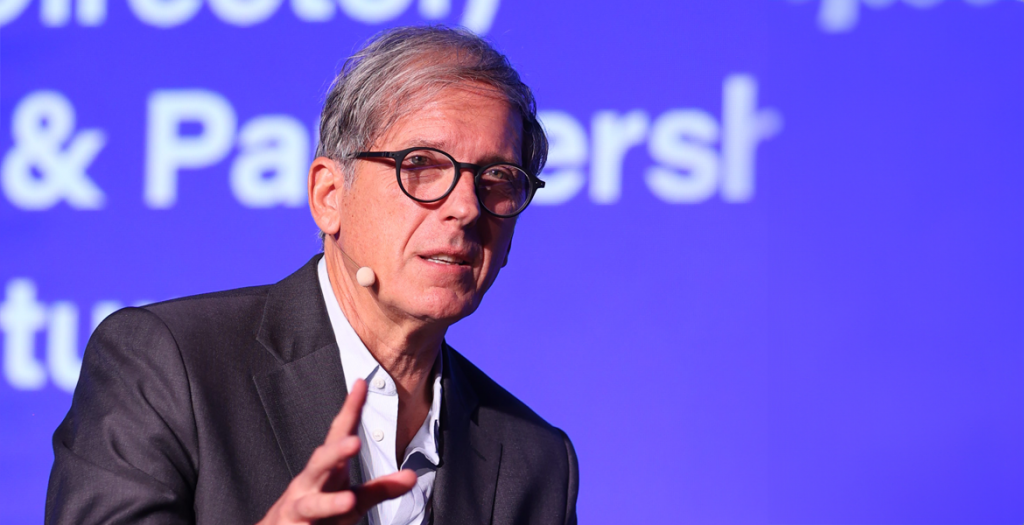
Stephan Ekbergh (CEO, Travelstart): Some of the most incredible stuff that’s going to happen in the next 10 years is happening as we speak.
Jarrett had asked for a Bosendrofer 290 Imperial piano. Instead, he got an out-of-tune piano made for operas. He wanted to call it off because on top of that, he was suffering from back pain. That performance and recording sold four million copies, the most sold jazz album of all time.
When Travelstart’s business was devastated by the pandemic, “I wondered seriously whether I should just quit”, said Ekbergh. But he and his team persevered, went on to build a new payments business, Glyde Payments, among other ventures, and started Innovation City, Capetown, to create a hub for the startup community in South Africa.
“Some of the most incredible stuff that’s going to happen in the next 10 years is happening as we speak,” he said at the start of an investors’ panel that he moderated.
The aforementioned Bobby Healy is no stranger to starting from nothingness. In April 2020, he was restructured out of the company he had worked on and built for 15 years. Car Trawler’s business was wiped out by Covid. “We had negative working capital, we were funded by own profits and forward bookings and it had to be restructured.”
Out of the ashes, Healy went on to scale Manna Drone Delivery into the largest drone delivery business in Ireland and Europe, and expanding to the US, and at the same time, co-founded Meili Travel Technology, a car rental tech platform, with Mike McGearty, former CEO of CarTrawler.
Healy believes “a disruptive Booking.com killer” could be around the corner. “It’s not going to be easy but disruption is available in our industry, more so now than ever.
“If I weren’t so busy, I’d be 100% building a travel business, and not a niche, but going after the big guys with something foundational. Steve Hafner (CEO, KAYAK), in a podcast said he believes the big guys have so much power, strength and momentum that they can take all the good ideas, build them and scale them but I am a believer in small businesses toppling giants. I’ve done it before, it’s doable.
“People should be ambitious enough and say, let’s go for the big guys. Now you have the availability of GPU, LLM and tech. In the end, it’s about solving pain for the customer and the travel companies still fail in that regard.”
-
India ripe for disruption, inflexion point predicted in 2027 or 2030
Gaurav Bhatnagar, co-founder of BTO.com, also believes that the time is right for another kind of OTA model to emerge in India’s online travel market. “The current crop of OTAs was based on the Western models – Expedia, Booking – but it’s a different market now and surely there is a possibility to create another kind of model.”
He also reminded the audience of how young India’s population is. At 44 years old, he says, “two-thirds of India is younger than me and, in my company, I am considered in the 90 percentile. Then you have school going children, aged 8-15, whose numbers are larger than the whole of America. There’s a whole new generation coming on and that’s never happened before in the history of mankind.”
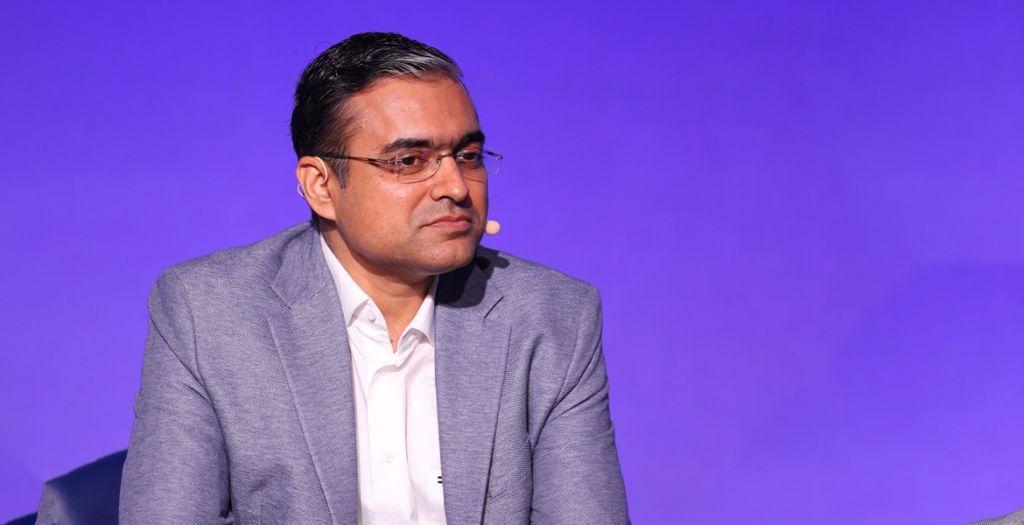
Gaurav Bhatnagar (Co-founder, TBO.COM): The current crop of OTAs was based on the Western models – Expedia, Booking – but it’s a different market now and surely there is a possibility to create another kind of model.
Aloke Bajpai, CEO and co-founder of ixigo, who was supposed to have been on the same panel but had to cancel due to unforeseen circumstances, shared this data point – 10.5b UPI real time transactions a month.
“India surpassed China by volume of daily transactions in late 2021. India accounted for 46% of all global digital transactions by volume in 2022 and expected to cross 50% this year. We must remember we are talking about a country where more than 1 billion passengers in total (not unique) already being booked online per year, two thirds of which is rail and bus. For reference Indian Railways carries eight billion passengers per year, while airlines manage only 150 million.”
So, the million-dollar question is, when is the magical inflexion point for India because both TBO.com and ixigo, founded 2007, have been waiting for the right time for a while?
Bhatnagar predicts 2027 while Bajpai went for 2030 – “what 2010 was for China, where many of the ongoing infra development projects would be complete, per capita income hits a point where discretionary spending on travel grows much faster than the current trend since GDP per capita in India will hit the $40,00-$5,000 mark then. Expect a lot of train bookers to move to air and higher speed rail and with improving road infra, luxury e-buses will offer a decent alternative too.
“Since we are a diverse country with multiverses inside, this inflection point has arrived already in the big cities and large tier 2 towns, where healthy double digit % growth in travel consumption is visible consistently, so the future is already here but not evenly distributed yet.”
-
Creators, content and conversions – harnessing the human sales force
It’s been talked about – the rise of the creators’ economy – and how travel brands in Asia are tapping into the giant, growing pool of user generated content, whether by influencers or customers, to inspire and convert.
For Trip.com, Boon Sian Chai, managing director & vice president, international markets, for the group said demand generation is key to how it differentiates itself from other OTAs. Trip Moments, its user generated content section, saw a 300% growth in users in 2023 compared with 2022.
He said, “We’ve gone from transactions to content generation/inspiration plus transactions, a whole ecosystem. Instead of acquiring traffic from external sources, which is very expensive, we have created our own travel ecosystem. Instead of them just posting content, we allow them to do live shows and sell their own products within the app. This creates organic traffic within our own system to inspire and to sell travel.”
When you consider that the Trip.com app has 3b downloads and grew by 5m in 2022, it becomes a powerful engine of organic traffic.
Klook has its Klook Kreators influencer affiliate programme, in which different levels of influencers are engaged to create content to inspire and sell. Said Gnock Fah, “We’re seeing that social media is able to become a conversion engine. Before, social media was more about building awareness and building a network effect, but we were not able to see how it could convert for us. Social media platforms themselves have been innovating towards conversion versus just engagement.”
For Dawn Jeremiah, vice president, marketing and ecommerce of Go City, China is one of her most exciting source markets in which she’s getting to experiment with mid funnel marketing via local content creators and influencers on Little Red Book, also known as Xiaohonghsu.

Dawn Jeremiah (Vice President, Ecommerce & Marketing, Go City): The influencer content done during the pandemic has been a gift that keeps on giving to us in Mainland China.
“It’s very unique in a sense that it is – crudely – a combination of Instagram, Pinterest with search and SEO capabilities, so there’s a longer shelf life to your content. Needless to say, the influencer content done during the pandemic has been a gift that keeps on giving to us in Mainland China. I’m very happy to share that a combination of purposeful social and commerce on both WeChat and Xiaohonghsu has helped us beat 2019 revenue levels since this summer and double the revenue of 2019 during Golden Week recently.”
South Korea-born OTA, Tripbtoz, is a new take on an OTA hotel model fuelled by user-generated videos and its creators are rewarded with Tripcash, so its creators also become its own sales force.
Tarique Khatri, Executive Vice President | Chief Commercial Officer at Almosafer, Saudi Arabia, said he was intrigued by the rise of social models in Asia and feels they will also have a role to play in the evolution of online travel in the Middle East, with a very similar young, social and mobile generation.
-
Job creation is travel’s responsibility and culture is travel’s advantage
There was a lot of discussion around displacement of jobs and what jobs AI could replace in the travel industry – where mundane and repetitive tasks can be delegated to machines to free humans up for higher value tasks.
Kittisak Pattamasaevi, CEO of Thailand’s Montara Hospitality Group, spoke of how his team used AI to generate ideas for eight food & beverage concepts and he estimated that AI did 80% of the work, leaving his team to complete the remaining 20%. In the past, he said, this process would have taken months, now it’s matter of weeks.
Morgenshtern of Agoda, which employs about 6,600 people from 90 nationalities in more than 50 office locations around the world, believes “we will need more engineers, not less” to do higher-level engineering work to maximise the potential of the developing tech.
While the creation of higher value jobs is important in developed and ageing markets like Singapore, South Korea and China, job creation is more critical in markets like India where an Oxfam report indicates that India’s top 1% owned more than 40.5% of its total wealth in 2021.
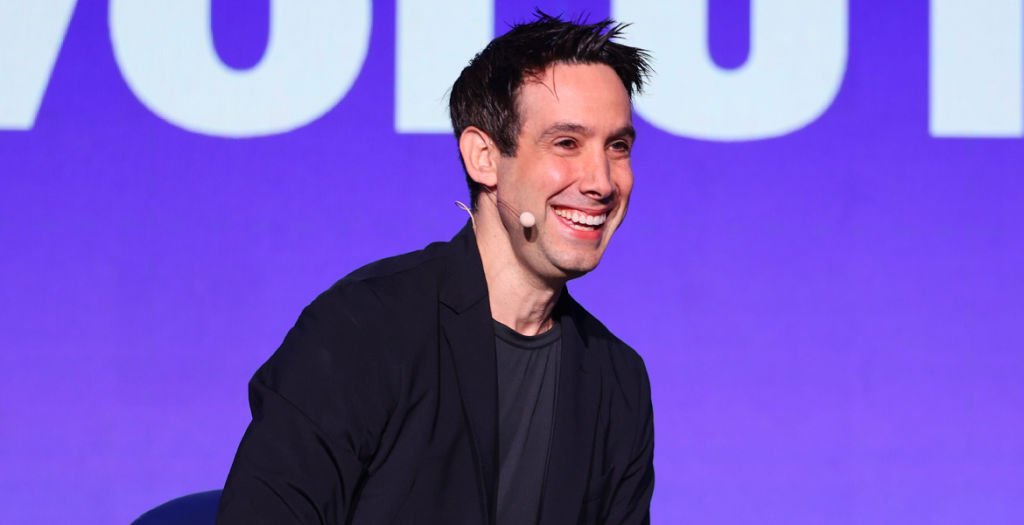
Omri Morgenshtern (CEO, Agoda): We will need more engineers, not less [to maximise the potential of the developing tech].
I asked BTO’s Bhatnagar, “In a country of extremes, where human labour is plentiful, how do you balance human employment with deployment of tech like AI that could replace some jobs?”
He said, “Travel has a huge role to play, it is one of the largest employers globally. Yes, I understand there are opportunities to automate parts of the business – post-booking service, quotations, and that’s from an intermediary perspective – but it’d be very sad to walk into a hotel and a robot greets you especially in our part of the world with our cultural differences.
“You know instantly when you walk into a hotel and someone greets you, whether you are in Thailand or India. And that’s a big opportunity for travel – our cultural advantage. And if you have 300m people coming into the workforce, you better have 300m jobs ready and travel is a low hanging fruit for many people into the workforce.
“Yes, AI has a big role to play, especially in Western countries with lack of people and ageing populations but in Asia, I don’t think the human experience will be replaced quickly in travel.”
In other words, Asia’s advantage in the age of AI is that “cultural knowledge cannot be codified”.
And as I sat by the pool, taking in the gentle sea breeze, listening to the waves lap at the sandy shores of Samui, eating my fresh chilled coconut and nearly choking on the spiciest tom yam kung ever while a smiling Thai staff comes to my rescue with a glass of cold water, I cannot imagine a world where these sensations and human service can be codified.
And don’t even get me started on the human touch of a masseuse.
March on, human revolution