I’ve been to many events in my life but never have I had an experience where a woman was vacuuming the stage, three minutes before the scheduled starting time, and in the middle of my delayed-by-an-hour panel, we were interrupted by a helicopter taking off on the lawn outside the venue.
That it happened when I was asking the most pertinent question of my panel of seven experts in travel tech investments – “if you were to meet an alien, what would you tell it about the human story?” – was a bonus.
As Ross Veitch, CEO and co-founder of Wego, answered (or rather shouted), “Mostly harmless”, quoting from “Hitchhiker’s Guide To The Galaxy”, the room, speakers and audience alike, erupted in laughter at the rather unusual occurrence of a chopper-take-off-moment in the middle of a conference – or perhaps it was Veitch’s answer. Hard to tell but in that one moment, we were united in a common bond of humanity – laughter.
And that is what attending the Global Investment Forum, as part of the UNWTO 25th General Assembly in Samarkand, reminded me – that when travelling, we should cast aside our pre-set notions of what is normal and expected in our home country and to embrace all that is different, celebrate what unites us and marvel at the bridges that brought us together.
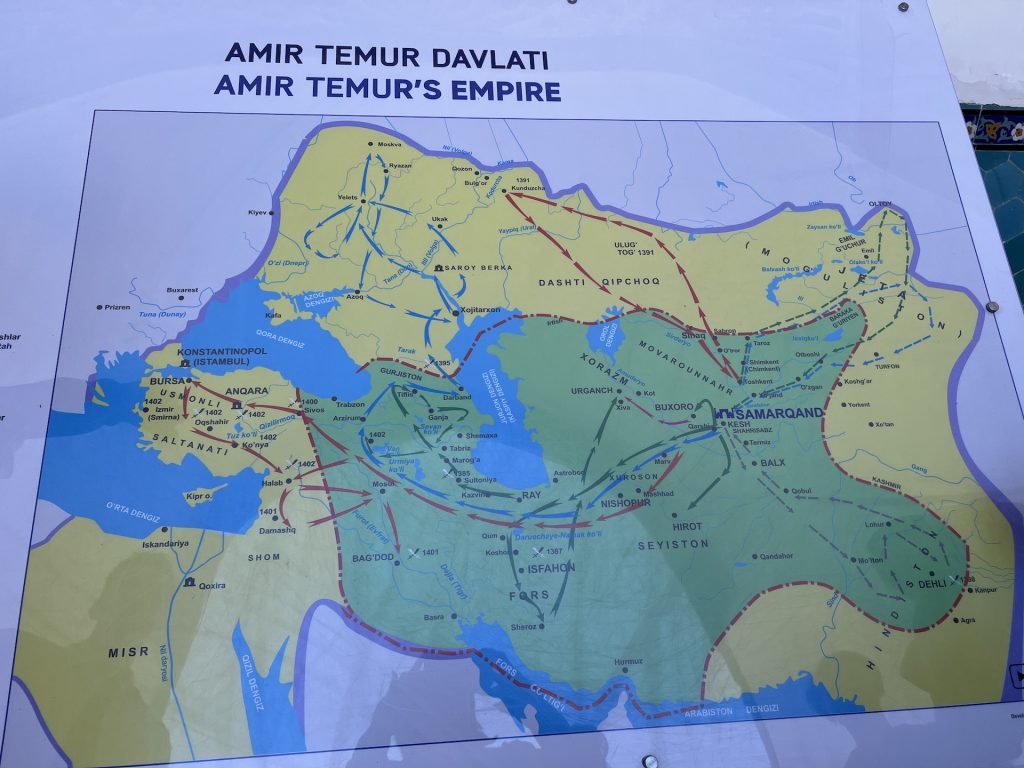
And if there is one place that most encapsulates the bridging of cultures, it is this ancient Silk Route capital of Uzbekistan, whose glory days were during the 14th and 15th centuries when a fighter and ruler, Amir Temur (also known as Tamerlane, who founded the Timurid Empire), united an empire that comprised all of Central Asia, up to and including Russia and Mongolia, and brought East and West together in a cradle of culture, knowledge, arts and sciences.
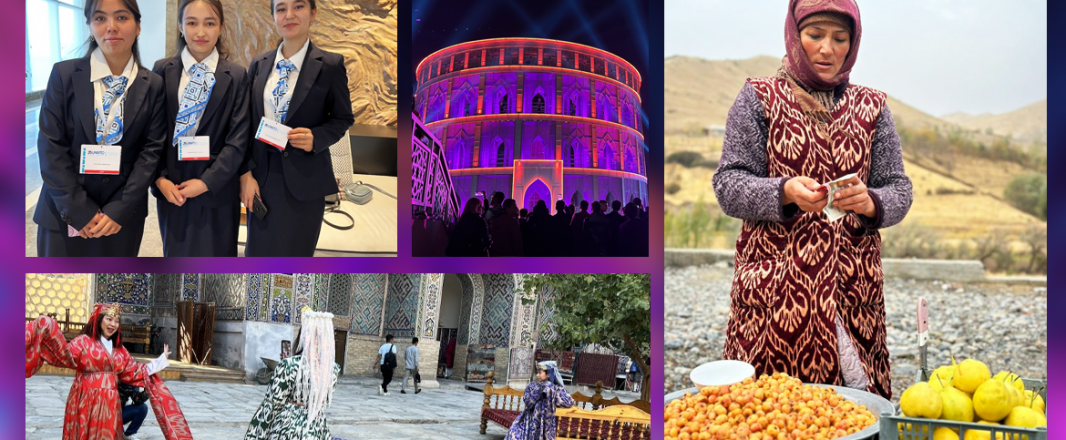
During the four-day UNWTO event, which attracted up to 2,000 delegates, the ambitions of Uzbekistan to bring back those glory days were on full display, including a spectacular light-and-sound-and-music show and a full array of performances, in which probably every artiste of Samarkand was called upon, driving home the message of how modern-day Uzbekistan is embracing the future while celebrating its past.
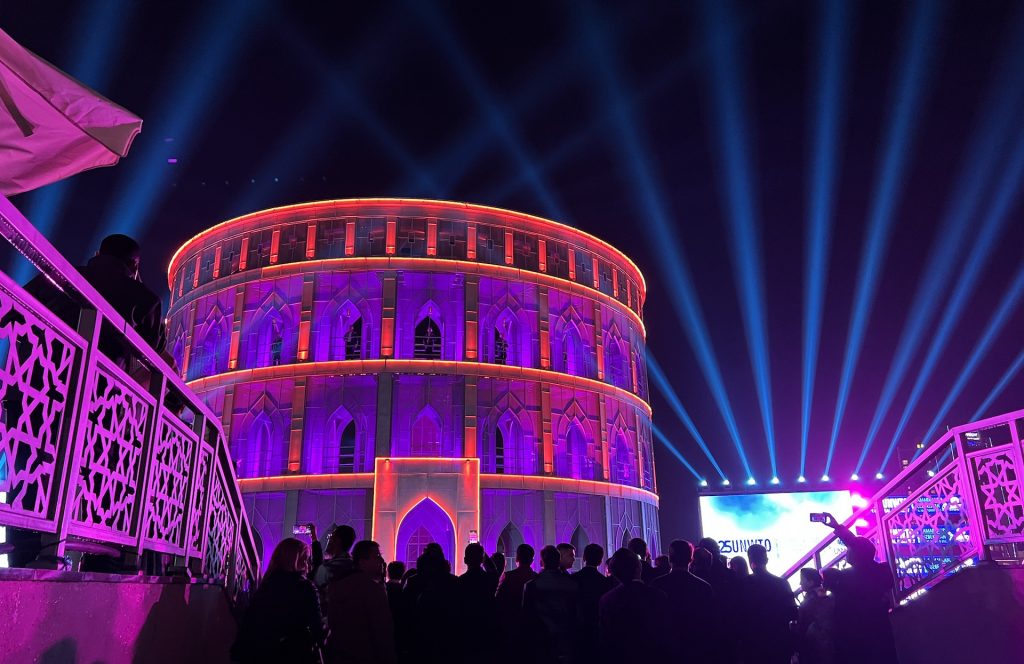
The sound and light show to welcome guests of the UNWTO General Assembly.
A plan to “create an ecosystem for sustainable and prosperous development” with “systematic reforms to liberalise the economy and create favourable conditions for investments” was declared by Uzbekistani ministers. Specifically, a $3b tourism development plan to further fortify the infrastructure was shared, and invitations issued to investors gathered in the room.
Last year, 5.2 million visitors came to Uzbekistan (population 35m). In the first three quarters of this year, 7m has already been recorded and it is expecting 10m in 2024, if the rate of growth remains at 30-40% a year. Visa requirements have been relaxed for 100 countries. The number of hotels has doubled from 600 to 1,200 and international chains like Hilton, Radisson and Wyndham have entered.
The hotel I was staying – Lia by Minyoun – is part of a new integrated development, opened just a year ago, which includes a massive conference and exhibition centre, several hotels and an entertainment-retail area called The Eternal City, which attempts to recreate the atmosphere and souks of ancient Uzbekistan, in a theme-park-like way.
For me, though, there is nothing like getting out into the city and countryside to see and feel the real thing.
Firstly, Samarkand is more modern and developed than I had expected. I had images of ancient Silk Route markets and towns in my head. What I saw were impressive four-lane highways, more Chevrolets than I had ever seen in any one place in my life and new, modern buildings – mostly low-rise and neatly lined up in rows, with none of the chaos one often sees in cities in South-east Asia.
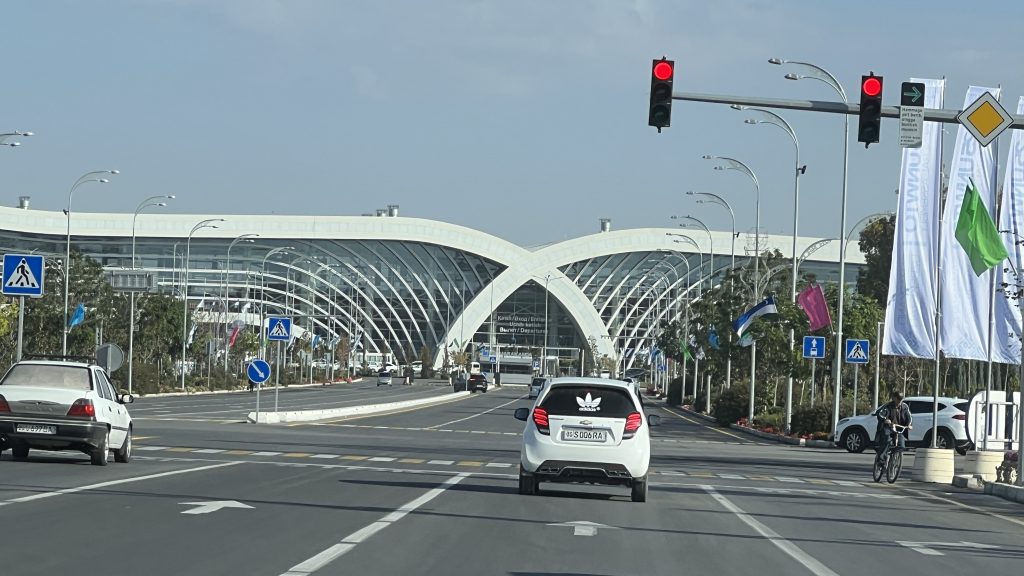
The road to Samarkand airport, which is designed to look like an open book. It is inspired by New Guragan astronomical tables, a comprehensive book on astronomy by the poet, astronomer, and mathematician Mirzo Ulugbek, who lived between 1394 and 1449.
The mosques, madrasahs and mausoleums are magnificent and impressive, and among the finest in the region. On my day tour of Samarkand, our guide took us to the Amir Temur Mausoleum Gur-i Amir Complex, built in the 14th century, and is said to have inspired the Taj Mahal in Agra. We also took in Registan Square, which is framed by three madrasahs. A bazaar used to be housed within the square, but has since been moved outside. An old photo shows you what it used to be like when Silk Route traders gathered in the middle of Registan (meaning ‘desert’ in Persian), trading and exchanging stories of their travels.
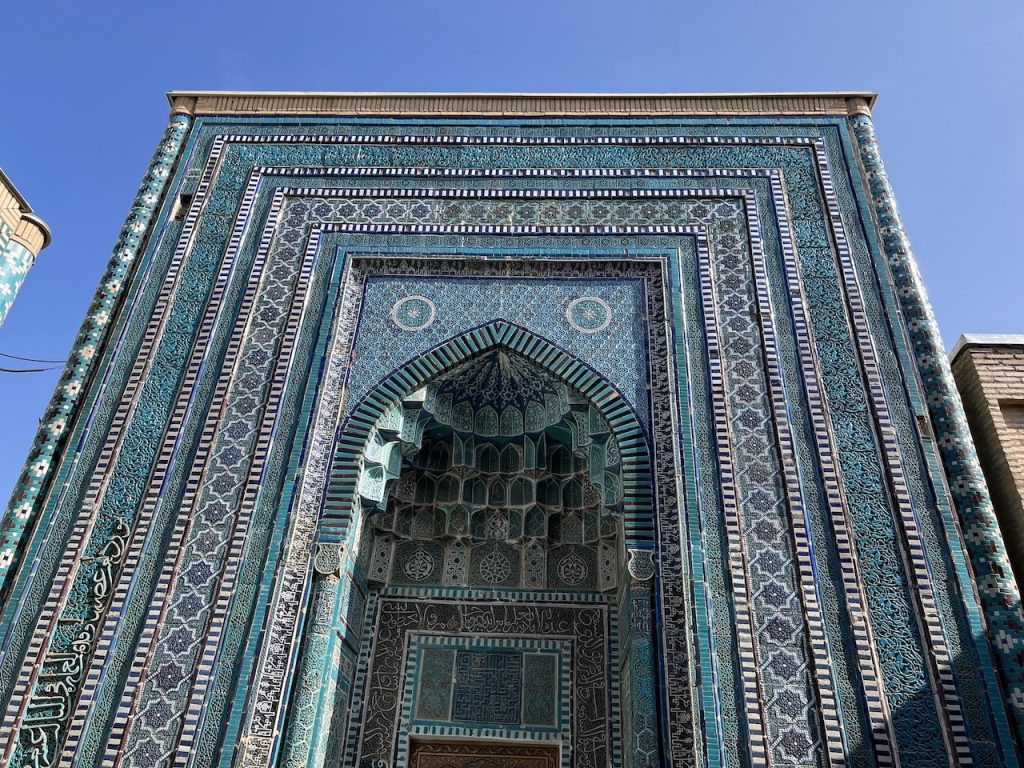
The Amir Temur Mausoleum
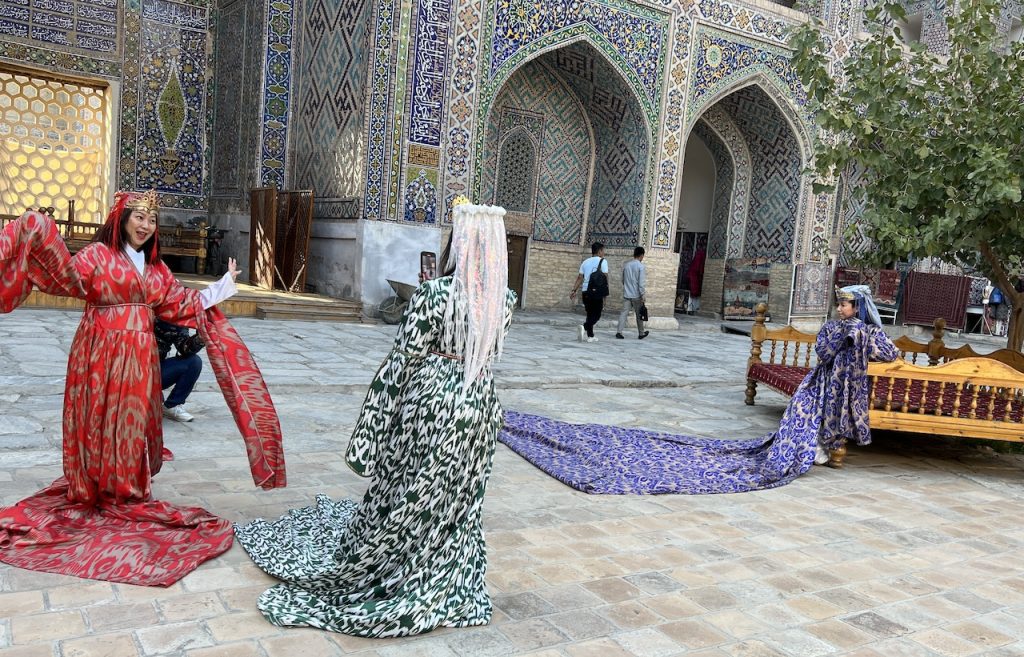
Dressing up tourism is becoming a big thing in Samarkand as it is in Korea and Japan – silks and fabrics of Uzbekistan are among the most sought-after items by tourists.
On the following day, I made a day trip to Shabkhrisabz, the birthplace of Amir Temur. As soon as you leave the valley of Samarkand, the road winds up into the mountains. Mists shroud the hills and mountains on this cloudy, rainy day. Autumn colours lend a golden hue to the landscape.
As the road weaves through through small towns and local villages, you see smartly-dressed school kids hitching rides on their way to school – seems almost everyone knows everyone in these villages and often, an uncle, cousin or neighbour would stop and pick them up. Goats, cows, donkeys and horses graze the hills and mountainsides. We stop to buy local fruits from local women – in season are pears and apples.
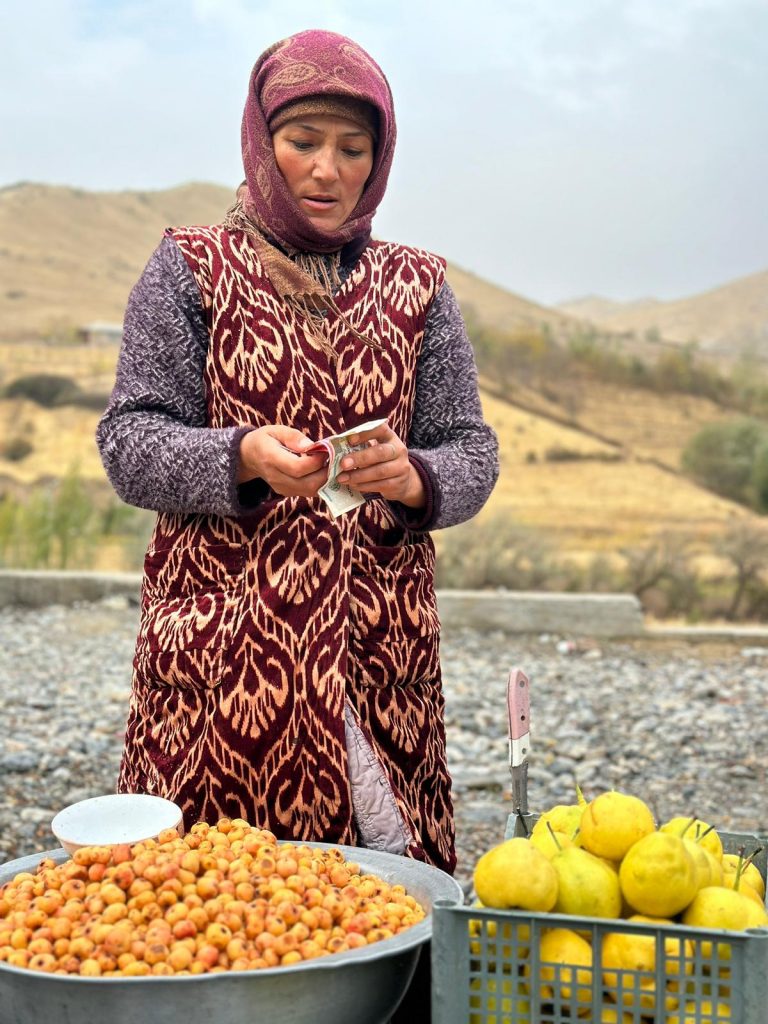
A fruit stop: The apples are sweet and crunchy, and pears juicy at this time of year.
One of the more intriguing stops include a site with a “love rock”, which interestingly was the location for a Russian movie, made in 1973, about American Native Indians called “Apichilar”. The movie billboard takes pride of place, and a local dressed as a Native American offers to take photos with tourists.
Shabkhrisabz is a mini-version of Samarkand with its modern roads and Chevrolets, and the highlight is the Ak Sarai – the white summer palace – which Amir Temur ordered to be built for him, as well as his own tomb. Here, he planted a tree which is still standing – which means it’s roughly 700 years old. The stories it could tell …
Despite the millions of tourists who visit Uzbekistan each year, it is clear this area is still new to tourism. At one viewing stop, a group of local women asked if they could take photos with us and asked if I was from Korea. It’s the Asian country (second only to China) they are most familiar with, probably through K-drama and K-pop but also because there is a big Korean community in Samarkand – which is why I’d recommend, if you want a change from Uzbekistani cuisine, to go to a Korean restaurant.
On the way back to Samarkand, we stop at a local restaurant clearly favoured by truckers and local villagers. Here, the speciality is lamb roasted in a tandir. You pick the cuts you want at a window and chunks of meat and sausages are served with salads and milk bread. Uzbekistanis love their meats (gh’ost). I recommend the salads, particularly the tomatoes, the best I’ve tasted in a long, long time – comes close to the tomatoes in Tuscany.
Uzbekistanis are also very friendly and hospitable. “You go into a village and they won’t let you leave until you’ve drank tea and eaten bread with them,” said Roma, our tour guide.
Roma speaks several languages including Russian and Farsi, and has travelled extensively – Moscow, Egypt, Dubai – ever since Uzbekistan opened its doors. Low cost airlines like Wizz Air and others have made it possible for youths like him to travel. Born in 1997, Roma tells me he gets his inspiration from Instagram and buys from the social site. He can text, talk, swipe, watch videos, as well as tell us stories while driving.
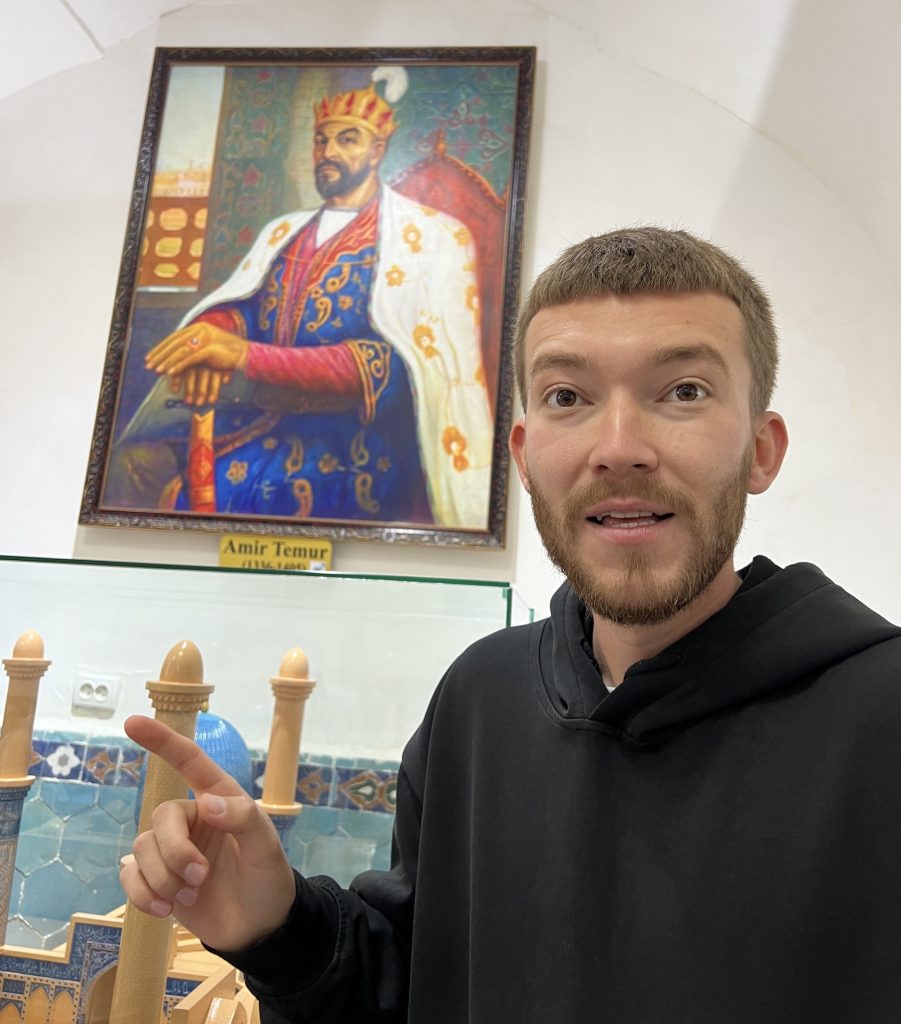
Roma regaling us with stories of Amir Temur. “With education, a man can cross a thousand oceans.”
He’s also talented at telling stories of Amir Temur. “Amir Temur believed that with education, a man can cross a thousand oceans,” he would declare in the middle of a discourse about the many stories of this mighty ruler. (I have to confess, I paraphrased that for simplicity).
He also told me of an Uzbek tradition that when a son is born, the father would plant 20 trees and when the son marries, he would use the wood from the trees to build a house for his bride. The kind of story we travellers love …
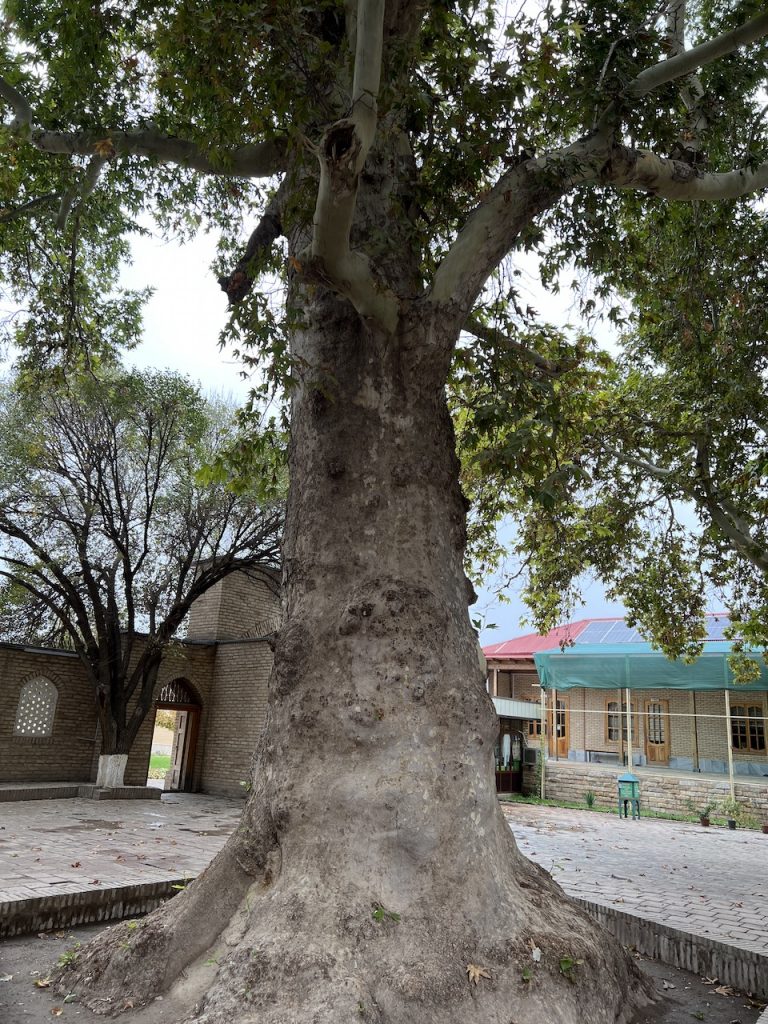
The tree, said to be planted by Amir Temur in his palace in Shabkhrisabz.
On the way to Samarkand airport to catch my Wizz Air flight to Abu Dhabi, my driver showed me a photo of his one-month-old son, Abdullah. I asked if he had planted 20 trees. I explained the story I had heard. “Good story,” he laughed. “We love our stories.”
He tells me how his life has improved in the last decade – he now earns US$600 a month – and he’s travelled to France and Germany for holidays. Previously, the average wage was US$100, now it’s US$400, I was told.
At the conference, I met many tourism and hospitality students, all dreaming of a bright future in the industry. “As long as we are professional, we will get a job,” one told me.
As far as human talent is concerned, and their attitude towards work and visitors, Uzbekistan is in good shape. Its hardware is modern and impressive, even creative – Samarkand airport is designed to look like an open book, inspired by New Guragan astronomical tables, a comprehensive book on astronomy by the poet, astronomer, and mathematician Mirzo Ulugbek, who lived between 1394 and 1449.
What it could do better at is solving payments – you can’t go cashless in Samarkand, it’s hard to pay even with credit cards in some places – and it’s hard to get around by taxis. There are a couple of ride hailing apps – Yandex Go – is one, but it rarely worked for me. Plus, data connectivity is a challenge. I could not get my Airalo eSIM card to work, despite several attempts.
So back to the panel on ‘Tourism’s Next Big Thing: The role of Venture Capital in Tourism Innovation” I was running in which we were interrupted by a helicopter – Uzbekistan could well be the new frontier for travel tech startups to one, capture a growing outbound and inbound market and two, to solve the pain points for travellers on the ground.
But there’s one thing technology will not be able to replace – the hospitality and generosity of the people. As I said goodbye to my driver, he gestures for me to wait, and from the boot, pulls out an apple and pear to “take home a taste of Samarkand”.
I hope they make it all the way home to Singapore so I can plant their seeds in my little garden so that they grow as strong as the tree planted by Amir Temur in Shabkhrisabz.
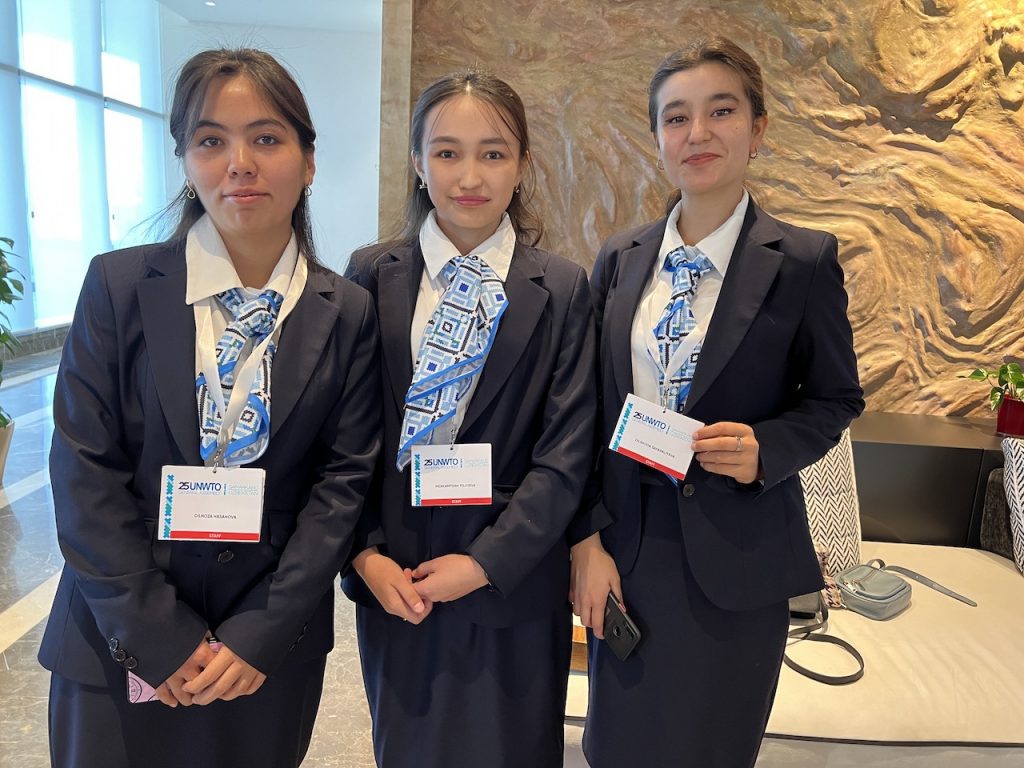
Uzbekistani students dreaming of a bright future in tourism for their country.