
The International Air Transport Association (IATA) has reported an increase in passenger demand for October 2023, indicating a continued recovery in the aviation sector.
According to the latest data, total traffic for October, measured in revenue passenger kilometers (RPKs), witnessed a rise of 31.2% compared to the same period in 2022. Globally, air travel has now reached 98.2% of pre-COVID levels, marking a positive trend in the industry’s rebound.
Domestic air travel saw an even more impressive surge, with a 33.7% increase in October compared to the previous year, surpassing the results from October 2019 by 4.8%. Notably, China played a pivotal role in driving this growth, recording triple-digit percentage expansion.
International traffic also experienced a substantial uptick, climbing by 29.7% compared to October 2022. All global markets witnessed double-digit percentage gains year on year, with international RPKs reaching 94.4% of October 2019 levels.
Willie Walsh, IATA’s Director General, commented on the results, stating, “October’s strong result brings the industry ever closer to completing the post-pandemic traffic recovery. Domestic markets remain above pre-COVID levels. International demand is recovering, but more slowly.”
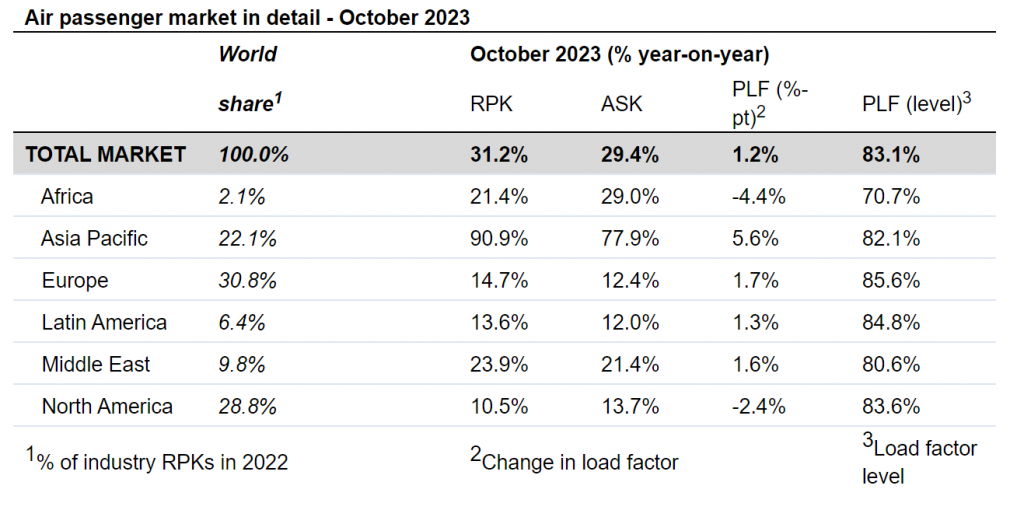
International passenger markets and regional highlights
Asia-Pacific:
- Traffic in the Asia-Pacific region surged by an impressive 80.3% in October 2023 compared to the same month in 2022.
- Capacity increased by 72.5%, and the load factor rose by 3.6 percentage points to 82.9%.
Europe:
- European carriers reported a 16.1% increase in October 2023 traffic compared to the previous year.
- Capacity rose by 14.5%, and the load factor edged up by 1.2 percentage points to 85.1%.
Middle East:
- Middle Eastern airlines witnessed a 24.1% rise in traffic in October 2023 compared to a year ago.
- Capacity increased by 22.2%, and the load factor climbed by 1.2 percentage points to 80.6%.
North America:
- North American carriers experienced a 17.5% rise in traffic in October 2023 compared to the same period in 2022.
- Capacity also increased by 17.5%, and the load factor remained stable at 83.9%.
Latin America:
- Latin American airlines saw a 21.2% increase in traffic compared to October 2022.
- Capacity climbed faster, up by 22.3%, resulting in a 0.8 percentage points decline in the load factor to 85.3%, the highest among the regions.
Africa:
- African airlines recorded a 25.3% traffic increase in October 2023 versus the previous year.
- October capacity was up by 32.4%, causing the load factor to decline by 4.0 percentage points to 70.3%, the lowest among the regions.
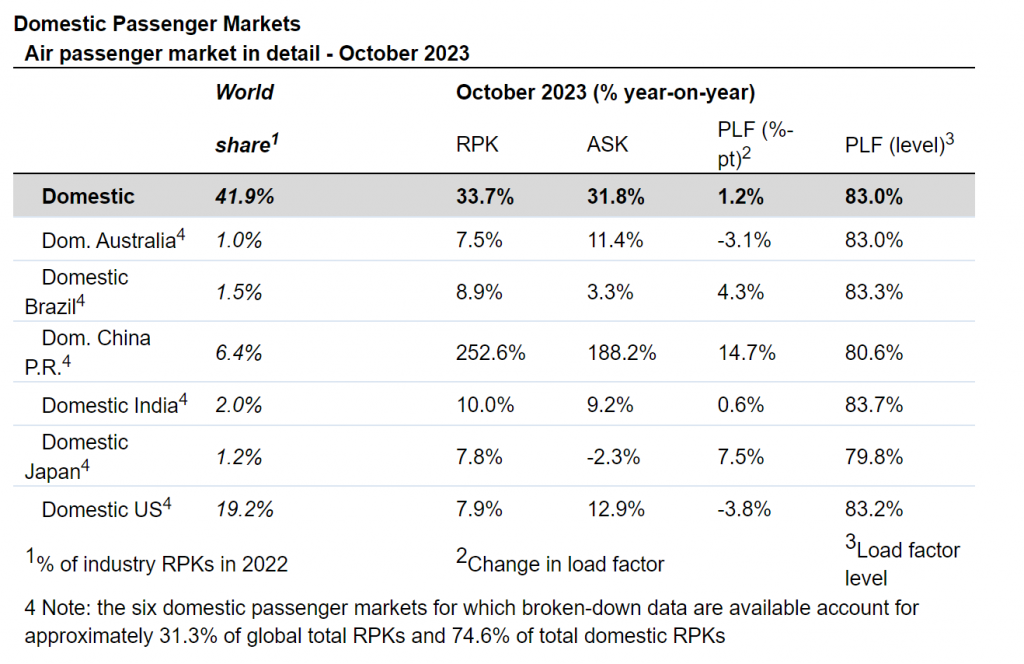
Domestic and specific market insights:
- Brazil’s domestic RPKs rose by 8.9% compared to a year ago and were 1.1% above the 2019 result.
- US domestic demand climbed by 7.9% in October, but a 12.9% rise in capacity pushed domestic load factor down for a third straight month, to 83.2%.

The bottom line: A call for sustainable practices
Willie Walsh emphasized the significance of sustainable practices in the aviation industry, stating, “People assign a high value to the freedom to travel. The strong demand we’ve seen all year confirms that. And aviation is committed to ensuring that people can continue to enjoy this freedom.”
To achieve long-term sustainability, Walsh called for immediate government support to stimulate Sustainable Aviation Fuel (SAF) production. The recent Third Conference on Aviation Alternative Fuels (CAAF/3) agreed on a global framework with the aim of making aviation fuel in 2030 5% less carbon intensive than current fossil fuel use.
IATA represents approximately 320 airlines, comprising 83% of global air traffic. For more industry information and updates, you can follow IATA on Twitter.