
The International Air Transport Association (IATA) recently released data indicating a continued rebound in global air travel throughout 2023, inching closer to pre-pandemic levels. Let’s delve into the numbers and trends shaping this recovery.
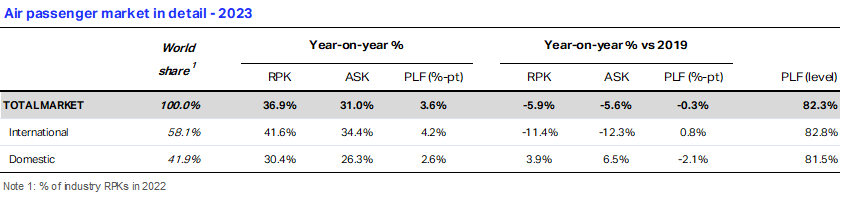
In 2023, total air traffic, measured in revenue passenger kilometers (RPKs), surged by 36.9% compared to the previous year. The year-end figures showed that global air travel had reached 94.1% of its pre-pandemic levels in 2019. December 2023 alone witnessed a 25.3% increase in total traffic compared to December 2022, hitting 97.5% of the December 2019 levels.
International air travel demonstrated a significant recovery in 2023, with a 41.6% increase over 2022, reaching 88.6% of the 2019 levels. Meanwhile, domestic air traffic also saw a notable uptick, rising by 30.4% compared to the previous year. By the end of 2023, domestic air travel surpassed pre-pandemic levels, standing at 3.9% above the 2019 figures.
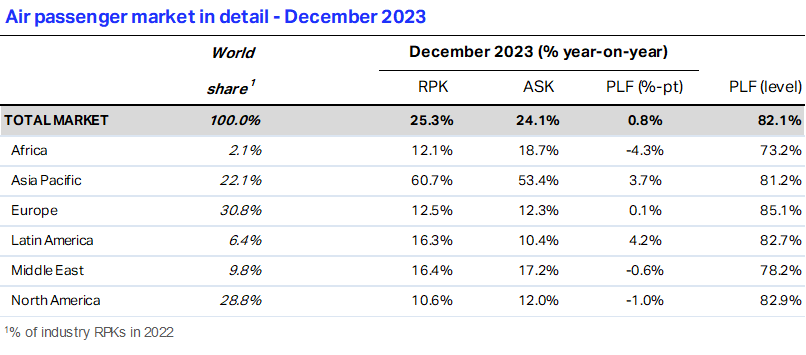
While the fourth quarter of 2023 showed a robust recovery, with traffic at 98.2% of 2019 levels, some regions faced different challenges. Asia-Pacific airlines experienced the highest year-over-year growth at 126.1%, with December 2023 traffic soaring by 56.9% compared to the same period in 2022. European carriers saw a 22.0% increase in full-year traffic, marking a significant milestone as December traffic surpassed pre-pandemic levels for the first time. However, African airlines lagged behind, with a 38.7% increase in annual traffic but maintaining the lowest load factor among regions.
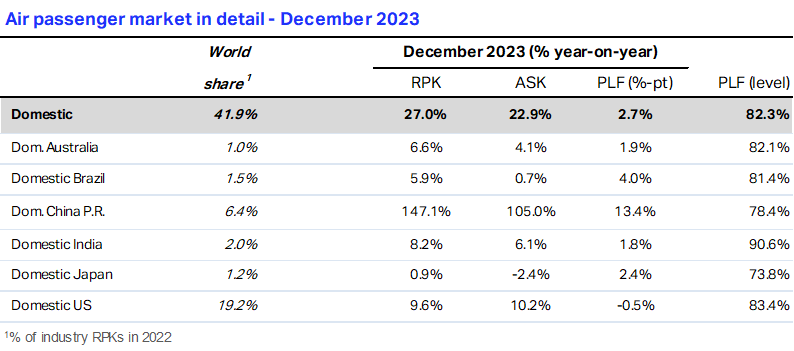
China emerged as a standout in domestic air travel, with a remarkable 138.8% increase in 2023 compared to 2022, surpassing pre-pandemic levels by 7.1%. Yet, challenges persist in markets like Australia and Japan, which are still struggling to recover to their 2019 traffic levels.
Despite the positive trajectory, Willie Walsh, IATA’s Director General, emphasised the need for a strategic approach to sustain this recovery. He stressed the importance of governments investing in cost-efficient infrastructure, incentivising Sustainable Aviation Fuel (SAF) production to achieve the net-zero carbon emission goal by 2050, and implementing regulations that deliver clear cost-benefit analyses.
Said Walsh, “The strong post-pandemic rebound continued in 2023. December traffic stood just 2.5% below 2019 levels, with a strong performance in quarter 4, teeing-up airlines for a return to normal growth patterns in 2024. The recovery in travel is good news. The restoration of connectivity is powering the global economy as people travel to do business, further their educations, take hard-earned vacations and much more. But to maximize the benefits of air travel in the post-pandemic world, governments need to take a strategic approach. That means providing cost-efficient infrastructure to meet demand, incentivizing Sustainable Aviation Fuel (SAF) production to meet our net zero carbon emission goal by 2050, and adopting regulations that deliver a clear cost-benefit. Completing the recovery must not be an excuse for governments to forget the critical role of aviation to increasing the prosperity and well-being of people and businesses the world over.”
As the aviation industry strives to rebuild and reconnect the world, Walsh underscored the necessity of prioritising environmental sustainability. While the utilisation of SAF increased in 2023, it still constitutes only 3% of all global renewable fuels production, highlighting the urgent need for collective efforts to accelerate the transition.