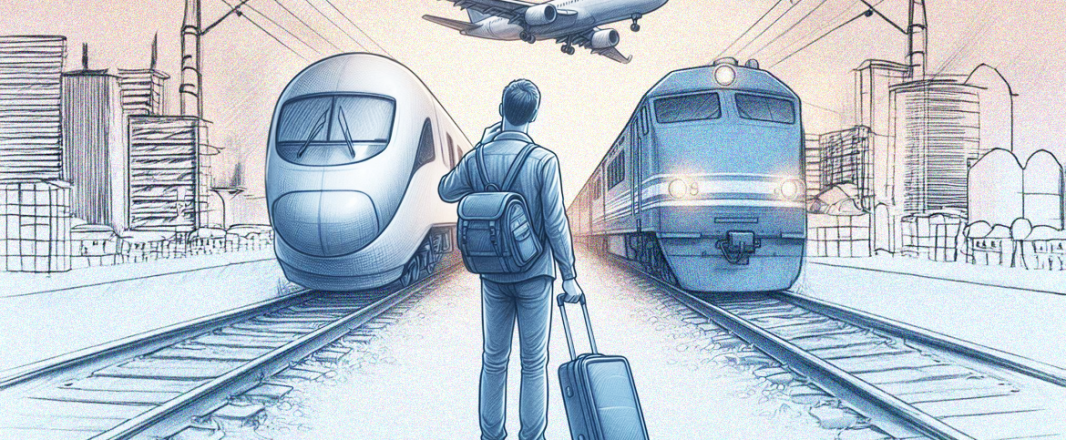
In recent years, there’s been an increasingly popular belief that rail could replace air travel, particularly for short journeys under 500 kilometers (or roughly 300 miles). With growing concerns over environmental sustainability and the push for greener alternatives, rail appears to be the perfect solution at first glance.
However, this seemingly simple switch from air to rail is far more complex and fraught with challenges than many advocates realise. In this article, I’ll explore the often-overlooked hurdles that could make this transition not just difficult, but potentially impossible without significant and costly interventions. Yet the politicians are trying to push an agenda that might get more votes but does not advance civilization nor help the overall economy. Culturally restricting travel will have profound impact on society.
Capacity crisis: Can rail handle the load?
The first major issue lies in the current capacity of our long-distance rail networks, particularly in Europe, where this shift is most often discussed. Long-distance rail services are already operating near their maximum capacity. The idea of adding more passengers to an already strained system raises serious questions about whether our existing infrastructure can cope.
Without substantial investment in expanding rail networks, increasing the number of trains, and improving scheduling efficiency, rail simply cannot absorb the massive influx of passengers that would result from a significant reduction in short-haul air travel. The bottlenecks in high-demand corridors would only worsen, leading to overcrowding, delays, and a deterioration in service quality.
The Price problem: Getting it right
Pricing is a critical issue. While rail is often lauded as a more cost-effective mode of transport, this doesn’t always hold true, especially when you factor in the need for new investments to accommodate increased demand. Infrastructure upgrades, new rolling stock, and the expansion of stations and railbeds all come with hefty price tags.
Who will bear these costs? If they are passed on to consumers, rail travel could become prohibitively expensive, particularly for the average traveler. Conversely, if governments subsidize these expenses, taxpayers might bear the brunt, leading to a whole new set of economic challenges. What happens to competitive pricing when a large element of competition is removed.
Currently there are many cases where rail is significantly more expensive than corresponding air travel. Why? This has to be considered.
In a scenario where pricing isn’t carefully managed, we could end up with a situation where rail isn’t a viable option for the majority, failing to offer the affordability that’s one of its main selling points.
Crowded chaos: The real impact on stations
Now, let’s consider the human element. Our railway stations are already bustling hubs of activity, often operating at or near full capacity. Introducing a wave of new passengers—potentially millions more—into these spaces could push them to a breaking point.
The implications of this overcrowding go beyond just discomfort. It could lead to increased security risks, longer wait times, and a degraded passenger experience overall. In some cases, stations may require complete redesigns or expansions to handle the increased footfall, further adding to the cost and complexity of this transition.
Infrastructure overload: The hidden costs
While we’re on the topic of infrastructure, it’s important to note the monumental costs associated with expanding and upgrading our rail systems. We’re not just talking about laying down new tracks or buying new trains. We also need to consider the construction of new stations, the reinforcement of existing railbeds, and even the acquisition of new land to accommodate these expansions.
The financial implications are staggering. These projects are not only expensive but also time-consuming, often taking years, if not decades, to complete. In the interim, passengers might have to endure suboptimal conditions, further disincentivizing the shift from air to rail.
The economic viability of rail as a replacement for air travel is questionable, especially for countries with low population densities or vast geographical areas. The high cost of developing and maintaining rail infrastructure may not be justified by the potential usage in less densely populated areas.
Many rail systems do not operate at a profit. Correspondingly airlines as a whole operate now at a profit and thus not a drain on national resources.
Can rail match aviation standards?
Another critical factor often overlooked is the strict regulations governing air travel, such as EU Regulation 261, which sets out the rights of passengers in case of delays, cancellations, and other disruptions. Air travel has a well-established framework for compensating passengers and ensuring a minimum standard of service. Can rail providers match this level of reliability and accountability? The answer is unclear. Rail systems are prone to their own sets of issues, from weather disruptions to technical failures, and it’s not certain that they can consistently meet the stringent standards set for air travel. Any failure to do so could lead to a backlash from consumers, further complicating the transition.
The current union structure and the ability of unions to shut down the entire network far outweighs the same structures in airlines. The frequency of strikes is further a challenge to overcome for governments.
Connection chaos: The short to long-haul dilemma
There’s the issue of connections between short-haul and long-haul journeys. Air travel has perfected the art of seamless connections, with airports designed to handle the complex logistics of transferring passengers and luggage between flights. Rail, on the other hand, is far less integrated, especially across national borders.
For rail to truly replace air for short journeys, there needs to be a significant improvement in the way rail networks connect with one another, as well as with other forms of transport like buses, trams, and even airports for those continuing their journeys by air. Without these connections, the convenience factor that makes air travel so attractive would be lost, further discouraging travelers from making the switch.
Geographical and topographical constraints
Rail networks are significantly influenced by geographical and topographical challenges, which can limit the expansion or efficiency of rail travel. In many regions, building new rail lines is not just costly but also practically challenging due to natural barriers like mountains, rivers, and urban density.
Speed and time efficiency
For certain distances, especially those exceeding 500-600 kilometers, air travel remains significantly faster than rail. High-speed rail, while faster than conventional trains, still cannot match the speed of commercial flights, especially when considering the entire door-to-door journey.
Environmental considerations beyond CO2 emissions
While rail is often highlighted for its lower CO2 emissions compared to air travel, other environmental impacts need to be considered. The construction of new rail lines can lead to significant ecological disruption, including habitat destruction, noise pollution, and land use changes. Further typically the argument is made in comparing journey vs journey. In Rail many trains run empty as they are re-positioned. The rail stock is typically used less than aircraft and thus less efficient. Also, rail stock is difficult and costly to recycle than aircraft.
Connectivity and intermodal activity
International rail travel faces additional complexities compared to air travel, including differing national regulations, rail gauges, and customs procedures. This can complicate travel logistics and limit the feasibility of rail as a replacement for short-haul international flights.
Mixing the two forms of rail (reserved long haul with commuter traffic) will increase complexity enormously in both logistic and physical space. Developing a new supporting infrastructure will take decades to achieve.
If short haul rail replaces short haul air, then there will now be further constraints on getting these connections to match each other. Consider the challenges today of when short haul air is removed – the congestion in and around airports expands significantly.
The road (or rail) ahead
The idea of replacing air travel with rail for short journeys is certainly appealing on many levels. However, as we’ve explored, the reality is much more complex. The challenges of capacity, pricing, infrastructure, regulation, and connectivity present significant barriers that cannot be ignored.
While the idea of substituting air travel with rail for short-haul routes is appealing from an environmental perspective, the practical, economic, and logistical challenges are significant. The idea of replacing air travel with rail for short journeys is certainly appealing on many levels. However, as we’ve explored, the reality is much more complex. The challenges of capacity, pricing, infrastructure, regulation, and connectivity present significant barriers that cannot be ignored. Many railways have ecosystems that stretch back to the 17th Century and have not evolved.
By examining all these factors, it becomes clear that rail is not a one-size-fits-all solution, and air travel will likely remain an essential component of the global transportation network for the foreseeable future. Each of these factors can be backed by relevant data and case studies to add depth and credibility to the overall analysis.
Before we can consider rail as a viable alternative to air travel, these issues must be addressed comprehensively. This will require not only significant investment but also careful planning and coordination at both the national and international levels. Only then can we hope to see rail play a truly transformative role in our future transportation landscape.
If you are interested in exploring this further, I have evidence to support the hypothesis outlined here. I am advocating that there be joined up thinking rather than blanked arbitrary rules where the true consideration for the requirements are largely brushed under the carpet. As a personal disclaimer – I am in favor of a balanced approach with comprehensive thinking that will result in reduced total climate footprint impact.