


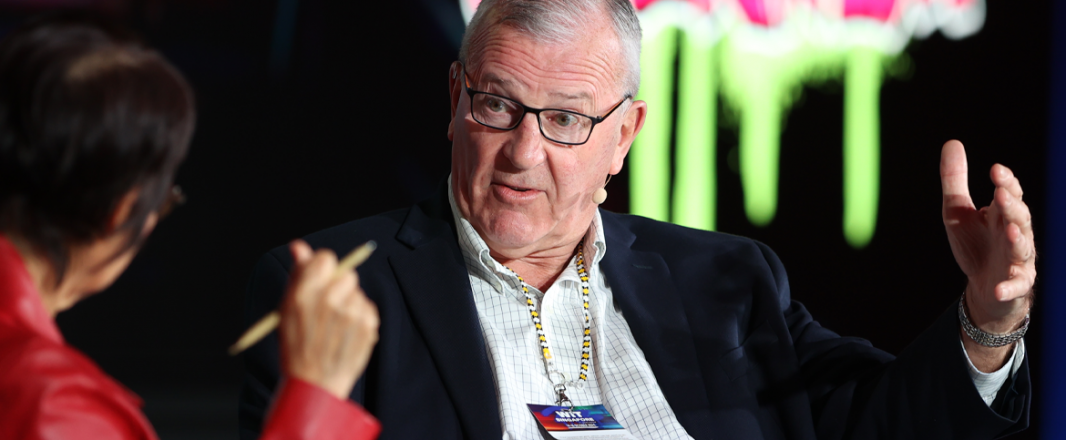
Editor’s note: As a key player in Ryanair, Michael Cawley has had a front row seat on one of aviation’s most transformative chapters. And as Luke Clark writes in covering his WiT Singapore session, Cawley’s fierce determination to spread the gospel of low-cost, remains as strong as ever.
There is a certain breathless energy when Michael Cawley sits down to speak. At first, you wonder if someone has turned the oxygen in the room down just a notch.
Cawley has the air of somebody who has sat in the hot seat before: the steel of a person who will let you know what he thinks.
Look closer at the gaze, and sense this is not a man who suffers fools. It’s the intensity of someone who has sat in some battles: and has usually emerged as he arrived – as the protagonist.
Clarity of vision from the outset
A quick look at his CV reveals why all these things are true. Cawley, a chartered accountant by trade, joined Ryanair in 1997 as chief financial officer, at a time when European aviation looked very different than today. During that period, he oversaw the company’s successful IPO process, becoming its chief operating officer in 2002.
Which means that Cawley was in the cockpit for what became a revolution for travel. As aviation strategists Emery Alva observe, from the 1990s, “Ryanair truly began to revolutionise the industry by embracing the ultra-low-cost carrier (ULCC) model, a concept that would forever change the way people think about air travel.”
All of this was achieved through a clear focus on simplicity and efficiency: “By stripping down the traditional airline service model to its bare essentials, Ryanair has made air travel accessible to millions of people who might not otherwise have been able to afford it,” the consultants write. “The key takeaway is the importance of efficiency, cost management, and a clear focus on delivering value to customers.”
Of course, that doesn’t mean the airline didn’t rattle more than a few cages. Renowned writer Fintan O’Toole, wrote in late 2016 in the Irish Times of Cawley’s boss: “Could there be an Irish Donald Trump? Yes – bigly. And his name would be Michael O’Leary.”
Quick to the witty joke, the writer explained: “O’Leary is an instinctive marketing genius who understood a long time ago that you didn’t need ad agencies and expensive TV slots… O’Leary long ago did to Aer Lingus and British Airways what Trump has just done to Hillary Clinton.”
More travellers means more understanding
WiT founder Yeoh Siew Hoon wisely begins the coffee chat with some warmup questions. Where does Cawley these days like to travel, and why does he go? “It’s all about experience, and it’s all about authenticity,” he notes. “In Europe in particular, we holiday a lot in Italy, which is one of my favourite countries.”
Asked what he thinks of Asia, it is clear that Cawley would like to see us mix and mingle even more. “What low-cost travel in particular has done for us in Europe, I see the beginnings of it here in Asia,” he notes. “And that’s the interaction of people who never met before – the frequency with which they now meet. And that’s fantastic. We understand one another,” he smiles. “People don’t have two heads.”
Cultural exposure, he posits, can provide an antidote to some of the friction points that the world is experiencing now. “I think that’s one of the problems with the United States, where 14% of people have passports. They don’t get out often enough, to see that other people have the same ambitions, the same values, and are interested in the same things in life.
“That’s one of the great things that has given me pleasure – and that we’ve done Ryanair, is facilitate the growth of that in Europe, and I love that we’re part of it.”
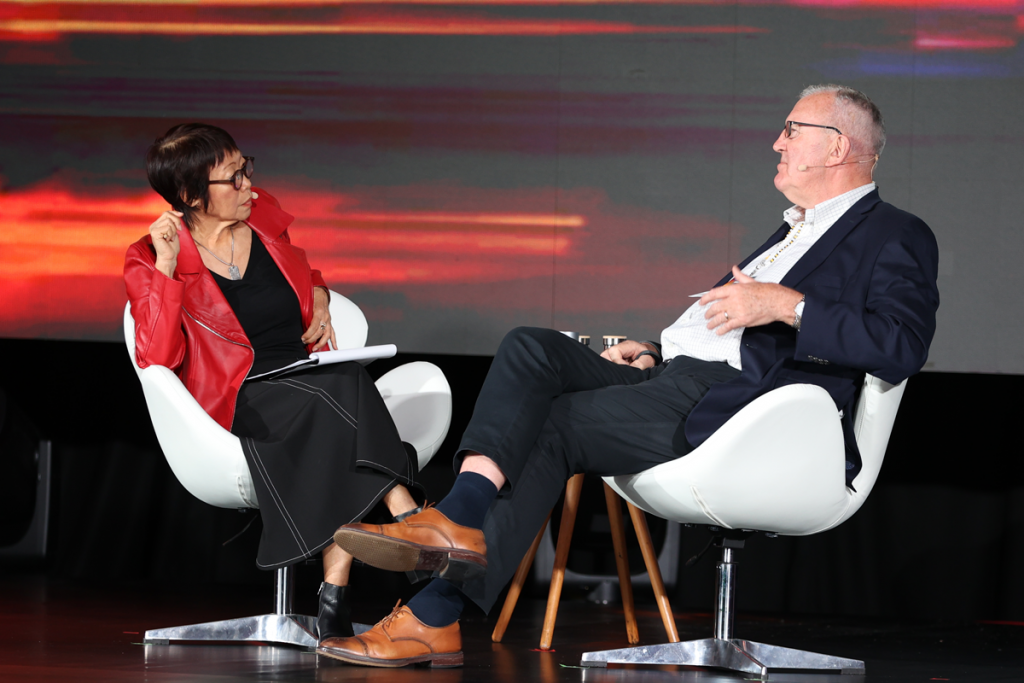
Michael Cawley at WiT Singapore 2024: “I joined Ryanair in 1997, and in 2000 people were saying ‘You’ve reached saturation point.’ We had about 1,200 passengers. This year, we’ll do 200 million passengers. And I believe we’re still only scratching the surface of the possibilities in Europe.”
Making peace with the OTA world
Having warmed up the room and spread peace and love, Yeoh decides to wear her reporter’s hat. Just 20 years back, Ryanair boss Michael O’Leary sat in a conference and predicted that Expedia would soon “be gone”. Back then, Ryanair shunned the OTA market: yet now, they actively have partnerships with them. So, what’s changed?
Cawley smiles. “So, as you know, I’ve chaired an OTA (Hostelworld) for the last nine years,” he notes. The difficulty that Ryanair had with OTAs? “Number one, they were not adding the value commensurate with the cost that they were offering our customers. They were putting a barrier between us and our customers,” he notes. “When we had schedule changes or cancelled flights – which don’t happen very often, but they do happen – we were unable to communicate directly with our customers,” he explains.
This was a problem during the pandemic, when Ryanair repaid two million euros in refunds to customers. “In the case of OTA customers, we had no guarantee that this money eventually got to the ultimate customer: because we repaid the OTAs.
“But we have signed agreements with the vast majority of OTAs that we had difficulties with earlier on – and now we have a working relationship, which means we can communicate directly with the customers. We have no objection to them charging a fee: if the customer perceives an added value that they’re prepared to pay a fee for, that’s fine with us.”
One of the OTAs that Ryanair will not be partnering with anytime soon, is eDreams. “They will not sign a contract with us,” says Cawley. “They are trying to screen scrape us and advertise in lower fares,” he notes, saying that the OTA currently advertises a lower fare than Ryanair, but then they add on a handling charge, which makes the total cost to higher, and is their profit. “Now that’s deception, and we won’t tolerate that and we’re fighting them in every jurisdiction in Europe,” he notes.
Backlash against mass tourism
How does an airline so proud of its record for being both Italy and Spain’s largest domestic airline deal with the pushback in many destinations now, against so-called mass tourism? Does Cawley fear that low-cost carriers may no longer be good for tourism and the planet?
“I joined Ryanair in 1997, and in 2000 people were saying ‘You’ve reached saturation point.’ We had about 1,200 passengers. This year, we’ll do 200 million passengers. And I believe we’re still only scratching the surface of the possibilities in Europe.
“We don’t fly to Turkey, for example, which, from a population point of view, is the biggest country in Europe: and we are only skimming the surface of Germany and France, some of the major big population centres. So from our perspective, the potential is there to grow to 300 million passengers, as we’ve bought the aircraft to do,” he notes.
“I think the issue of ‘over-tourism’ is exaggerated. There are some individual cities like Amsterdam and Barcelona, which have run into problems with Airbnb, for example,” he notes. “There’s a convergence of how local people see the diversion of local property, accommodation and supply into tourism, at the expense of local residents. That’s a real difficulty which individual cities have to address.
“We don’t encounter that problem anywhere in Italy,” he notes. “It’s not in Madrid, for example, and it’s not in any other city in Spain to my knowledge,” he asserts. “It’s got far more publicity than is warranted.”
Being part of the cleanup
“I am a big advocate of changing in relation to the climate and the threat of climate change,” says Cawley. “And Ryanair is the forefront of that: we’ve one of the newest fleets in the world.”
He believes firmly in fuel-efficiency: “One, because of climate change – but also it’s the cheapest way of doing business. So we have large fuel efficient aircraft carrying a significant number of people with the lowest carbon footprint of any airline in the world.”
He believes aviation, which accounts for 2% of carbon emissions, has fielded a disproportionate amount of kickback. “We are making more than our share of the efforts to fix our problem: much more than shipping, agriculture, energy and various other areas. And I have no difficulty defending both Ryanair’s and the industry’s position with regard to climate change.”
Airline winners in Asia will champion cost-reduction
Moving back to Asia, Yeoh asked Cawley, with a number of players eyeing growth in low-cost in the region, what must they absolutely focus on?
“It’s just a religious, a religious zeal about cost reduction,” he emphasises. Ryanair champions the reduction of cost in all areas, he notes. “We celebrate it when we negotiate new deals: but we deliver growth in return,” he stresses.
“Airports are nothing without passengers: and they’re the ultimate fixed cost. They can’t move their bricks and mortar anywhere. So the more activity they can put through their airports, the unit costs fall,” he stresses. “That’s our deal with all suppliers and partners – we can do more volume, if you give us lower cost. And you can make more revenue.
“The potential here in Asia to grow is enormous. Everybody should be ambitious for that growth, And it can only happen if you drop the fares, and exploit that elasticity of demand, which is in the inventory.”
Building better businesses
Now at a stage in his career when he can stretch his wings beyond aviation, Cawley has had a number of board positions in areas where his skills can be well utilised. Having spent his life helping successfully disrupt one industry, he now finds himself with plenty to say in terms of helping others grow.
In October, he stepped down as chairman of Hostelworld: having initially helped it lower the Board’s age profile: “We’ve recruited some younger directors who are more in touch with the desires and wishes of customers,” he notes. “You’ve got to have insights into customers. It’s the same in every business: essentially, if you’re not minding your customer, you have nothing.”
Having spent decades connecting Europeans through flight, he and his Hostelworld team have applied the same principles to helping the rising number of solo travellers make meaningful connections on the road. “They need to be able to communicate with each other once they get there and find out who wants to help one another – who wants to go on a particular trip, or meet in in the bar. We’ve now developed a social network which is getting more sophisticated – and is used by up to 75% of the people who book on the platform.”
Next on his agenda? From a position on the Board at Ireland’s Health Service Executive (HSE), Cawley wants to help inject better business management principles to his country’s health service.
He says Ireland is the third highest spender on health in Europe, and has seen success with many patient treatments in areas like cancer and heart disease. “But in many other cases, the service that patients or customers get is not good – and it’s not acceptable for the amount of money we’re spending. So maybe we can bring cost focus and better customer service focus to that.”
While many familiar names in aviation are hailed for launching businesses, not everyone recognises those who do the work to make them endure. Having arrived prior to Ryanair’s IPO process, Cawley speaks with pride at having been involved in the tough work of helping deliver a strong and durable business to its shareholders. “Ours has been a phenomenal investment. We have multiplied our share price by over 40 times since the IPO,” he notes.
Ultimately, you sense this is where he’d like to help add value elsewhere now too. “I think airlines have not had good management generally, but it’s improving. If you have a good business in any sector, it will prosper.”
Watch the full session here:


