
The International Air Transport Association (IATA) released the results of its 2024 Global Passenger Survey, revealing that travellers continue to prioritise convenience and speed. For a smoother travel experience, they are eager to use biometric identification and complete some travel processes before reaching the airport.
“Passengers want flexibility and transparency when planning and booking travel, plus speed and convenience at the airport. More are embracing biometrics, digital wallets, and off-airport processes to make it happen,” said Nick Careen, IATA’s Senior Vice President of Operations, Safety, and Security.
Here are some key takeaways:
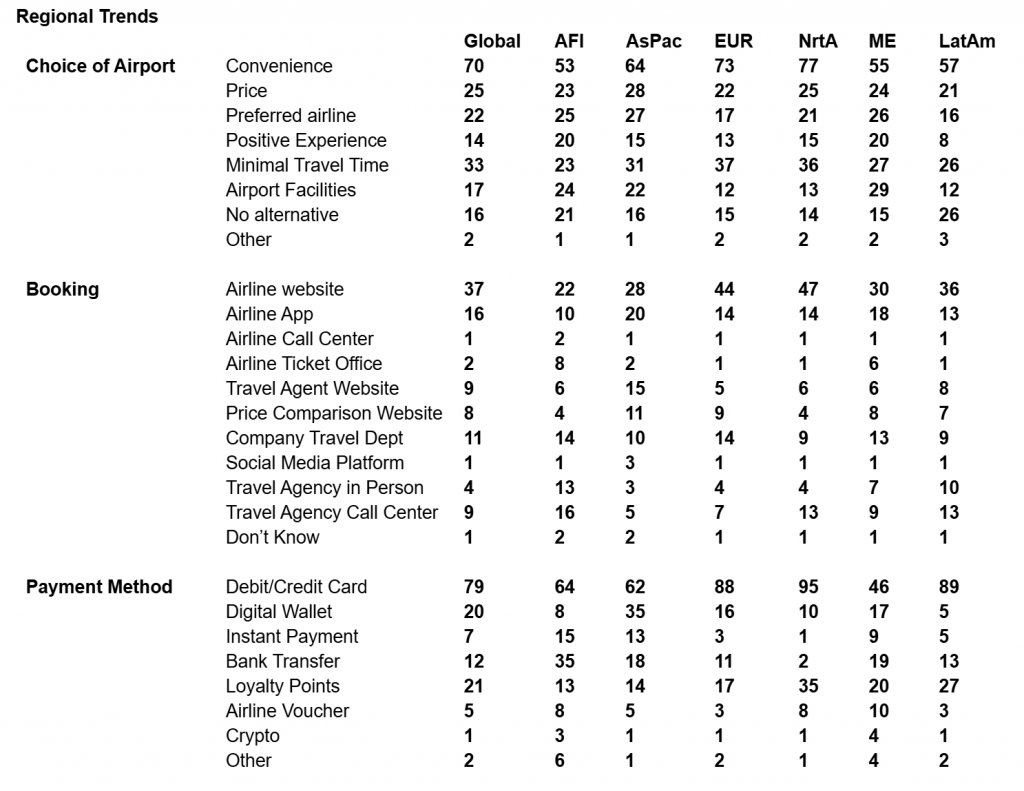
- 68% said proximity to the airport was their top priority when selecting their departure airport, followed by minimizing total travel time (33%) and getting the best ticket price (25%).
- 71% said they book travel online or via a mobile app, with 53% preferring to use the airline’s website / app and only 16% preferring human interaction.
- 32% said they wanted to have all travel information consolidated in one place during the pre-travel process.
- 79% prefer to pay for travel with a credit or debit card (+8 ppt on 2023), followed by digital wallets at 20% (+2ppt on 2023) and instant payment solutions, such as IATA Pay, at 7% (+3ppt on 2023).
- Convenience was the main reason passengers chose a particular payment method (70%), followed by benefits (39%) and security (33%).
“Technology continues to change the way people plan, book and pay for travel. Travellers expect the same conveniences when shopping for travel that they get in any other online shopping experience. That means simplicity, clarity, and with options to meet their preferences while keeping their data secure. The industry is stepping up to meet the demand for greater customer centricity through IATA’s Modern Airline Retailing initiative. Passengers will experience its positive impact progressively in the very near future,” said Muhammad Albakri, IATA’s Senior Vice President for Financial Settlement and Distribution Services.
Airport
- 70% said they want to reach their boarding gate in 30 minutes or less when traveling with just a carry-on; 74% expect it to take no longer than 45 minutes with a checked bag.
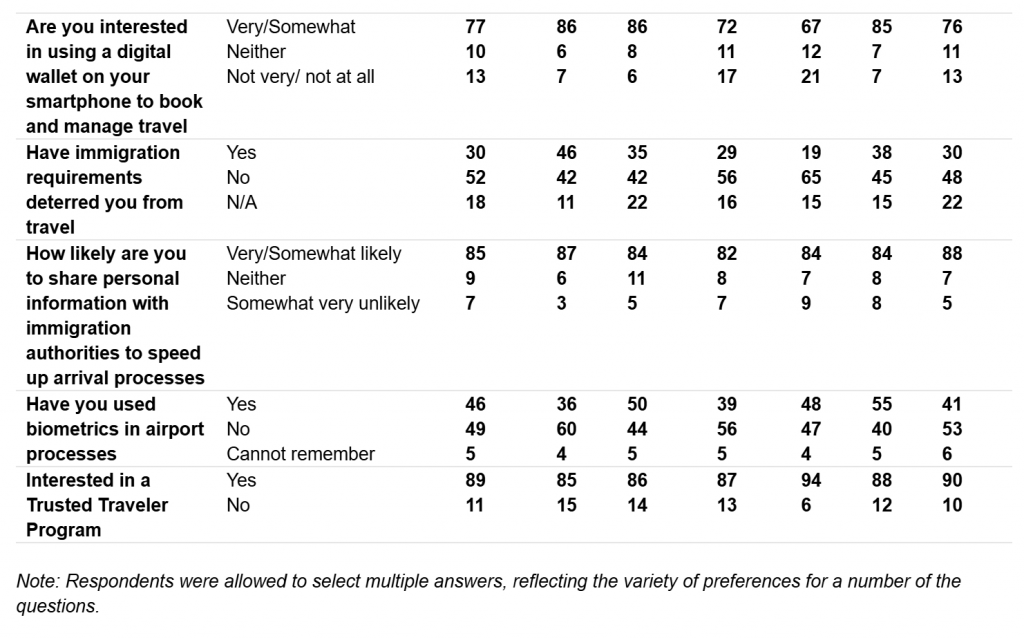
- 85% said they are willing to share immigration data i.e. passport, visa with authorities before departure to speed up airport process. And 89% are interested in a trusted traveler program to expedite security screening.
- 45% said immigration procedures should be completed before reaching the airport, and 36% feel the same about check-in. Additionally, 70% of passengers said they’d be more likely to check-in a bag if they could do so in advance.
- 46% of travelers experienced airport processes using biometric identification. The highest usage is seen at entry and exit immigration checkpoints (43%). 84% of users were satisfied. And 75% prefer using biometrics over traditional passports and boarding passes.
- 50% said they are concerned about data protection and 39% would be more open to biometric solutions if assured of their data’s security.
Digital solutions are preferred by younger generations
According to IATA, under-25s are considerably more proactive in using technology to improve their travel but want assurances on security.
- 51% would choose digital wallets for payment, far above the global average of 20%.
- 90% expressed interest in using a smartphone with a digital wallet, passport, and loyalty cards for booking, payment, and airport navigation, surpassing the global average of 77%.
- 48% prefer biometrics over traditional passports and boarding passes, compared to 43% of those aged 56-75.
- 50% of under-25s would be more open to biometric solutions if assured of data security, versus the global average of 39%.
Regional trends
Africa Passengers
The report states that African passengers prioritise convenience when choosing an airport but often face limited options due to a lack of alternatives. More passengers in this region book their tickets through travel agents than in any other area. They also show a stronger interest in adopting digital solutions and technology to streamline travel processes. Additionally, complex visa requirements are a deterrent for African travelers compared to other regions.
Asia-Pacific Passengers
IATA shared that Asia-Pacific travelers are the most price-conscious when choosing their departure airport. They lead in using mobile apps and digital wallets to book and pay for travel, more than any other region. They are also more likely to use biometric technology at airports, although their satisfaction with the experience is the lowest among all regions. Complex visa requirements deter more travelers from Asia-Pacific than most other regions.
Europe Passengers
European travelers are more likely to book through an airline’s website and pay with a credit or debit card. They tend to be slightly more cautious about using digital solutions and sharing personal information to enhance their travel experience compared to other regions. Europeans are also the least likely to share biometric data to speed up processes, and when they do, their satisfaction is lower than that of travelers from other regions.
Middle East Passengers
IATA’s data showed that Middle East passengers are the most likely to choose an airport for its facilities and services. A higher percentage book their flights through a channel where human interaction is involved than most other regions. Over half have used biometrics instead of a passport for airport processes in the past 12 months, with nearly all reporting satisfaction with the experience.
North America Passengers
North America passengers overwhelmingly and more than any other region prefer to pay for their flights with debit or credit cards and are the most frequent users of loyalty points for payment. They actively use biometric identification for airport processes and report high satisfaction with it. Nearly all are interested in providing data in advance for more ‘lighter’ security checks at the airport.
Latin America and Caribbean Passengers
Latin America and Caribbean passengers prefer booking travel with a credit or debit card. They place the highest value on payment flexibility, preferring to pay in instalments more than any other region. They are more inclined than any other region to obtain visas from a consulate or embassy. They use biometrics less frequently than other regions; however, they show a strong willingness to adopt the technology and report high satisfaction when they do.
Aviation priorities for Thailand and APAC – Infrastructure, digitalisation and sustainability
IATA urged Thailand to strengthen the foundations of its aviation sector as it emerges from the impact of COVID-19. Thailand’s passenger numbers are expected to see a compound annual growth rate of 3.88% between 2024 and 2043.
“Thailand’s aviation potential is bright. Already demand has reached 88% of 2019 levels and we can expect the start of real growth from 2025. With world-class tourism assets and a growing regional business sector, Thailand is well positioned to become a top 15 global market for aviation in the next two decades,” said Dr Xie Xingquan, IATA’s Regional Vice President for North Asia and Asia-Pacific (ad interim).
Xie urged the government and authorities to take steps to further strengthen Thailand’s aviation sector to maximize the benefits that aviation can catalyze across the Thai economy.
“With 84% of tourists to Thailand arriving by air (pre-COVID), the importance of aviation to this key economic sector (7.4% of GDP pre-COVID) is clear. Nurturing tourism should be a priority. A low tax burden is key to securing Thailand’s leading position in Asia in the tourism and meetings, incentives, conferences and exhibitions (MICE) sectors and to strengthening the Bangkok hub. Instead of considering, again, the introduction of a tourism tax, which can have a dampening effect on passenger demand, the government should look at ways to grow the sector with lower costs,” said Xie.
Along with avoiding any increase to aviation’s tax burden, Xie highlighted infrastructure, digitalisation and sustainability as key focus areas.
Infrastructure: The upgrading and expansion plans at Suvarnabhumi Airport are critical in ensuring the airport infrastructure is able to support the anticipated growth in air travel.
“A revised masterplan for Thailand’s airport capacity is critical to delivering the economic benefits of aviation. This effort can be maximized with customer input. Consultation with airlines will ensure alignment with market developments for the timely delivery of functional and cost-effective infrastructure,” said Xie.
Digitalisation: Thailand is also investing in technology and automation to improve passenger processes throughout the airport, including automated border control gates.
“The efforts to improve the passenger experience with technology will deliver their best if they are aligned with global initiatives to modernize processes. These include adoption of One ID standards to implement digital identity in the passenger journey and One Record to streamline cargo processes,” said Xie.
Sustainability: Thailand’s Ministry of Energy is currently working on the draft National Oil Plan 2024.
“As aviation decarbonises, there is a golden opportunity for Thailand to reap the economic benefits of establishing a successful Sustainable Aviation Fuel (SAF) production. While the government explores policies to support SAF production, it needs to keep in mind that airlines can only purchase SAF if it is available on the market. There needs to be sufficient SAF supply before any mandate is introduced, with flexibility across the entire mandate period. Airlines must not be penalized if national targets for production are not met,” said Xie.
Fully digital travel experience closer to reality
The International Air Transport Association (IATA) and its partners have successfully demonstrated that the industry is ready to deliver a fully digital air travel experience. This was achieved in a proof-of-concept (PoC) involving two passengers using different digital wallets and travel credentials on a round-trip between Hong Kong and Tokyo.
IATA partnered with Cathay Pacific, Hong Kong International Airport, Narita International Airport, Branchspace, Facephi, NEC, Neoke, Northern Block and SICPA for the travel which took place on 21 and 22 October. The airport elements of this PoC were conducted in a live environment, building on an initial PoC carried out in a test environment in 2023.
In the PoC, two travelers used digital wallets containing their digital passport, company ID, and frequent flyer credentials to obtain personalized offers, book a flight, obtain a visa, check their travel documentation, check-in and receive boarding passes. The travelers used biometric identification to manage airport processes in a live environment without repeatedly showing their travel documents. The successful journey integrated seven verifiable credentials (ePassport copy, live biometric image, visa copy, company ID, frequent flyer membership, order, and boarding pass), two digital wallets and a trust registry to verify issuers.
“Government efforts to adopt digital travel credentials based on ICAO standards are picking up pace. Europe is already planning to issue Digital Identity Wallets to citizens and residents by 2027,” said Nick Careen, IATA’s Senior Vice President for Operations, Safety, and Security.
The PoC demonstrated that IATA’s Modern Airline Retailing vision and IATA’s One ID Standards can seamlessly improve the customer experience, from shopping to travel, in harmonization with existing airline/airport processes. With a traveler’s identity document securely stored in a digital wallet, the traveler can consent to share their biometrics to pass through various airport checkpoints—such as bag drop, security, immigration, and boarding—without needing to show physical documents. In doing so, several other key elements of digital travel experience were validated:
Industry standards to support a digital travel experience are fit for purpose:
- Verifiable Credentials (VCs) for live biometric VCs and boarding pass VCs, developed this year, were successfully tested. In addition, a Visa VC was successfully used to demonstrate paperless document verification.
- The draft Technical Guidance for Digitalization of Admissibility was used as a baseline to successfully define requirements for interoperability.
- Critical interoperability: Successfully using multiple VC issuers, verifiers, and wallets by two travelers on the round-trip journey validated the flexibility of the required technology across travel stages and jurisdictions. The VCs integrated smoothly with existing biometric systems at both Hong Kong and Tokyo’s Narita airports.
- Trusted Issuer Registry was successfully tested: This system verifies that a credential was issued by a trusted entity. To enable widespread adoption, an open ecosystem with credential issuers from both the public and private sectors is desired, making such verification critical.
The HKG-NRT PoC was developed in the IATA Data and Technology Hub. The Hub brings together industry partners from across the travel value chain to develop solutions and test new technologies to overcome industry challenges. The aim is to help the aviation industry generate value as it transitions towards digitalisation.