
Recently, a headline in Bloomberg, “China’s Biggest-Ever Bid For Foreign Tourists Is Falling Flat”, caught my eye.
It reported that despite the extension of visa-free entry access to 38 countries, “the influx of foreign tourists and the billions of dollars in spending they could have brought simply hasn’t materialized”.
It seemed counter-intuitive to what I was hearing and seeing from my perch in Singapore, where friends around me, from Malaysia to Thailand, Indonesia, Vietnam and Korea – seemed to be flocking to China for the year-end holidays, and many have trips planned for the next few months as well.
I got deeper into the report and read this – “visitors from the US and most of Western Europe – where political and trade spats with Beijing abound – stayed away. Instead, tourists from nearby Asian countries and less developed markets came calling.”
Curious to find out more about the Asia angle, I asked Trip.com Group to send me their data on search demand for China from its Asian markets – to see what trends they were seeing.
Well, in the last three months of 2024, Trip.com Group saw search demand for China from its Asian markets soar – with markets like Korea, Thailand, Malaysia, Vietnam and Indonesia leading the pack. In December, Thailand saw a surge of 456% year-on-year in search demand, Korea by 240%, Malaysia by 208%, Vietnam 164% and Indonesia 175%.
It is understood that destinations such as Kunming, Chengdu and Chongqing have become increasingly popular – Kunming especially with Thais, due to the increase in flights between Bangkok and the Yunnan capital, and its proximity, less than three hours flight away.
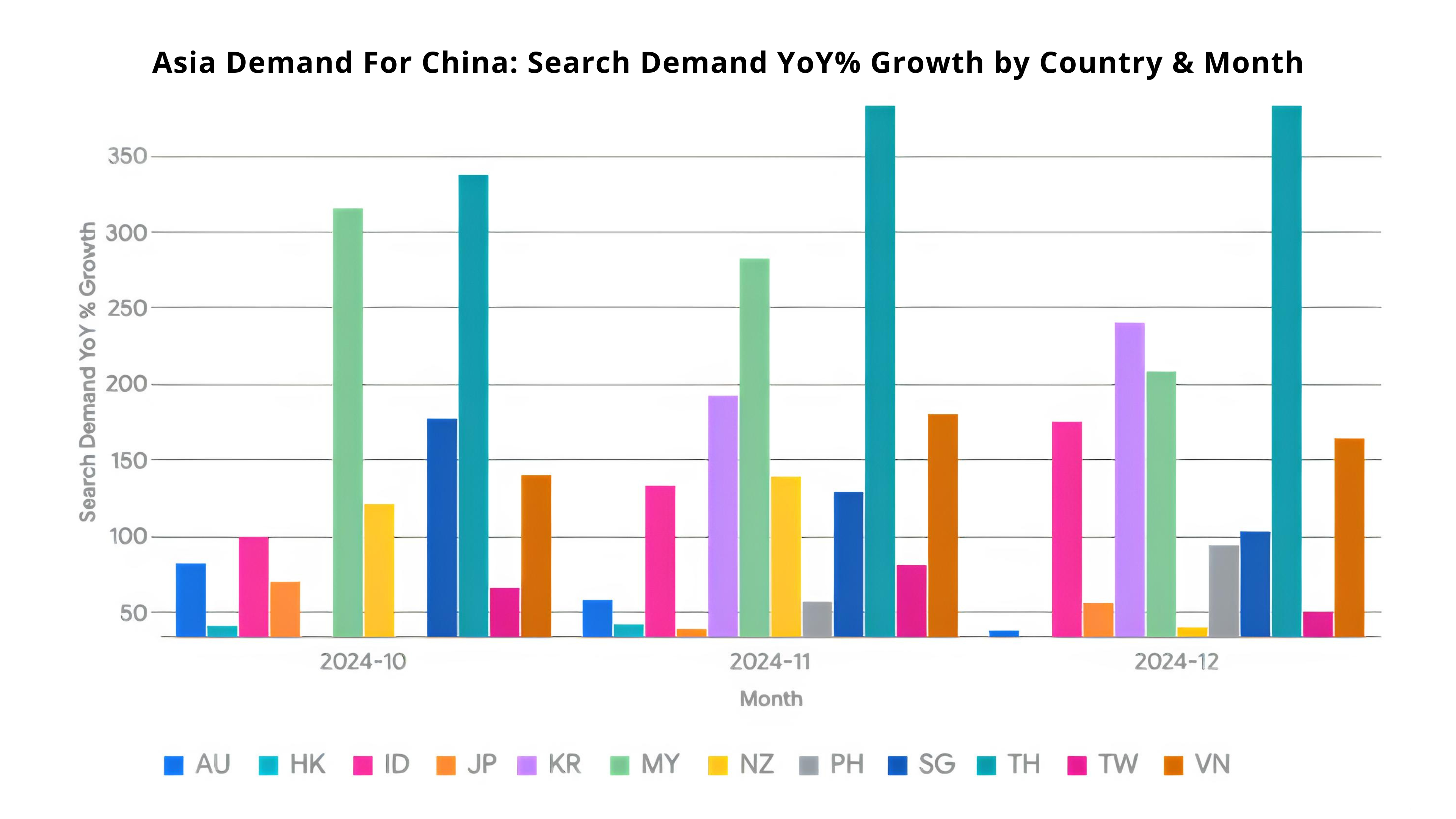
[Source: Trip.com Group]
Okay, it’s the holiday season so surges are expected, plus they were probably from low bases – but it proves that easing of visas works especially for your neighbouring markets, whose travellers can just up and book flights at short notice.
Whether the demand from Asia will be enough to make up for the lack of interest from Western markets remains to be seen – according to Bloomberg’s analysis, foreign visitors to China totalled just under 23 million in the first three quarters of 2024, 63% of 2019’s same-period level.
But you can count on the fact that there’s a lot of pent-up demand from travellers in nearby Asian markets, particularly from South-east Asia – the need for visas held back a lot of leisure travel in past years – and the growing influence of Chinese commerce and culture in South-east Asia is palpable, and growing, from Singapore to Malaysia, Thailand and beyond.
Call it the “mala-tisation” of Asia or whatever but “mala” is the new spice. At my favourite salad bowl place, “mala” prawns is the hot protein. “Mala” hotpots have become as ubiquituous as ramen joints and Chengdu cuisine is suddenly, everywhere. Everytime a “Chagee” joint opens, there are queues. Luckin Coffee is the new Starbucks.
“What’s with this Chagee thing,” asked an English friend visiting Singapore, when she spotted a long queue snaking outside the outlet.
“Some sort of tea trend,” I replied.
Just as K-culture spread, thanks to K-drama, K-fashion and K-pop, let me tell you, C-culture is already embedded among us in South-east Asia.
Speaking of which, with the looming ban on TikTok, the migration of the 170 million users of TikTok to Xiaohongshu has been most interesting to watch from afar. On January 13, the app surged to number one in the US Apple App Store, attracting more than 700,000 new users and the hashtag “TikTok refugee” had garnered about 250 million views and over 5.5 million comments on RedNote a few days after.
This video on TikTok I thought particularly interesting – a TikToker sharing his views after “visiting” Red Note; his discovery that the Chinese are “really beautiful people”.
As Mark Twain famously wrote: “Travel is fatal to prejudice, bigotry, and narrow-mindedness, and many of our people need it sorely on these accounts. Broad, wholesome, charitable views of men and things cannot be acquired by vegetating in one little corner of the earth all one’s lifetime.”
Well, it looks like digital works too …