
From multi-tripping to sustainability – 10 travel trends travel providers need to know this year
Travel technology solutions provider, Sabre, surveyed its team members and analysed its industry data to uncover the key trends shaping travel this year. The findings highlight how leisure travellers are planning, spending, and booking their trips – offering insights for travel providers looking to meet changing consumer expectations.
Here are some key highlights:
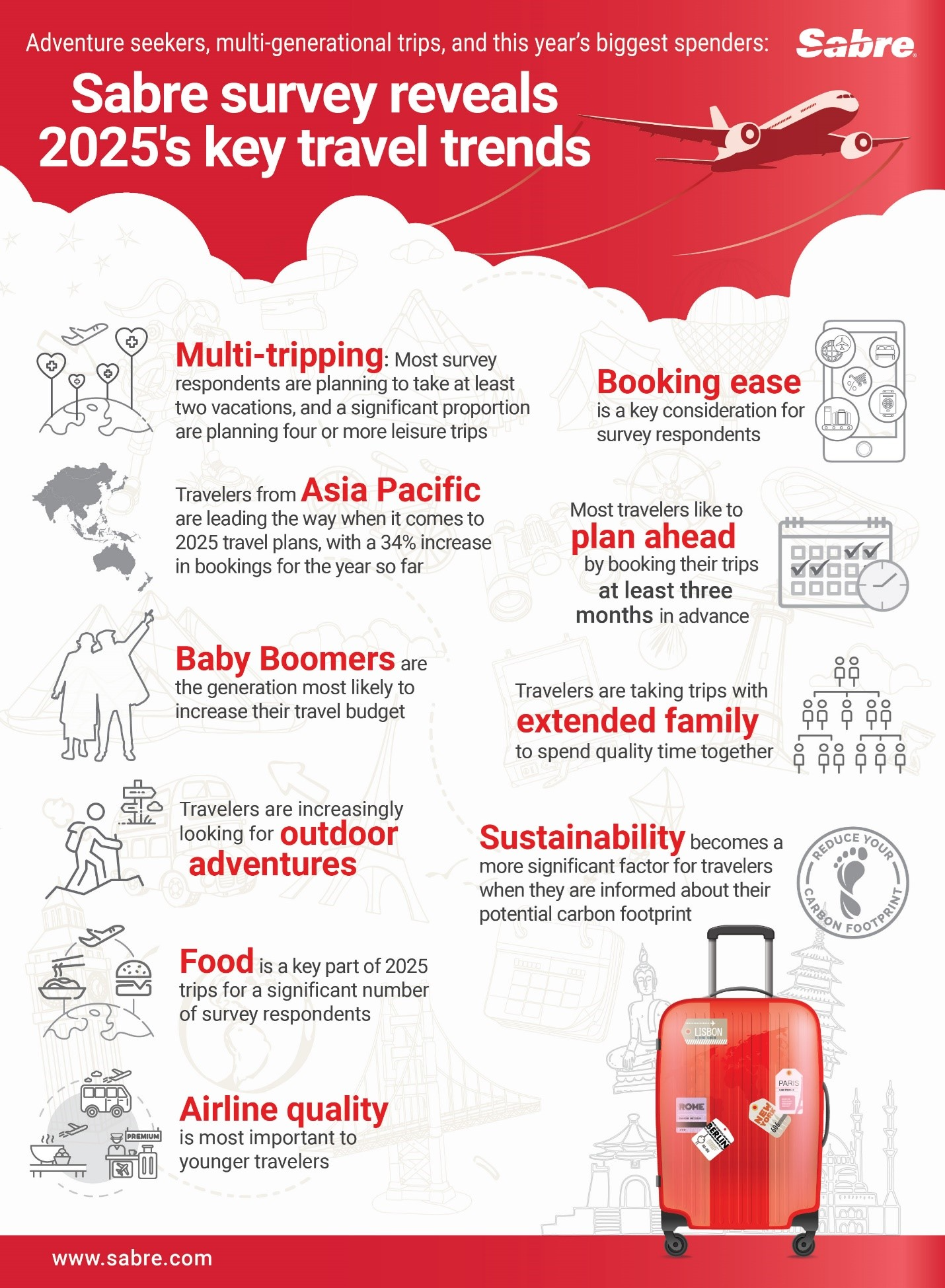
- Multi-tripping: Most survey respondents are planning to take at least two vacations, and a significant proportion are planning four or more leisure trips;
- Travelers from Asia Pacific are leading the way when it comes to 2025 travel plans, with a 34% increase in bookings for the year so far;
- Baby Boomers are the generation most likely to increase their travel budget;
- Travelers are increasingly looking for outdoor adventures;
- Food is a key part of 2025 trips for a significant number of survey respondents;
- Airline quality is most important to younger travelers;
- Booking ease is a key consideration for survey respondents;
- Most travelers like to plan ahead by booking their trips at least three months in advance;
- Travelers are taking trips with extended family to spend quality time together; and
- Sustainability becomes a more significant factor for travelers when they are informed about their potential carbon footprint.
Most respondents in Sabre’s study plan to take at least two leisure trips this year—an increase of 6% from 2024. Nearly a quarter are scheduling four or more getaways, while 12% expect to take at least five. Meanwhile, the number of people skipping vacations entirely has dropped significantly, from 9.4% in 2024 to just 3% in 2025. Sabre’s booking data supports this trend, showing a 9% year-on-year increase in air travel bookings.
Sabre adds that APAC is emerging as the fastest-growing travel region, with a 34% rise in bookings for 2025 compared to the previous year. Several factors are driving this growth, including a 10% drop in airfares in the first quarter and a 5% reduction in the second quarter. Additionally, the expanding middle class in markets such as India, Indonesia, and Vietnam is fueling increased travel demand.
Sabre’s data also highlights that while overall travel spending is rising, different generations are approaching budgets in distinct ways. More than 90% of travellers plan to maintain or increase their travel budgets compared to last year. Gen Z travellers are prioritising budget-friendly options, while Baby Boomers are leading the way in increasing their travel spending. This generation has the highest proportion of respondents willing to allocate significantly more to travel in 2025 than in 2024.
Additionally, Sabre’s data reveals that adventure and outdoor activities are taking center stage in 2025. While cultural experiences remain popular – 46% of respondents ranked landmarks, museums, and galleries as top priorities – nearly 30% are prioritising outdoor pursuits and sports. Gen Z travellers are leading this shift, with 73% favoring adventure-based experiences. Interestingly, Baby Boomers are also embracing adventure, with 45% emphasizing outdoor activities in their itineraries.
Furthermore, food is becoming an integral part of the travel experience, particularly for Baby Boomers, 27% of whom identified culinary exploration as a primary travel priority. According to Sabre, this aligns with broader industry projections – research from the IMARC Group predicts the culinary tourism market will reach $4.2 billion by 2033, growing at an annual rate of over 14% from 2025 to 2033.
While cost and destination remain top considerations for travellers, younger generations are paying closer attention to airline quality. Nearly 10% of Gen Z respondents identified airline service as a key factor when booking flights. Gen Y travellers echoed this sentiment, suggesting that airlines with a strong focus on quality could capture more loyalty from younger demographics.
On top of that, ease of booking remains a critical factor, particularly for Gen X and Gen Y travellers. Families traveling with children are more likely to opt for package tours, appreciating the convenience of structured itineraries.
Sabre’s data shows 52% of travellers booking flights three to six months in advance, a 14% increase from last year. Additionally, 14% are securing tickets at least six months ahead—a 4% uptick. Notably, APAC travellers are driving early bookings, especially around major holidays like China’s Golden Week.
Sabre also revealed that while couples and nuclear families remain the most common travel groups, there is growing interest in extended family travel, particularly in Latin America, the Caribbean, and North America. Industry data supports this trend – Beaches Resorts and Censuswide found that 69% of parents would like grandparents to join them on vacations, while Booking.com reports that 47% of Asian families prioritize bonding time with extended relatives. Sabre’s data shows a 14% increase in group bookings for seven travellers and a 23% rise in bookings for groups of eight or more.
According to Sabre, 54% of survey respondents said they considered carbon emissions when presented with clear data. Among them, 5% would opt for the most eco-friendly flight even at a higher cost, while 49% would choose lower-emission flights if prices were comparable.
Header photo credit: Courtesy of Sabre