
$6 trillion worth of goods a year flown by air, 35% of world trade
With global air cargo at a record high, it is no wonder that new tech startups are attempting to disrupt this sector that transports $6 trillion worth of goods annually, accounting for approximately 35% of world trade by value, according to IATA.
Last week, IATA reported record growth in 2024 with full-year demand for 2024, measured in cargo tonne-kilometers (CTK), increasing by 11.3% (12.2% for international operations) compared to 2023.
Said Willie Walsh, IATA’s Director General, “Air cargo was the standout performer in 2024 with airlines moving more air cargo than ever before. Importantly, it was a year of profitable growth. Demand, up 11.3% year-on-year, was boosted by particularly strong e-commerce and various ocean shipping restrictions. This combined with airspace restrictions which limited capacity on some key long-haul routes to Asia helped to keep yields at exceptionally high levels. While average yields continued to soften from peaks in 2021-2022 they averaged 39% higher than 2019.”

Alex Khor (left) and Jeff Pan in the Belli home office in Singapore
One new cargo startup is Belli, which won the Asia Pacific leg of the Global Startup Pitch 2024, by WiT and Phocuswright. It’s founded by self-professed serial entrepreneur Jeff Pan and co-founder Alexander Khor, who both worked at AirAsia prior to founding the business.
“The interesting thing is, air cargo accounts for only 1% of total freight by weight but 35% of global trade by value,” said the Singapore-based Pan, who’s clearly gotten into the weeds into this sector since starting Belli in March 2024.
Pan, who’s got extensive travel experience, having worked with Booking.com and Flymya in Myanmar for three years, first came up with the idea of Belli, which is building next-gen cargo software for airlines, during his time consulting with McKinsey.
“I was working with airline clients and realised that the bottom of the plane is 85% empty most of the time, and that’s a lot of space. Within a year, I went from consulting to join an airline and I was surprised – I assumed everything was automated and digitised – but a lot of airlines are still using paper.
“Given my experience building software for travel, I saw this huge opportunity and thought I could combine my experience in travel with cargo.”
After starting Belli in March 2024, he brought on former colleague, Alexander Khor, who was Jeff’s first product manager hire at Teleport, AirAsia’s cargo department. Khor, who trained as a molecular biologist, told WiT, “It was pretty evident this is a problem worth solving. We experienced the pains ourselves. So, I joined a couple of months after it started up.”
Early challenges: Funding and finding customers
Of course, there were the initial challenges. First, the funding. “There isn’t a good track record of aviation startups getting finding – it’s very rare. Nobody believed we could sell to airlines – usually it’s a three to four-year cycle, and nobody knew anything about cargo,” said Pan.
“We pitched to investors and got 60 rejections. Then we got connected with a VC in Singapore, whose general partner has a pilot’s licence.”
Belli raised $500,000 in pre-seed funding with venture capital fund Iterative, and is currently in the process of closing its seed round now that it is hitting breakeven less than nine months after writing its first line of code.
Then, the selling to airlines. “We did this by brute force. We attended every single cargo conference. At that time, we were essentially selling CVs, we didn’t have a product yet. Eventually after meeting 20-30 airlines, one signed up,” said Pan.
In fourth quarter 2024, it signed three airline customers in three months and at the time of the interview closed two additional $100,000 ARR customers, which would bring the startup to breakeven and profitability.
Building the product: Overcome challenges of tech legacy
Said Khor, “We are building an operating system for airlines to manage cargo, to help them increase revenues – much like how a tablet gets rid of paper in restaurants and distribute menus to good delivery systems.
“It’s a lot more complex than selling passenger seats. With cargo, you have to maximise for weight and volume, and you have to balance the weight. Cargo loads change dynamically all the time.”
Khor said his molecular biology experience helped in the sense that “it’s to do with systematically breaking things down, and experimenting, and improving upon those experiments”.
Pan said the biggest challenge is dealing with the cargo industry’s technical legacy. “Cargo tech is about15 years behind passenger tech. The current systems are already old, it’s a complex network of components and parts. It’s like trying to perform open heart surgery in the back of a moving ambulance. The standard of digitisation is different across airlines and you have to deal with airports, airlines and ground handlers.”
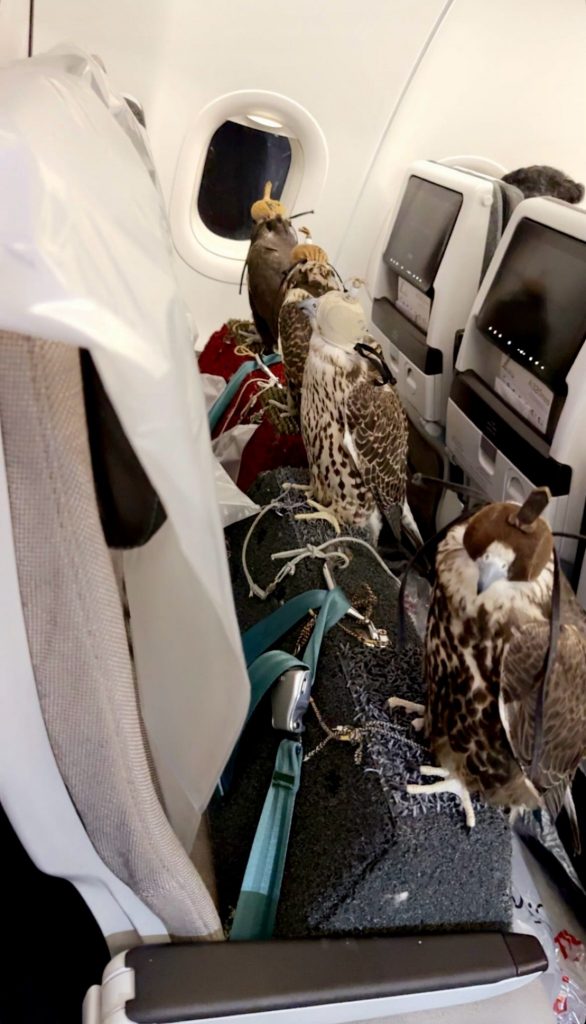
Falcons onboard Gulf Air
From human remains to whales and mosquitoes: The fascinating world of air cargo
Prompted to share some of the more interesting items carried in the underbellies of airplanes, Pan said, “Durians (the stinky, thorny fruit) are fine. Human remains are – interesting. Animals too – the largest animal was a blue whale and did you know, on any given day, 200 horses are being shipped around the world. Gulf Air, an airline based in Bahrain, routinely flies falcons side-by-side with passengers.”
Pan’s favourite air cargo story is from a German airline. “There was an outbreak of some disease in Mexico and they traced the cure to a set of mosquitoes in Morocco and they flew a plane full of mosquitoes to eradicate the outbreak”.
And as we saw during the pandemic, cargo played a vital role in the distribution of vaccines around the world. “It was a feat of human engineering which we took for granted,” said Pan.
Digitisation critical to tackling disruptions in supply chains
It’s also a challenging industry due to constant supply chain disruptions “which happens every three to four months” which is why digitisation is critical to help airlines manage these disruptions, said Pan.
“The pandemic was an opportunity to fix tech stacks in cargo but it wasn’t done. Now there’s lots of catching up to do,” said Pan. “E-commerce is going through the roof – people shopping on sites like Temu and Shein, that’s got more of an influence on global trade than the pandemic did, and that will boost cargo growth.”
Pan said cargo also offered airlines a 70% operating profit margin compared to passengers at a 5-10% margin. “So you can imagine the upside if you get efficiencies and revenue management right.”
Pan considers himself an entrepreneur at heart. At the age of 21, he ran a bed and breakfast in Brooklyn, with six rooms. The business, called Loftstel, ran for 12 years and it grew to 1,000 beds. “I built the software for Loftstel and that’s how I got into travel tech. You don’t remember but you introduced me onto the Phocuswright stage.”
Unlike his bed-and-breakfast business, Belli has lots of headroom to grow. IATA projects that the global air freight market, which was $300.93 billion in 2023, will reach $484.12 billion by 2031.
Looking to 2025, Cargo Facts Consulting anticipates global air cargo traffic will expand between four and five percent, following the double-digit surge in 2024. This sustained growth in 2025 will be propelled by e-commerce resilience, high-value cargo shipments, and strategic manufacturing relocations from China towards South-east Asian and Latin American markets, creating new air cargo demand corridors.
IATA estimates growth to moderate to 5.8%, aligned with historical performance. Said IATA’s Walsh, “Economic fundamentals point to another good year for air cargo – with oil prices on a downward trajectory and trade continuing to grow. There is no doubt, however, that the air cargo industry will be challenged to adapt to unfolding geopolitical shifts. The first week of the Trump administration demonstrated its strong interest in using tariffs as a policy tool that could bring a double whammy for air cargo—boosting inflation and deflating trade.”