


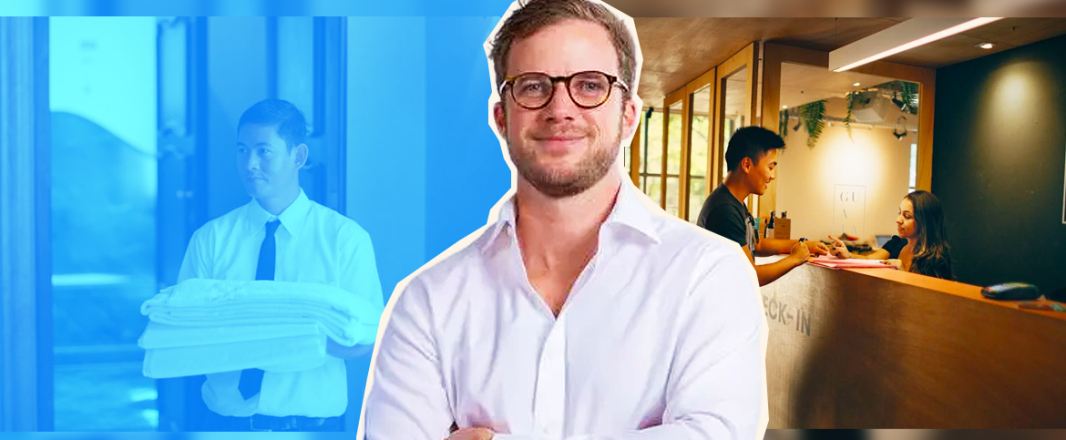
Tackling a gap where the frontline got left behind
When Matt Spriegel founded Atiom, a tech platform for hospitality staff training and engagement, he wasn’t chasing shiny trends – he was trying to fix a problem no one was really talking about. “The frontline workforce – we call them the Forgotten Workforce,” he says. “They don’t get the same kind of love and attention that the middle managers and above get in any service-first company.”
That neglect is especially glaring in training. Spriegel points out, “If you’re a housekeeper in Jakarta and you’re content in English, it’s probably not going to do much.” The problem is even bigger when you consider high turnover and the sky-high expectations of post-pandemic guests. “A lot of hotel leaders feel like they’re behind the eight ball, always trying to get their teams up to standard,” he adds.
Most hotels are great at talking about service, but not-so-good at equipping their staff to deliver it consistently, especially at scale. For Spriegel, the issue isn’t just about content, it’s about access.
“These staff don’t even have email addresses in many cases,” he explains. “They’re not getting the same tools, the same resources, the same time.” In a post-COVID world where staffing shortages remain chronic, that gap becomes even more obvious. “Hospitality already has high turnover, so you’re constantly trying to get new people up to standard, fast,” adds Spriegel.
Atiom’s answer? A tech-first platform that blends AI, gamification, and localisation to deliver bite-sized, daily training and recognition. “We use technology and AI to create access for all staff in an organisation,” Spriegel told WiT. “We’re able to transform large content sets into daily modules, peer-to-peer recognition, surveys and even mystery shopping.”
Customisation meets gamification
Spriegel isn’t just hawking another LMS. He’s created something closer to a habit-forming app for service benchmarking – think Duolingo, or even Headspace, but for hotel staff.
“One of the things we learned early on is that cookie-cutter content doesn’t work,” he says. “Before AI, we had to manually co-create content with hotels. It took a lot of time and skill.” Now, with generative tools and a strong tech-first infrastructure, that’s changed. “We can build custom content programs for each hotel, each brand, even down to individual properties,” he explains. “We’re winning clients now because the tech actually works and the content is theirs, not a generic off-the-shelf module.”
But tech alone doesn’t engage teams – people need a reason to keep showing up. “We live in the attention economy,” says Spriegel. “If there’s no reward system, no recognition, no mechanism to build a daily habit, people won’t come back.” That’s where gamification comes in.
“Atiom adds a layer of gamification over everything. We’ve got keys that unlock boxes, leaderboards; it’s fun, but it’s also meaningful,” he says. “It gets people learning a few minutes a day, every day, and that’s what drives real behavior change.”
Personalisation, not just SOPs
Surprisingly, the most popular feature on Atiom isn’t a quiz or a specific module – it’s peer recognition.
“If I see Tanya go above and beyond at the front desk, I can give her a peer-to-peer reward,” Spriegel says. “That recognition means something. It’s not about checking boxes on an SOP, it’s about reinforcing the human behaviors that create memorable experiences.”
And those behaviors – kindness, initiative, empathy – are hard to teach through traditional training programs. “You can’t expect someone to sit in front of a screen for an hour and learn how to open a bottle of wine,” he laughs. “Our goal is short, daily nudges. Three to six minutes a day, then back to work. That’s it.”
Spriegel compares it to meditation, hence the Headspace comparison: “Even one minute a day, just five deep breaths, can change your state of mind. It’s the same here. One 10-second video from the GM saying, ‘Hey, I see you, I appreciate you’ – that goes miles. Especially for the frontline.”
Surprising insights from the Hotel Service Index
One of Atiom’s more data-driven initiatives is its Hotel Service Index, which surfaces real-time, regional insights about service quality. The most surprising result so far? “In Doha, Qatar, the number one hotel on the ranking list was an ibis,” says Spriegel. “That’s a budget brand under Accor – but they outperformed luxury brands.” Spriegel’s takeaway is simple, “Just because it’s a budget hotel doesn’t mean it’s budget service. In fact, it might be easier to delight guests at a place where expectations might be lower.”
The data reinforces a bigger point: brand loyalty often stems from people, not just price. “We saw in the qualitative data – guests return for the people. That one rockstar at the concierge can move the needle.”
Cultural nuance at scale
Atiom didn’t follow a hyper-growth, blitzscaling model. “We’re not an overnight success. It’s been a lot of sleepless nights,” Spriegel says, laughing. The company started in China, then expanded to Singapore, which was a move that unlocked regional deals across Southeast Asia. Atiom then moved into Indonesia, Thailand, and the Pacific region.
The real game-changer came when Atiom joined Hub71, a UAE government-backed tech program. “It was a sponsored opportunity, and it came with resources and a bit of investment,” says Spriegel. “That allowed us to land smoothly in the GCC. Now, we’re in 70 countries.”
But the growth wasn’t always linear. “We stretched too far, too fast at one point,” he admits. “So we reeled it in. We focused on hospitality and became methodical. And we haven’t lost a client in years – knock wood.”
Spriegel is also cautious about funding. “A lot of startups take the wrong check and end up with the wrong partner. That can kill a business,” he says. “We’ve always run a tight ship. COVID taught us a lot.”
As Atiom expands globally, it’s had to grapple with cultural nuances. “In Asia, people live on their phones. In Germany, they don’t even bring them to lunch,” Spriegel says. “In places like France and Japan, unions and compliance are also major factors.”
To stay relevant, Atiom developed a desktop version for markets where mobile usage is limited. “In Europe, many employees don’t want to use their personal phones for work. So we adapted,” he says. “It’s about respecting user behavior and meeting them where they are.” Even gamification had to be tested. “We weren’t sure how our red envelope concept [part of Atiom’s gamification layer that unlocks new rewards] would land in the Middle East,” he admits. “Turns out, it’s one of our most engaged regions.”
Defining success beyond engagement
Spriegel doesn’t care about vanity metrics. “We know engagement is going to go up when hotels use Atiom,” he says. “One hotel had three million touchpoints in one year – peer rewards, quizzes, content. That’s a given.”
What matters more? Impact.
“We work with leadership to pick a real business objective – loyalty enrollments, guest experience scores, upselling. Then we build playbooks around that.” In other words, Atiom is about more than just staff training – it’s about revenue. “Loyalty is top of the totem pole,” says Spriegel. “If our content can increase enrollments, that’s success. If we improve service quality and guest scores – that’s success.”
The future is human, ironically
Looking ahead, Spriegel believes tech will be even more embedded in hospitality operations – but ironically, that’ll make human interactions even more valuable.
“With all this AI-generated content, people will crave real human service,” he says. “When you’re not scanning a QR code but actually talking to someone at the front desk – that will stand out more than ever.”
He sees frontline staff playing a larger role in data-informed decision-making, too. “It’s not just your IT guy using tech. The frontline will be using data and tools to shape guest experience, in real-time.”
So will Atiom replace trainers or managers? Not quite. “We’re not here to automate the soul out of hospitality,” Spriegel says. “We’re here to activate it, one minute at a time.


