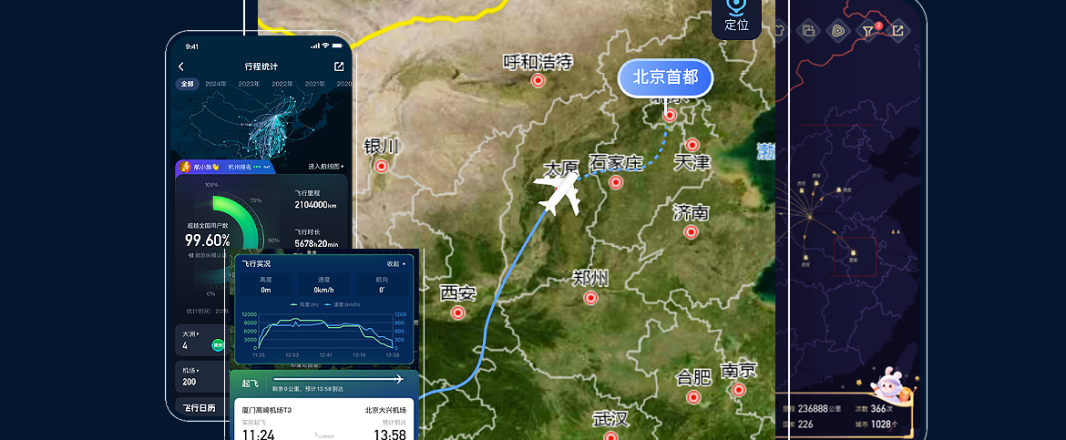
When the Civil Aviation Administration of China (CAAC) and 37 Chinese carriers – pretty much all of them – announced the launch of a unified direct ticket sales platform — embedded in the popular Civil Aviation Information app “Umetrip” — it immediately drew parallels to past airline-led booking alliances.
Orbitz in the US, Opodo in Europe, and various short-lived GDS bypass initiatives all share a common DNA: carriers banding together to assert control over distribution, pricing, and customer relationships.
The difference? Umetrip’s roots are squarely in the Chinese aviation ecosystem and its technological backbone is provided by a single provider: TravelSky Technology (the national provider and State-Owned Enterprise for China)
The stated goal
Officially, the new Umetrip capability is about creating a “convenient, official, secure” way for passengers to book directly with any participating Chinese carrier. For years, the platform has been a must-have app for flight status and travel documents; now, it adds multi-airline ticketing without sending users to third-party OTAs. It was particularly useful for knowing the state of your aircraft which was a reason for the app to be sticky.
Given the relentless growth of Trip.com Group as a domestic and global powerhouse – with deep brand equity, app stickiness, and cross-selling clout – the strategic aim is clear: claw back traffic, data, and commission margin from intermediaries.
Sound familiar?
Déjà Vu or something different?
If this sounds familiar, then it is. Airline have tried this before:
- Orbitz (US) – Initially an airline joint venture to reduce reliance on GDSs, later evolved into a full OTA and was eventually sold to Expedia.
- Opodo (Europe) – Similar airline consortium intent ultimately became just another OTA under new ownership.
The pattern: airlines can align on the tech, but competing brands, loyalty programmes, and divergent commercial strategies make it hard to sustain a unified front against OTAs for long.
What makes Umetrip different is its regulatory support, its embedded position in China’s air travel infrastructure, and its integration with the national provider who has both the PSS and the GDS capability. For essentially it is the only player in the market – TravelSky. This is not a competitive environment rather it is coalition of equals; Like many entities in China, it’s a centrally enabled, state-endorsed platform.
TravelSky’s strategic position
According to Morgan Stanley’s August 2025 note, the launch is “marginally positive for Chinese airlines in terms of pricing power with limited earnings impact on TravelSky”, but with a significant upside if Umetrip becomes a true mass-market direct channel. Obviously, there is no guarantee here. The China domestic market is very different from the more open markets of the West. The emergence of large players like Ctrip (now Trip), Metuan and Qunar along with AliBaba’s Fliggy have come to dominate the marketplace but in a different form to the Western brands like Expedia and Booking.com. So, it is a natural desire to claw back the transactions.
TravelSky’s core revenues come from its service of the entire Airline marketplace in China:
- AIT (Airline Information Technology) – steady growth, directly tied to passenger traffic and booking activity.
- Airport IT – the core capabilities for airports and flight information
- SI (System Integration) – more volatile, tied to project completion schedules.
- Financial Services – it provides BSP type services not just in China.
Unlike the Western heavyweights Travelsky does not participate in Accommodation. In 1H25, net profit before minority interest was up ~5% YoY to RMB 1.45B, but this was bolstered by credit impairment reversals. Stripping that out, growth trailed traffic recovery. That means TravelSky needs more monetizable volume — and Umetrip’s expansion is one lever.
Trip.com’s shadow
The competitive subtext here is hard to miss. Trip.com isn’t just an OTA; it’s now a global travel services company, driving not only massive Chinese outbound volumes but also inbound and domestic sales. Its position in the West is also through its ownership of Skyscanner, and Travelfusion. Its tech stack is tuned for upsell, cross-sell, and loyalty capture in ways most airline.com experiences can’t match. Even with Umetrip’s national reach, the question is whether consumers will shift habits without meaningful incentives.
Additionally, the infrastructure of payments and communications that have become a distinct part of China’s residents’ lives will be impossible to dislodge.
Challenges ahead
- Customer Experience – Unless Umetrip matches or exceeds OTA UX, payment flexibility, and aftersales service, consumers may not switch.
- Commercial Alignment – Airlines will need to avoid undercutting the platform with better deals on their own sites or through OTAs.
- Monetization Model – For TravelSky, the platform needs to be more than a booking front-end; ancillary sales, advertising, and loyalty integration will be key to profitability.
- Global Context – Unlike Trip.com, Umetrip currently has no international hotel, package, or activities inventory — limiting cross-sell potential.
The big question
Is this a replay of Orbitz/Opodo – a defensive maneuver that will eventually get absorbed into the competitive OTA landscape – or is it a uniquely Chinese state-backed distribution pivot that could hold its ground?
The answer depends on whether Umetrip evolves beyond “official convenience” into a true marketplace for all airline-controlled products and services, with the kind of UI, loyalty hooks, and personalization that can rival the private sector leaders.
Right now, as Morgan Stanley’s view hints, the launch is strategically interesting but financially neutral. That can change quickly – if Umetrip becomes the default flight booking habit for many Chinese travelers.