


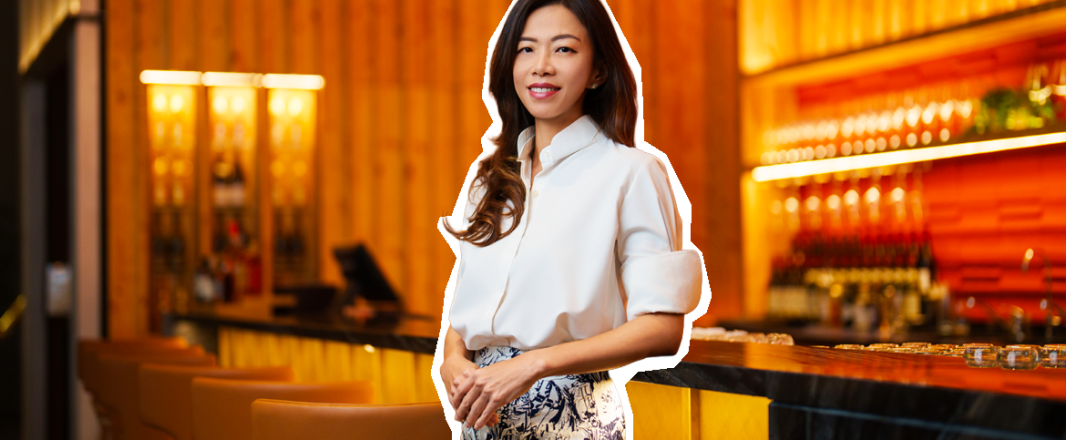
When I listen to Dawn Teo speak about Amara Hotels, I feel she’s not just describing a business but a Singapore family epic that spans three generations – one that started with a grandfather wanting to honour his roots, to her father building up a strong and proudly Singaporean brand and now her, taking the family business into the future.
Roots: From builders to hoteliers
It all started in the 1980s with Dawn’s grandfather, who came from a family of builders. “We were in the construction business, and my grandfather had the vision to be a developer and asset owner,” Dawn says.
His decision to acquire a site in the neighbourhood of Tanjong Pagar carried both business logic and sentimental weight: it was near the shophouses where his ancestors first lodged upon arriving from China – “like co-living today,” as Dawn recalls.
In her childhood, Dawn remembers watching her father and grandfather poring over giant floor plans for their first hotel. “I was like a fly on the wall, listening to them talk about elevation and windows.”
She tagged along to the construction site. “Other kids spent outdoors at the beach, I spent mine at the site,” she says.
When the hotel opened, she spent weekends refilling peanuts at the bar and recalls with pride selling her first log cake at Christmas.
Hospitality was, quite literally, in her blood.
Twists and turns: Making Amara their own
It is not widely known but the Amara Singapore was intended to open under a management agreement with Scandinavian Airlines (SAS) as SAS Amara. But when SAS pulled out amid the late 1980s financial crisis, the family was left with a hotel and no operator when it came to opening time in May 1986.
“We had all the SAS branded collateral ready. So, my dad, grandfather, siblings, everyone, said, ‘Okay let’s roll up our sleeves and do it ourselves, figure it out along the way, and learn on the job’.”
And that was the first lesson Dawn picked up from her father. “When the going gets tough, the tough gets going. You stay calm and you come out stronger and better.”
In many ways, the SAS pullout was a blessing in disguise. While it was a baptism of fire, it was the genesis of Amara as an independent hotelier, and over the last 39 years, they’ve built up a strong and proudly Singaporean hotel brand, Amara, with three other properties in Sentosa, Bangkok and Shanghai.
The family balance: Legacy and transformation
Her entry into the business just happened naturally. “It wasn’t like from one moment to the next. There was no single milestone or deadline. My dad and I liked to talk shop over deals, and he would drop into the conversation a line such as ‘in future when you join, don’t forget this and that’. And after many years,” she laughs, “we decided to crystallise what ‘in future’ means.
“I had been in banking for a while, I had three kids, and I was looking for something meaningful and I thought, what greater purpose is there than to serve your own family.”
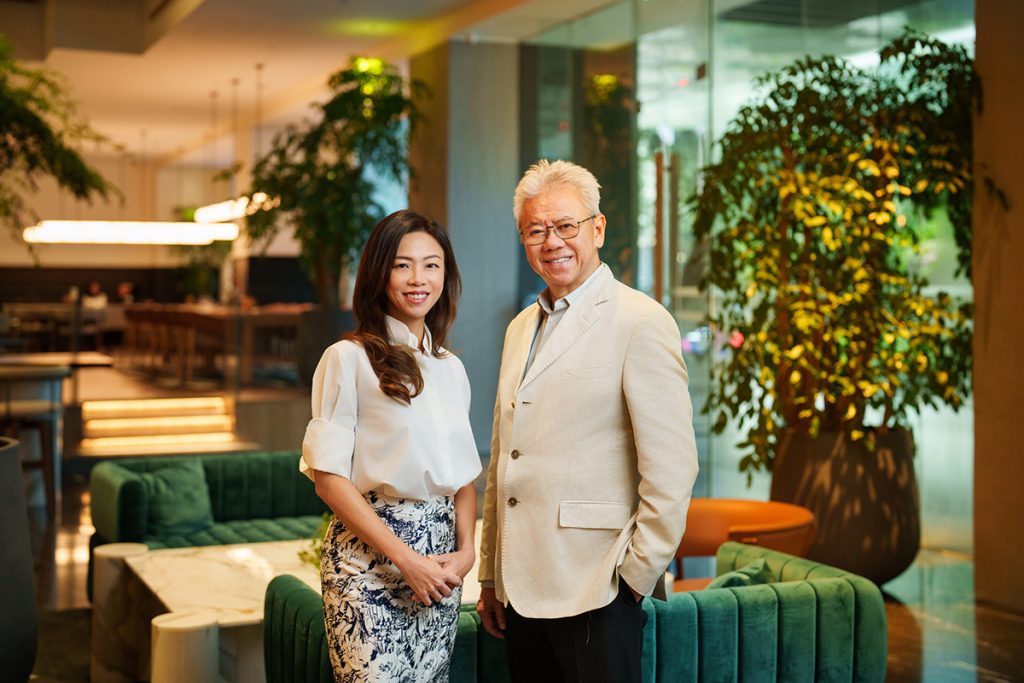
Dawn Teo with Amara CEO, Albert Teo
Running a family business, Dawn acknowledges, comes with its own complexity. “It’s a delicate balance between legacy and transformation,” she says. Move too fast, and she risks alienating long-serving staff and stakeholders. Move too slow, and the company risks irrelevance.
“Trying to calibrate, what is too fast, what is too much, what is too little, that was definitely challenging. Many people say that running a business is very difficult, but I would say running a family business is more so – there’s a huge layer of expectations as well, sometimes self-imposed.
“There’s always the concern that if things don’t go well, you’re not just disappointing yourself, but disappointing your whole family.” In her case, generations.
Her partnership with her father remains central. He still comes to the office daily with ideas and networks, while Dawn brings her financial chops, her own perspectives and an openness to collaborations.
While she acknowledges that her father will always see her as “his young daughter”, their intergenerational debates over projects, such as the recently transformed flagship in Tanjong Pagar and their first venture into a resort property, the Amara Sanctuary in Sentosa, symbolise their ability to weave past, present, and future together.
“If my father hadn’t told me how when he first visited the Amara Sanctuary site, it was “all weeds up to here”, I would not have appreciated the heritage of the property. With the renovation of Amara Singapore, the whole family got involved and it was a true blend of the generations, which makes it extra rewarding.”
Weathering storms: The Covid reset
A few years after she joined, she was to be tested herself during Covid-19. With borders closed, Amara pivoted quickly, converting rooms into quarantine and healthcare facilities and moving F&B online.
“The silver lining was the mindset change. We are an established organisation which means a lot of times, we tend to stay the course and do the same thing. But when Covid came, there were no excuses. Everyone had to do something different. Everyone got creative.”
“It was a reset,” Dawn states.
The next chapter: Post-delisting growth
On July 21 this year, Amara Holdings delisted from the Singapore Exchange after more than three decades. For Dawn, the move was about flexibility and unlocking growth. “We weren’t really using the capital markets,” she explains. “It took up a lot of management bandwidth, and the company was undervalued. Privatization gives us more freedom to grow.”
New shareholders such as Wing Tai Holdings and Hwa Hong Corp signal fresh resources and ambitions. Expansion plans focus on acquiring assets in key Asia Pacific gateway cities – Japan, Australia, and South-east Asia – while also diversifying into adjacent “living” segments such as senior and student accommodation.
Partnerships, including management contracts, are also on the horizon, marking a shift from Amara’s tradition of fully owning and operating its hotels.
To strengthen global distribution, Amara in April joined Preferred Hotels & Resorts, marrying the freedom of an independent brand with the reach of an international sales and marketing platform.
“As an independent, it’s hard to compete with the loyalty programmes and distribution of the global giants, so this is the first step towards looking at supplementing our more local or regional distribution,” says Dawn.
Future-proofing Amara
Dawn’s vision is clear: to create hotels with personality, rooted in place, combining timeless design, Singaporean values of efficiency and reliability, and authentic neighbourhood connections.
From Amara Singapore’s “Triad Trails” run by Architects of Life which works with reformed ex-convicts to share the story of early Tanjong Pagar life, to Amara Sanctuary’s heritage tours in Sentosa, Amara is curating experiences that give guests more than just a stay – they leave with stories.
Dawn has her own story about triads by the way. When the hotel opened, triads came to demand protection money from the family. “The area was very different then, lots of discos, so neighbourhoods also change, and the hotel has to evolve with them.”
She continues, “Tours is only one part of it. We have to look at different content pillars to deliver the personality. The best hotel stays are the ones where it personally touches you and it leaves an impression. My vision is really to try to infuse both the hardware and software together to make a more memorable and complete stay.”
Technology, she insists, should be invisible – freeing staff to focus on hospitality’s human heart. From motion-sensor energy savings to housekeeping apps and self-check-in counters, tech is there to streamline operations, not replace human warmth.
Ultimately, Dawn doesn’t see herself building a brand just for her generation or the next. “I want to future-proof Amara,” she says, ensuring it remains relevant across shifting demographics, from millennials to seniors.
Eyes twinkling, she adds, “You know, I often ask my children for ideas. I’d put up all these sheets of white paper and ask them to imagine, what if you were to design your own hotel, what would it have? When we were renovating, I wrote wifi – and they said, ‘boring’. Pets, pets are big with them, so Amara Sanctuary is pet-friendly.”
You can just picture the next generation poring over floor plans the way Dawn did with her grandfather and father.


