Did you know that in 2009, online travel penetration in APAC was just 17.4%? By 2025, it has surged to 65.4%. The growth is huge.
Cruise, however, has always been the laggard. Flights, hotels, tours and activities all went online earlier. Cruise, with its complexity, was the last holdout. That’s now changing, and at Cruise World Asia in Singapore, three industry players – Chan Chee Chong, CEO, GlobalTix; Edmund Ong, Senior Regional Director, Trip.com; and Josh Wen, Regional Director, Int2Cruises.com – unpacked what’s shifting and what still stands in the way.
From curiosity to inflection point
Trip.com only began taking cruise seriously outside China last year, when it set up a headcount in Singapore to look after the vertical. “This year, we’re seeing a surge of local Singapore customers, as well as South-east Asian travellers,” said Ong. “Trip will continue investing in technology that enables travellers to book seamlessly, and partners to list their products more easily”
GlobalTix, best known as a B2B tech player in attractions and activities, also saw the spark. “We’ve always been curious about cruise – does it belong to hotels or to tours and activities?” said Chan. “But with the launch of Disney Cruise Line in Singapore, suddenly OTAs in the attractions space became very interested in cruise. We were pleasantly surprised by the numbers”
Cruise, he added, sits right in the middle of the experience economy. “Travellers don’t just want to see a city anymore – they travel for an experience, for a reason. And with cruise, it’s like a destination by itself. Youngsters love the gym, love the sea. The trend will keep coming.”
Complexity, hybrid models and human touch
But enthusiasm must wrestle with complexity. “Cruise is a high-touch product,” said Wen, who spent years at Royal Caribbean before co-founding Int2Cruises in 2021. “Yes, online demand is growing, but many still browse online and book offline. They have a thousand-and-one questions before they book.”
In other words, you need a strong hybrid model – online to catch the fish, offline to land the fish.”
GlobalTix discovered the same when it launched cruise. “We thought OTAs would dominate. But to our surprise, almost 50% of our bookings came through offline agents,” said Chan. “It’s not enough to just have APIs. We had to set up a dedicated cruise hotline and staff so people could ask questions and get answers.”
Ong admitted the challenge too: “Cruise booking is complicated. At Trip.com we’re working to simplify the steps month by month. But honestly, pricing and promotions also matter –consumers want transparency and value.”
For Wen, knowledge is another barrier: “Even agents can be overwhelmed. Different ships, even within the same cruise line, have different offerings. Consumers ask everything from ‘does the ship serve buffet 24 hours?’ to family-specific needs. Equipping agents with cruise knowledge is as critical as simplifying booking flows.”
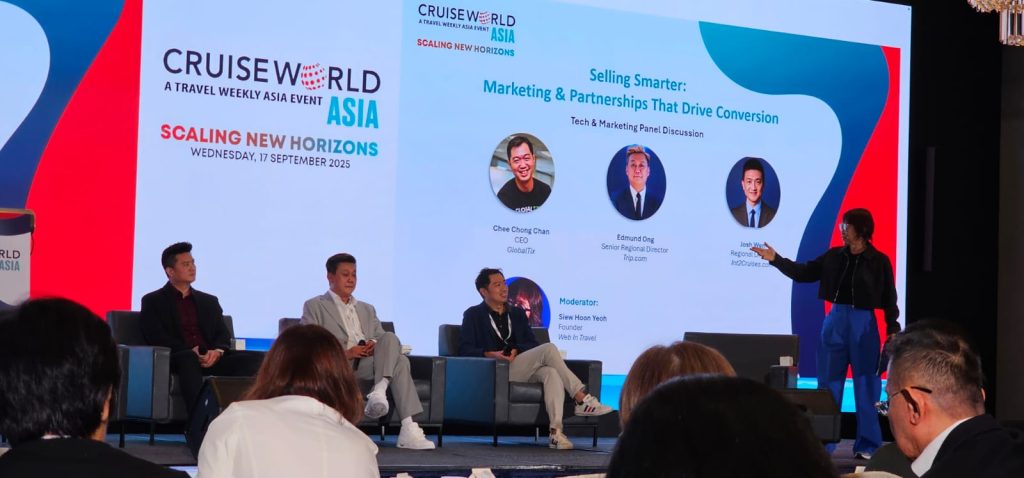
From left: Josh Wen, Regional Director, Int2Cruises.com, Edmund Ong, Senior Regional Director, Trip.com, Chan Chee Chong, CEO, GlobalTix, Yeoh Siew Hoon, Founder, WiT (Moderator)
APIs, AI and the edge cases
Connectivity is a constant pain point. Chan admitted he is still “begging some cruise lines to open their APIs.” GlobalTix is working on mapping cruise APIs into its tours and activities framework.
“In tours and activities, you call an API for a whole month’s availability. In cruise, it’s one day at a time. To serve partners, we had to cache everything to make it usable for OTAs,” he explained
Trip.com, meanwhile, has 20 direct connects with cruise companies. Ong said the company draws lessons from China, where it built a robust back-end ecosystem to manage demand at scale. Trip’s chatbots already handle 90% of queries, leaving only 10% to humans, it was noted.
AI is creeping in across the board. Trip.com’s Trip Genie has become the “Swiss Army knife of trip planning,” with users in Malaysia using it for price comparisons, Thai users for inspiration, and Singaporeans for reviews. “What we see is users who use Trip Genie have a higher chance of converting,” Ong said
GlobalTix is deploying AI to handle cruise queries. “It used to be you had to structure the chatbot. Today we just throw it to ChatGPT, tweak the answers, and it works,” said Chan.
Wen added: “Like it or not, consumers are going to ChatGPT directly. Whether we integrate it into our sites or not, it’s already influencing decisions”
Still, humans matter. Chan told of a Singaporean passport that listed birth year as “XX XXX 1933. “We didn’t believe it until we saw the passport. Try asking a bot to solve that!” he laughed.
Catching the fish: Social, promotions and nano-influencers
If online is to “catch the fish,” how do you bait the hook? For Ong, the answer is social media. “We can’t just rely on Trip assets. TikTok, Xiaohongshu – these platforms are where we need to be. Cruise owners need to tell their story through short-form video content. The shorter, the better.”
Wen agreed: “We have to leverage social media to create awareness.” Chan added that creativity in promotions is just as important: “Free transfers, bundled perks – these ideas stick. They glue customers to a product.”
And influence doesn’t have to come from celebrities. The panel agreed about the power of nano-influencers. “Someone with fewer than 10,000 followers, but relatable – travelling the way you do – is more trusted than a big name you can’t relate to. Relatability drives conversions,” said Ong.
Looking to the horizon
The panel wrapped with a rapid-fire round. What will power cruise ships in 2040? “Something we haven’t invented yet,” said Chan. The next boom market? “India and Asia,” answered Ong and Wen in unison. The one thing they hoped never changes? “Slow motion,” quipped Chan. “Human service,” Wen countered.
“Digitise your marketing, but humanise the connection,” Wen summed up. It was the perfect coda to a conversation that showed cruising’s future will be powered by tech – APIs, AI, social media – but anchored in storytelling, service, and the very human desire to feel taken care of at sea.