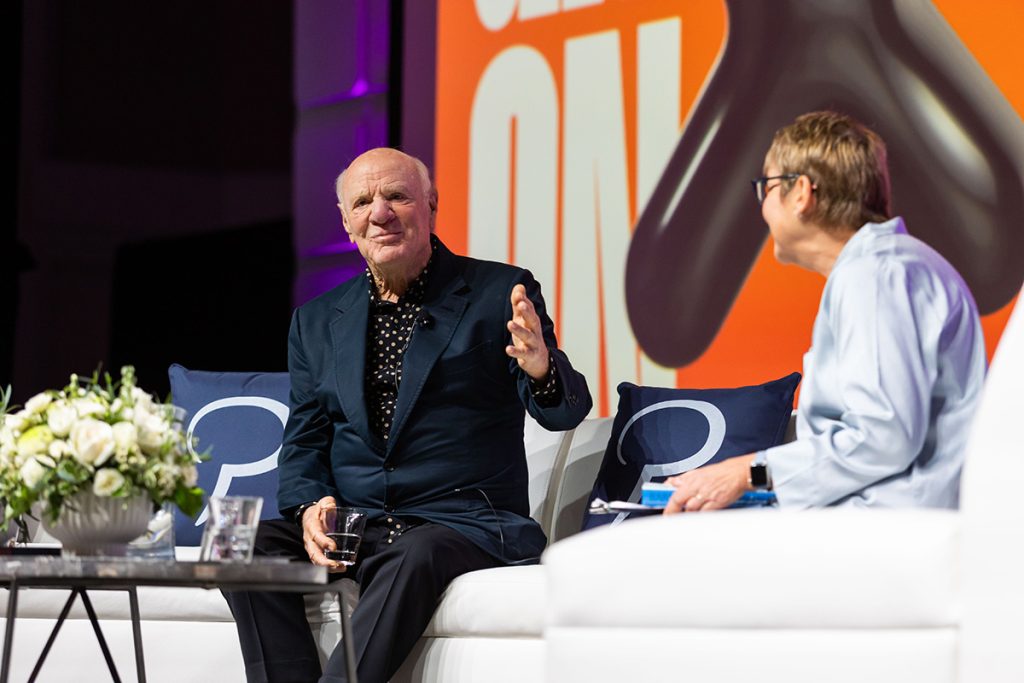
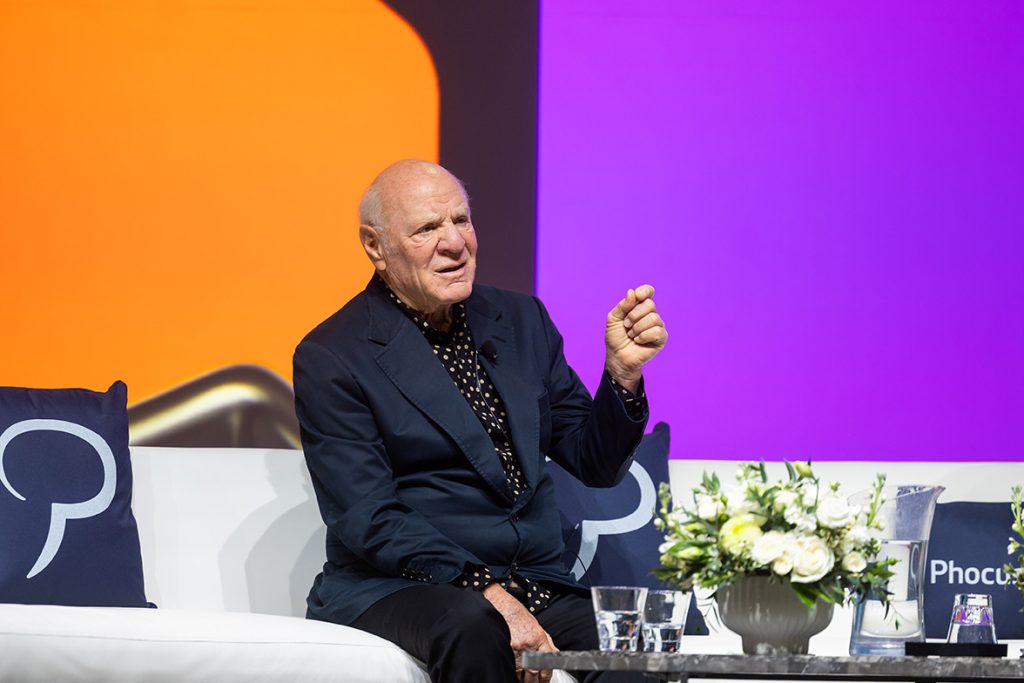
I’ve long been a fan of Barry Diller, so when he walked onto the Phocuswright Centre Stage in San Diego, 20 years after his last appearance, I was all agog with anticipation – as were the delegates in the room. Let’s just say it was the most packed session of the three-day event.
And so it should be.
At 83 years old, the executive who entertained the world with Hollywood hits, the entrepreneur who foresaw the first inkling of commerce through the screen at the age of 49, the leader who kept faith with travel through the darkest days of September 11, the philanthropist who gave New York two of its most enduring attractions, High Line and Little Island, deserves attention – not only for his business acumen but his personal courage in telling all in his book, “Who Knew”.
I had listened to the audiobook, which I highly recommend, so I knew his life story – and yes you can watch the video of his interview – but there’s nothing like being in the room and watching Diller field questions with ease and humour, speak with aplomb and confidence and essentially, tell the truth as he sees it.
I had seen him in action before, of course, speaking at previous Expedia Group’s EXPLORE events in Las Vegas and a few things he had said over the years still stick with me.
Truth matters: The unexpected response
For example, he believes in being as direct as possible and speaking the truth. And that was the intention behind the book.
“I thought, if I’m going to tell it, there’s no reason to do it other than to tell it true,” he said of the autobiography he laboured over for a decade, revisiting chapters, reopening wounds, and resisting the urge to soften the edges.
His wife, Diane von Furstenberg, had warned him “to get ready, it’s going to be very exposing.’ And I thought, oh please – my life’s been exposed for so long. Well… let me tell you. It is extraordinarily exposing.”
What he was most surprised by was the emotional response to the book. “I didn’t think it was all that emotional, and yet, I guess it is.”
“It all starts with the story”
In his book, he also talks about how “it all starts with the idea, the story” and guided by that philosophy, his name has become associated with blockbusters such as Saturday Night Fever, Grease, Raiders of the Lost Ark, Terms of Endearment (1983) and Beverly Hills Cop, among many more.
Which is why, when referring to his current media businesses, he related how when he visited his team at Travel & Leisure, he asked, “How come you didn’t invent White Lotus?”
And to the team at Food & Wine, “How come you didn’t invent Casamigos?”
“They have thought of themselves as totally advertising businesses. I want them to think of themselves as domain experts – because of our knowledge and because of our megaphone, we can invent things and promote them.”
For Diller, if you have domain expertise, you deserve to tell the story.
The end of Google search: “It is our opportunity”
Another belief he has is that to be a leader is to be an editor (it’s his media roots speaking here) – to ingest, digest and cut to the heart of things.
As he did when speaking about Google and the end of search, as we know it. “We have lived in the monopoly of Google… My company and its nearest competitor spend over $10 billion a year with Google on search. That’s ending.”
He credits AI, not competition, for breaking the monopoly. “Microsoft, after decades trying to crack into search, now finally has a chance. The search monopoly experience of Google is going to end.”
And in case we all lose sleep over what will happen to Google, he quipped, “Don’t worry about Google… they will be fine. But for those of us who serve on the land of Google, as Google has increasingly taken the page… this is ending. And it is our opportunity.”
The endurance of intermediaries and travel
And just as he believed in travel back then, when he went ahead with the decision to acquire Expedia during September 11, driven by that by-now famous phrase, “If there’s life, there’s travel”, he also believes that “if there’s travel, there are always going to be intermediaries” – okay, I paraphrased that.
Here’s what he said, “If you’re engaged in travel, you can’t be disintermediated. If you’re an intermediary, and you use AI tools… I don’t believe we are going to get disintermediated in that future.”
He knows AI will reshape business economics. He knows a bubble is coming. He knows electricity, not software, is the current winner.
But the truth remains: AI doesn’t replace travel; it only rewires it. “Nothing is going to disintermediate travel. No technology, no anything is going to get in the way of the experience of travel.”
Even the metaverse got the Diller treatment: “The metaverse was a nice idea… but that’s yesterday’s news.”
AI, not avatars, is the force that will reshape the next era, he believes and yet he says, “I’m going to count on human folk walking around, thinking, talking and relating to each other.”
Either you are or you aren’t
In his book, Diller shares the moment when at 49, he decided to leave the corporate world to become an entrepreneur, acquiring QVC, the home shopping network, declaring, “Either you are or you aren’t.”
“I wasn’t a natural one. I was a tried-and-true corporatist,” he wrote.
On stage, he said, “I had to literally push myself out of the door to start something new.
“I don’t think of it so much as aspirational, because working in companies your entire life is a certainly fine thing, and I have absolute respect for it. But if you got that urge in you, that bug at some point, grab it, because every year that you don’t, you will have regret.
“I didn’t want to have that life of regret.”
He sees himself as more a builder, not a custodian. “I’m not a very good shepherd of things already built,” he said. “I like buying. I don’t like selling.”

Las Vegas is the asset you can’t replace
Diller’s philosophy on irreplaceability is simple: Buy what technology can’t touch.
That’s why he bought MGM Resorts. “No one is ever going to duplicate Las Vegas anywhere in the world, not Saudi Arabia, not anywhere… it’s not possible.”
And he shared that 42% of every dollar that flows through Las Vegas flows through one of MGM’s properties.
Philanthropy and the next risk
Asked about his philanthropy work, Diller smiled, saying, “Go to New York. Go see Little Island. It’s a pretty thing – I mean, it was a nightmare to build but bad experiences you don’t remember.”
When asked, “What’s the next risk you’re going to take”, his answer came fast: “When I walk out of here.”
I imagined he was worried about being mobbed by fans – and perhaps deep down, underneath that smooth, easy confidence borne of 83 years of experience, is that shy, awkward teenager who came from a difficult family, who struggled to fit in at school, confused and unsure …
Or maybe that’s just my imagination but then as Diller says, the story matters.