


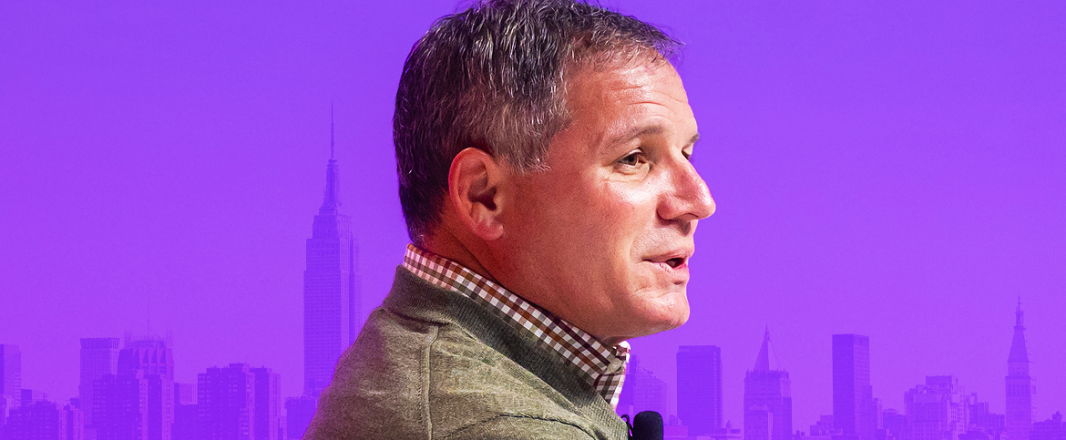
He probably has the toughest job in travel right now – for instance, I had more anxiety travelling to the US than Riyadh, Saudi Arabia, where I had just been before making my way to San Diego.
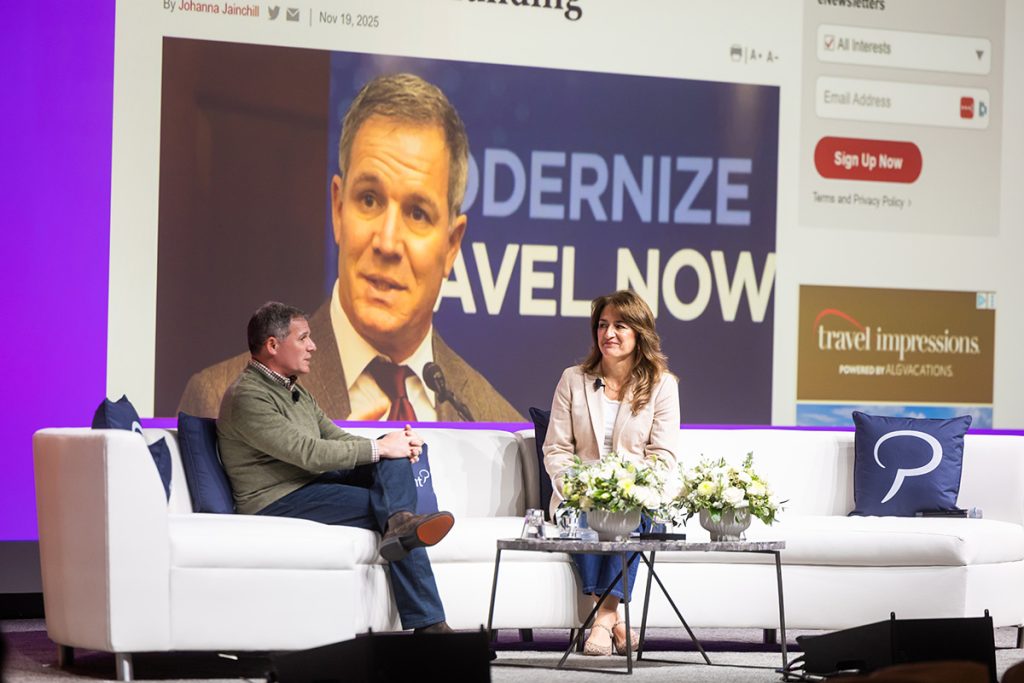
So, when U.S. Travel Association president and CEO Geoff Freeman spoke at Phocuswright, I listened with interest, and he didn’t disappoint with his candour and frankness.
He opened with a stark warning – the United States is becoming one of the least competitive travel destinations in the world and the decline is self-inflicted.
The recent federal shutdown was only the latest blow to confidence in US travel, he said. Visa bottlenecks, rising fees, negative perceptions at the border, political dysfunction and a lack of urgency are all contributing to a troubling trend: the US will be the only nation worldwide to see a decline in inbound travel this year.
“We had 79 million visitors before the pandemic… this year, we’ll have 68 million visitors, four million less than last year. We’re going the wrong way.”
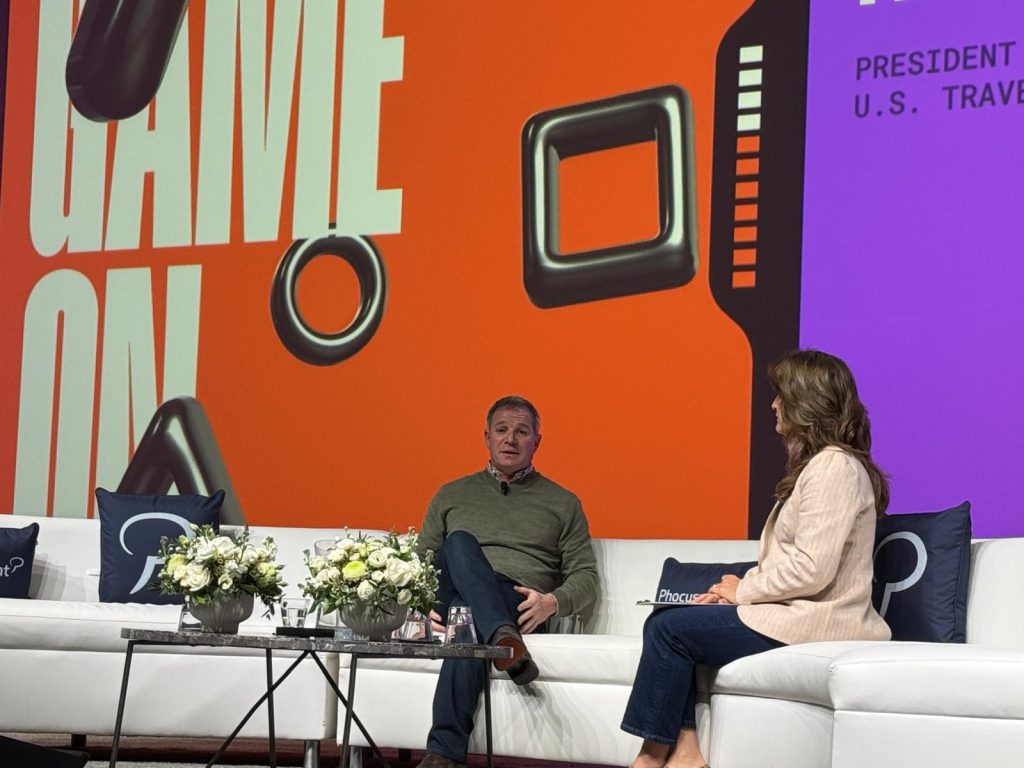
The shutdown: “Terrible and irresponsible”
Freeman did not mince words. The recent government shutdown, which he called “terrible” and “completely irresponsible” was disastrous for travel sentiment and operations.
“We saw a substantial reduction of at least 10%. I spoke with some of the airline CEOs who are looking at much bigger numbers through the end of the year. It really does affect consumers’ confidence. It affects their willingness to obviously get out there to travel for the holidays. It’s a big concern.”
Freeman said he hopes the political pain is fresh enough to avoid a repeat in January but he’s “not going to bet too much on that.”
“Nobody Feels Like They’re Winning”
Despite many policy wins under the Trump administration – $13 billion for air traffic control modernisation, faster global entry wait times, innovations at Customs & Border Protection –Freeman said the industry sees no net benefit. “Nobody feels like they’re winning right now, despite all of these positive things.”
International travel to the US is projected to be down 6% this year, driven by Canada, down nearly 25%. Germany is down more than 10%. The UK is barely positive at +5%. Mexico, notably, is a rare bright spot, up 12%.
Freeman highlighted a phenomenon he said few in D.C. want to acknowledge: fear of the United States is rising globally.
“There is fear about coming to the United States… fear of being detained… fear of having your device searched. People are now thinking that way coming to the US.”
Add to that a still-strong dollar and expensive airfares – compounded in Asia by the inability to fly over Russian airspace – and demand is softening across key markets.
Perception, he warned, has become a major deterrent. “There hasn’t been enough done to arrest that perception… to change that perception.”
To add salt to the wounds, the funding cut to Brand USA – 80% of its public budget – was “devastating,” Freeman said.
Now, a bipartisan bill aims to restore funding, but Freeman is clear: marketing isn’t enough. “Travellers know we have beautiful attractions… what they don’t know is that they’re welcome.”
“Visa integrity fee”: Stopping this is priority
Visa processing delays have exceeded 400-500 days in markets like India and Colombia. While the administration has made progress, Congress has added a new problem: the proposed $250 “visa integrity fee”.
Freeman is unequivocal: “We call it a deterrence fee… It would make the United States the second most expensive country in the world to enter, next to Bhutan.”
A family of four from Brazil would pay $1,000 just for the privilege of entering the U.S. Stopping this fee, he said, “is our top priority.”
He noted that US missteps are driving travellers to rival markets. “What I hear from our counterparts around the world is a big, hearty thank you. We’re driving travellers into their arms.”
A two-tier travel economy emerging at home
Domestically, the US is experiencing what Freeman calls a “K-shaped” travel economy:
- Affluent Americans are spending more than ever
- Everyone else is pulling back
High costs and economic uncertainty are suppressing middle-class travel. Yet the desire has never been stronger. “They value travel more than they did before COVID… they want to create memories.”
If certainty returns, he believes demand will follow.
Biometrics Could Cut Wait Times by 70% But Not Until 2042?
Freeman is bullish on technology if it can be deployed fast enough. Customs & Borders Protection is piloting “walkthrough” biometric entry, where most travellers are processed instantly using facial recognition.
TSA has the tech too – AI-enabled CT scanners – yet rollout is painfully slow. “At current funding levels, TSA will have every airport up and running by 2042.”
Freeman ended with a call to action: “The sky is not falling… but the need for this industry to be much more vocal than it’s ever been before is undeniable.”
Shutdowns, visa policies, funding diversions – these are political decisions that can be influenced. “Policymakers take travel for granted… we need to demand a greater focus,” he urged.


