
Selling an air ticket from Point A to Point B should be as simple as hailing a ride on Grab or Uber, shouldn’t it? After all, it’s been nearly 60 years since the first Global Distribution Systems took flight. Yet, in 2025, the experience is arguably more complicated, fragmented, and confusing than ever.
At WiT Singapore, a panel of experts from across the aviation and corporate travel ecosystem unpacked one of the industry’s most stubborn questions: Can we make flight booking about the customer again?
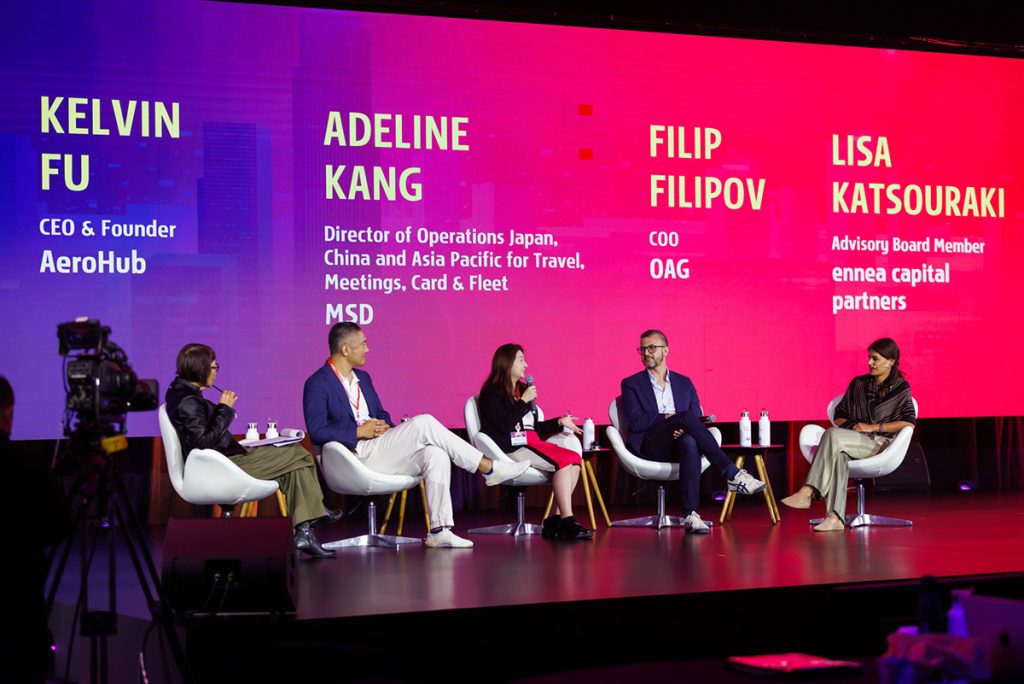
The panel featured Kelvin Fu, CEO and Founder of AeroHub; Adeline Kang, Director of Travel, Meetings, Card & Fleet (TMC&F) Business Partners, MSD; Filip Filipov, COO of OAG; and Lisa Katsouraki, Advisor at ennea Capital Partners
The great irony: More tech, more complexity
A show-of-hands poll revealed an audience evenly split on whether flight booking had become easier or harder than a decade ago.
For Kelvin Fu, a technologist and engineer, the answer lies in structure. “Ideally, the booking experience should be something we don’t even feel,” he said. “With AI assistants and standardized data, we’ll get there but only if flight and transportation data becomes better organized and connected.”
The culprit, he said, is fragmentation. “Hundreds of airlines building their own APIs will only amplify chaos unless the industry aligns on common standards.”
The corporate traveller’s double life
For Adeline Kang, representing one of Asia’s largest corporates, the complexity has moved from systems to expectations.
“In the corporate space, it’s become harder, not easier,” she said. “With so many choices, travellers now think they’re experts, they’ll challenge your fares because they’ve seen something cheaper online or asked AI where to find the lowest price.”
The irony, she added, is that the same person behaves completely differently when booking leisure versus business trips.
“They’ll be patient searching for the best holiday deal, but when it’s work, they expect someone else, often an assistant, to handle everything perfectly. And in Asia, when you’re booking for doctors or senior guests, expectations multiply,” she said with a smile

Adeline Kang (MSD): “With so many choices, travellers now think they’re experts, they’ll challenge your fares because they’ve seen something cheaper online or asked AI where to find the lowest price.”
The moment of truth: Disruption
From the data side, Filip Filipov (OAG) said the industry has focused too long on finding and booking flights, not fixing what happens when things go wrong.
“It’s easier to book now, but it’s still incredibly hard to change anything once you’re travelling,” he said.
“The real moment of truth is during disruption. Imagine your flight’s canceled – your calendar updates, and the system automatically finds you another seat and asks, ‘Would you like me to rebook?’ That’s when we’ll know we’ve nailed it.”
Personalization vs. fairness
The conversation then turned to one of travel’s most controversial frontiers – personalized pricing.
Fu warned that personalization can create confusion and distrust. “Diversity often equals complexity,” he said.
Lisa Katsouraki went further: “I think personalized pricing, as applied to airlines, is somewhat unethical. You can offer fare classes or volume-based deals, but charging different people different prices because of their profile or device? That crosses a line.”
Filipov recalled when Orbitz once showed higher fares to iPhone users – a decision that sparked a massive backlash.
Kang agreed: “Everyone in the room believes they’re the best buyer. No one wants to think they’re paying more than the person next to them.”
Her point underscored the heart of the issue: algorithms might be smart, but human ego is stubbornly analog.
The untapped territory: Backends and groups
If the front-end experience has seen innovation, the back-end remains a black hole.
“Everyone’s obsessed with front-end UX,” said Kang, “but the back-end – invoicing, group bookings, integration with meetings and events – remains painfully outdated.”
She described how even booking 21 people for a corporate or family trip still requires going through an agent. “No airline or online tool lets you do that easily. It’s a massive, untouched opportunity – but nobody wants to go against the GDS giants,” she said
Filipov admitted it’s a hard nut to crack. “The nine-passenger cap in GDS systems literally comes from saving a digit on 1960s computers,” he laughed. “It’s a miserable user experience — but for startups, it’s a car crash of complexity.”

Kelvin Fu (AeroHub): “Diversity often equals complexity.”
OTAs enter the corporate arena
Katsouraki noted that OTAs like Trip.com, Agoda, and Booking are expanding into SME and unmanaged corporate travel but warned of blurred boundaries.
“OTAs can offer a slick experience, but they don’t provide duty of care,” she said. “That’s the difference between unmanaged and managed travel, and that’s what corporates pay TMCS for.”
Fu agreed that OTAs’ agility gives them an edge: “They move faster, cover more airlines, and adapt quicker. They’re digital-first. But the service layer still matters and that’s where traditional players must reinvent themselves.”

Lisa Katsouraki, ennea Capital: “OTAs can offer a slick experience, but they don’t provide duty of care. That’s the difference between unmanaged and managed travel, and that’s what corporates pay TMCS for.”
The price paradox
With 61% of passengers now booking directly with airlines (according to T2RL), Filipov questioned whether the distinction between channels even matters.
“If your AI agent books your flight based on your preferences, does it really matter whether it’s direct or via an OTA?” he asked.
Price remains a factor, but less so than before. “People still click the first, cheapest result – but in an agentic world, that decision will be automated. Maybe your AI will factor in layovers, safety, or even coffee prices at the connecting airport,” he joked.
The real metric: Safety and trust
Kang brought the discussion back to fundamentals. “For me, cost is never the most important thing. The most important thing is safety,” she said. “Whether I’m managing corporate travel or flying myself, duty of care comes first. If booking tools could surface real, trusted information – like safety ratings – people would make better choices.”
Filipov agreed, adding that despite rare tragedies, “air travel remains one of the safest forms of transport on earth. Four billion people fly every year. That’s extraordinary.”

Filip Filipov (OAG): “It’s easier to book now, but it’s still incredibly hard to change anything once you’re travelling.”
AI, agents, and the next flight forward
When asked if flights will ever be sold like ride-hailing – instant, transparent, personalized – the panel split evenly between “yes” and “never.”
Fu was optimistic: “AI will get us there.”
Filipov deadpanned: “I hope not – or they’ll try to sell me a meal mid-flight.”
Katsouraki argued that innovation won’t come from a single sexy startup but from network effects. “This industry runs on perseverance and hard work, not just ideas. It’s about scale and trust, not novelty,” she said. “Distribution is finally shifting away from the GDS paradigm, but it’ll take time and grit.”
Rapid fire
- One thing to still pack in 2045? “Underwear,” said Lisa, to laughter.
- Will travel agents disappear? “Never,” Filipov insisted. “People have been predicting their death for 20 years. They’ll stay.”
- In-flight meals in 20 years? “Only better,” said Adeline.
- Where would Kelvin time travel to? “Home – to see where we’ll go next.”
The takeaway
For all the talk of AI, APIs, and automation, the panel circled back to one truth: air distribution has always been about people – travellers, agents, engineers, and dreamers trying to connect the world more seamlessly.
Technology may rewrite the rules, but the next 20 years will test whether the industry can rewrite its mindset – from systems built for suppliers to systems that finally, and fully, serve the customer.