



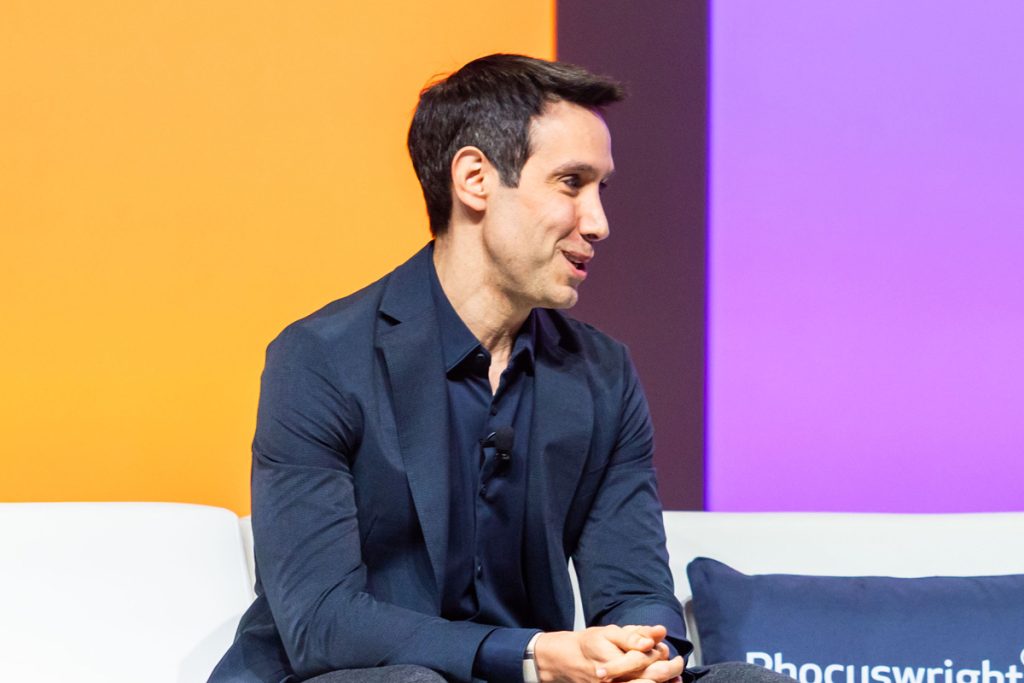
Phocuswright 2025 opened with a quiet but unmistakable shift in narrative: for the first time in its history, the conference handed its opening spotlight to a brand from Asia. And on centre stage stood Omri Morgenshtern, CEO of Agoda, a company celebrating 20 years and increasingly shaping how the future of travel will be built from East to West.
If the moment carried pressure, Morgenshtern didn’t show it. “More pleasure than pressure,” he told me.
“Travel grows over the long term, and Asia, because of its sheer scale, its rising GDPs, and the velocity of its young consumers, is where the future is being written. But it’s also the most competitive, most diverse, and hardest region to scale. That’s what makes it fun.”
What followed was a fast-moving conversation about the future of OTAs, why AI isn’t their demise but the biggest unlock they’ve had in years, and why trust, not tech, is the real game being played.
AI Won’t Kill the OTAs. It Will Make or Break Them.
For an industry that once predicted the death of travel agents and is now predicting the death of online travel agents, Morgenshtern was both clear-eyed and unfazed.
“AI is a huge opportunity. We relied on search engines for many years. Now, for the first time, we can become the search engine ourselves.”
OTAs, he argued, finally have a chance to own the top of the funnel, something they once outsourced to Google at a very high cost.
Developing the tech to get there used to be nearly impossible. Now, with AI:
- The cost is lower
- The capability is higher
- And the opportunity is existential
He predicts a radically different user experience within two to five years, much of it led by OTAs rather than the big search platforms.
But he also warned against hype. “You need to resist the temptation to chase hype. Solve real consumer problems quietly, systematically.”
The Real Travel Problems Aren’t at the Top of the Funnel
Trip-planning demos are sexy, but Morgenshtern believes the problems that matter most – and where trust is won or lost – lie deeper.
“Payments, FX, access to funds, when things go wrong on a trip… these are the real pain points. We’re solving them gradually.”
Anxiety around money – how much you’re paying, how much you’re losing, how much you might need – is, he says, “the shared anxiety of humankind.” Fix that, and you build trust for life.
Trust, in fact, was his recurring theme. “One bad interaction and you lose the customer. Maintaining trust is everything.”
In a moment when AI can easily overpromise or mislead, this grounding felt strikingly pragmatic.

Will Asia Leapfrog the West in AI? Maybe. Maybe Not.
If Asia leapfrogged the world in mobile and social, could it do the same in AI, I asked? Morgenshtern thinks the answer lies with the consumer, not the companies.
“Asian consumers are young, fast to adopt, and open to change. But the region is so diverse that scaling one AI solution across markets is very hard.”
He sees Asia leading in adoption but not necessarily owning the innovation. AI will land “everywhere at once,” he said, but Asia’s complexity will force OTAs to experiment more aggressively and more locally.
At Agoda, that means thousands of experiments running daily, exposing different UI and UX concepts to different consumer groups across markets such as Japan, Thailand, Indonesia, India, and China.
And yet the big unlock remains unclear. “Trip planning is not just a chat problem or an app problem. It’s something in between—and nobody knows exactly what that is yet.”
Holding the Line: How to Win in Asia
Morgenshtern repeated a refrain he first shared at the GetYourGuide Summit in Bangkok in October: success in Asia requires both agility and discipline.
“Holding the line is as important as pivoting.”
It’s a region that demands:
- Deep localisation
- Patience
- Constant experimentation
- And the courage to stay the course
Asia is the land of extremes – fragmented consumer behaviours, fast-moving markets, and intense competition. Companies that panic or flip strategies too quickly often burn out. Those that stay consistent win.
Why Agoda Thinks OTAs Will Become Banks
Morgenshtern also spoke with great enthusiasm for fintech, an area he feels is especially complex to solve in Asia and thus, holds the greatest opportunity for those able to crack it.
“I’m a FinTech geek. Payments is where so much innovation will happen. Everything payments, everything FX, everything travel money, this is where big value is.”
He argues:
- OTAs already operate massive internal fintech engines
- They move staggering volumes of money
- They optimise FX and payment networks “to the cent”
- They are among the strongest lead-gens for financial products
So, could OTAs become more like banks? “We already help banks access travel. Over time, we’ll expose more of our fintech capabilities. That will grow everywhere, not just in the US.”
His belief: Travel is the biggest discretionary spend most consumers make annually. When someone buys a US$2,000 holiday, it is often the moment they think about loans, savings, credit, loyalty points, FX, or insurance.
Banks know this. OTAs increasingly know it too.
The Agoda-Booking Question: Would He Run It Differently?
Asked whether he’d run Agoda differently if it weren’t part of Booking Holdings, Morgenshtern smiled, and played it straight.
“If I were a founder running it myself, many things would be different. But I’m lucky. Especially in Asia, we get the support to invest, grow, and stay entrepreneurial.”
The fact that he who, he said, is deeply technical, deeply product-led is now CEO of Agoda tells the story, he said, of a parent company that wants innovation rather than restrains it.
To my question as to what he’d advise the next Glenn Fogel (CEO of Booking Holdings), he ducked, flipped the question and quipped, “Figure out what he’s doing to stay so young and do it.”


