
GetYourGuide’s expansion from Europe into the US — and now a renewed focus on Asia Pacific, where the company’s journey began — spans markets with very different travel behaviours, holiday patterns, and sensitivities around price. Yet, according to Emil Martinšek, Chief Marketing Officer of GetYourGuide, one constraint has remained consistent throughout that journey.

“You have two very valuable assets in your life: time and money,” he says. “You’ll spend money where you think it gives you something for your time.”
That belief frames how Martinšek thinks about travel decisions across regions — and how GetYourGuide approaches growth: not by competing purely on price, but by helping travellers choose experiences with greater confidence.
Demand Was Never the Question
Martinšek does not describe travel demand as cyclical or fragile.
“Very fundamentally, there is an extraordinarily powerful desire to travel,” he says. “If you look at the past 25 years, through economic uncertainty and geopolitical uncertainty — travel just keeps going up and to the right.”
What has changed is not whether people travel, but what they expect from it.
“In the last 10 years, you’ve seen a huge shift from just ‘I’m going to fly there and book my hotel’ to ‘I want to experience the local culture. I want to experience different things.’”
Experiences, in his view, have moved from being optional additions to becoming central to why people travel at all.
Europe: Long Holidays, Deep Planning
GetYourGuide was founded in Europe, where Martinšek observes that travellers often plan longer, more immersive trips.
“Europeans are often travelling on longer holidays — to Thailand, Indonesia, Japan,” he says. “They’re reading everything. They’re consuming everything. They’re watching all the content.”
Across those journeys, the focus is consistent.
“What everyone is really focused on is how do I experience that destination more immersively than I otherwise could.”
Serving that traveller required depth — content that could support high-consideration decisions and extended planning cycles.
The US: When Time Becomes the Pressure Point
The context shifted when GetYourGuide expanded into the US.
“In the US, people don’t have a lot of holiday,” Martinšek says. “They’re really focused on maximising every day. They need to book the thing they want to do.”
In that environment, mistakes carry a high cost.
“If they get anything wrong, they’ve lost very valuable time.”
The strategy that worked was not centred on discounting.
“You really want to be sure that you have all the prices and availability there,” he explains. “You want to make sure all the photos and reviews are there, so they know what they’re booking.”
Clarity and certainty became the differentiator.

Fixing Fragmentation Before Scaling Value
Before GetYourGuide could scale globally, it had to address a structural problem in the experiences market.
“One of the challenges when we first started building the business was that suppliers of activities and experiences were highly fragmented,” Martinšek says.
Many operators were offline or invisible to international travellers.
“The first challenge was just to bring them together, get them online, get their content visible.”
But visibility alone was not enough.
“Over time, we then found ways of expressing that content — bringing in reviews, making sure the photos were good — so that consumers could actually see and almost feel what the experience was going to be like.” Execution mattered.
“If people are inspired to do experiences, the product has to actually be there. They have to understand what’s possible. They have to be able to book it.”
Who Actually Drives Experience Spend
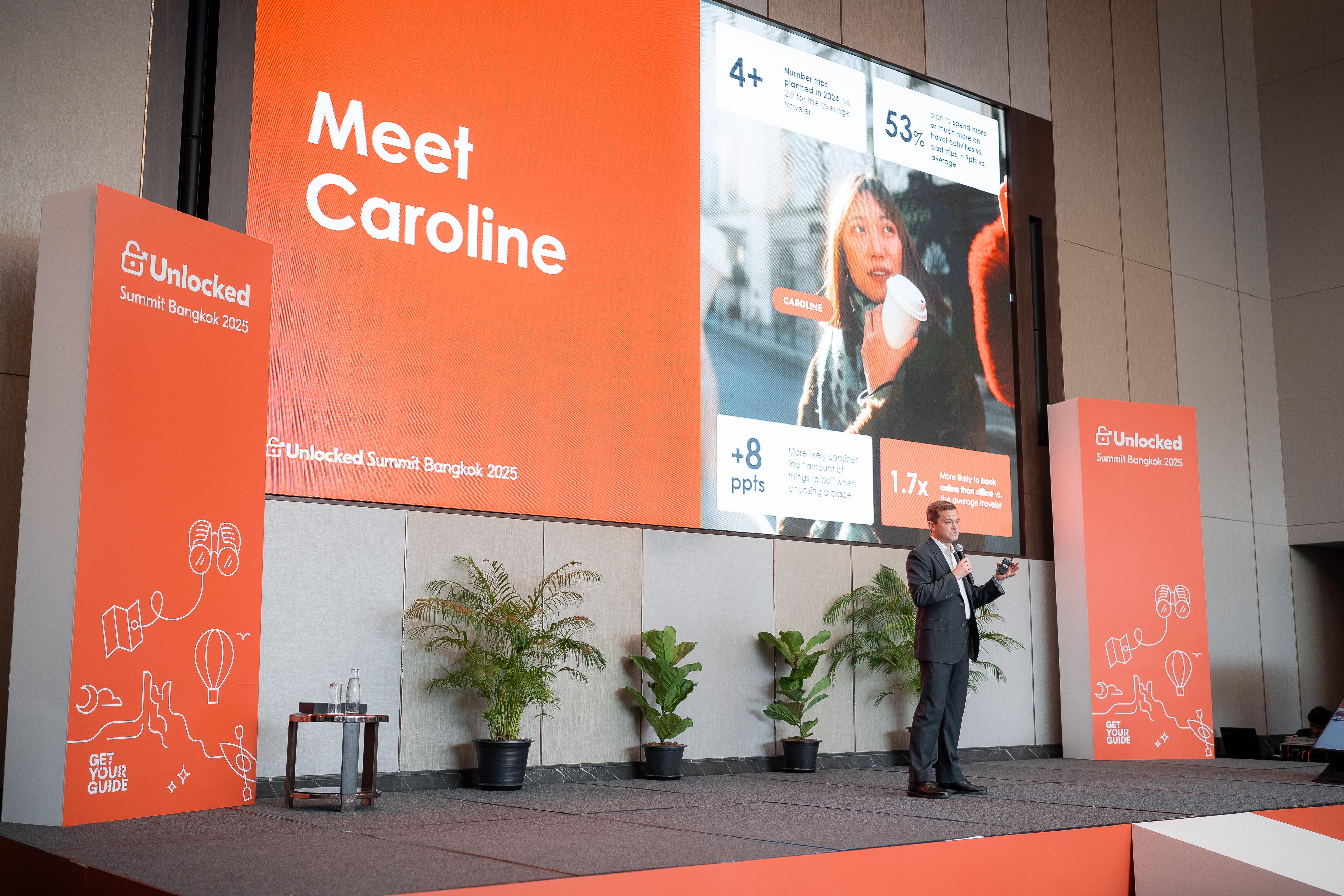
Internally, GetYourGuide works with a defined customer archetype known as Caroline.
“We call our customer Caroline,” Martinšek says. “We’ve done a lot of conversations with customers to try to learn what motivates them.”
Caroline is not an occasional traveller. “She travels usually between two and five times a year — not your once-a-year or once-every-two-years traveller.”
Her importance lies in how she spends.“The Carolines of the world make up about 40% of all travellers, but they make up over two-thirds of all experience spend.”
Her intent is explicit.
“93% percent of them say: when I travel, I want to make sure that I’m doing experiences in my destination.”
Asia: Price-Conscious, or Time-Constrained?
Asia is often described as a price-conscious market. Martinšek does not dismiss that perception, but he reframes it.
“Of course, we do see the price-conscious side of Asia,” he says.
“But ultimately what people are asking is: is this the thing I really want to do?”
What the Numbers Are Showing
Martinšek points to strong momentum in both travel volume and value across Asia.
“If you look at our business right now, travel within Asia — Southeast Asia and East Asia travelling to the same region — is up over 100% year over year,” he says.
Inbound demand is also growing.“We also have Europeans coming into Asia, up about 75% year over year.”
The movement is not one-directional.“If you look at Asian travellers going to Europe or going to the US, that’s growing between 50 and 80% year over year, depending on the geography.”
Spending behaviour is shifting alongside volume.
“We’re actually seeing average order values in Asia climbing,” Martinšek says, noting that “In some cases, they’re already higher than the average order values in European countries.”
He attributes this to more deliberate choice.
“People are finding experiences that are unique — one-time — and they definitely want to do them,” he explains.
“Instead of saying, ‘I want the standard experience 20% off,’ people are saying: ‘I’m going to pay two times as much because I know I’m going to love it.’”
AEO and Where Decisions Now Begin
Discovery, Martinšek notes, is also changing.
“A year and a half ago, we had basically no AEO — AI engine optimisation — traffic,” he says. “Today, it’s about 10% of our SEO-equivalent volume.”
The trajectory is steep. “By the end of next year, we think it could be close to 50–50.”
That shift changes where decisions begin.
“AI allows you to connect with people much further up the funnel,” he explains.
“When someone starts asking questions like ‘What can I do in Jakarta?’ you can be there with answers based on your content and your community’s knowledge.”
The requirement becomes usefulness.
“You have to set up your content to be useful in an AEO world,” he says. “You win by solving customer problems.”
From Discounts to Guidance
AI also reshapes how marketing works.
“In Meta advertising, we do a lot of targeting of individual consumer groups now,” Martinšek says. “In CRM, email programmes, notifications — you can customise content at scale.”
That enables more specific conversations.
“You can say: you’re travelling to Rome — here are the things you should think about, based on what you’ve told me and what I know about you.”
This supports a move away from discount-led acquisition.
“I don’t want to market by throwing a discount on a meta search site,” he says. “I want to tell a story. I want to create the content. I want to make your experience stand out.”

Closing: Why Creators Drive the Next Phase of Value
Looking ahead, Martinšek believes creators will play an increasingly central role in shaping not just discovery, but value.
“Creators tell the story so well. They get people so excited,” he says.
“And I think that brings a lot of value for the partners who are trying to present themselves in a unique way.”
That storytelling, he explains, shifts behaviour.
“It’s not just about booking the cheapest walking tour,” Martinšek says. “It’s about booking the walking tour with the guide that you really want to spend time with.”
When that connection is made, price becomes secondary.
“Instead of just saying, ‘I want the standard experience 20% off,’ people are willing to pay more because they know they’re going to love it,” he says.
For GetYourGuide, this is where creators, content, and technology converge — not to push discounts, but to surface experiences that feel personally meaningful.
“AI allows us to send more unique and specialised content to individual travellers,” Martinšek says.“So you can find the things you might not have otherwise found.”
As that happens, value follows. “That’s how you move away from just selling the cheapest option,” he adds,“and toward higher-value experiences that people actually want to spend time on.”
In that future, creators don’t just inspire travel — they help define which experiences feel worth choosing, and which journeys travellers remember long after they return.
—————————————————————————————————————————————————–
Watch the full video interview with Emil Martinšek, Chief Marketing Officer of GetYourGuide here: