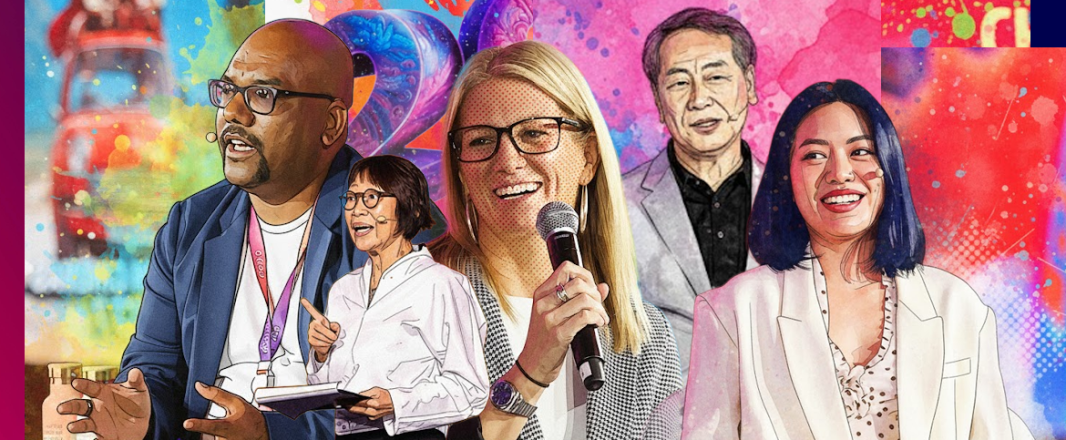
From rock-and-roll endings to raw honesty on AI, WiT Singapore 2025 hit every note –human, hopeful and hilariously unfiltered. Founders bared souls, CEOs dropped truth bombs, and travellers found faith again in connection. Here are 20 stories from Luke Clark that prove The Next 20 wasn’t just a conference – it was a jam session for the future of travel.
Industries Need More Rallying Calls Like Xing Xiong’s
We sometimes like to believe that we are rational beings. But when something lands that delivers us the right emotive punches, we realise again how important it is to hear encouraging and human messages from our own industry leaders. Such was the case with Trip.com Group’s chief operating officer, Xing Xiong.
While we all rationally dismiss the doomsday talk of machines replacing humans, many people continue to buy into the idea that AI is a better bet than hiring human beings. It was timely to hear some balance. “AI is just one of the milestones of human advancement,” he noted. “It’s an empowerment, not a replacement.” Xing in turn provided the knockout punch in terms of the show’s quotable quotes. “AI doesn’t have passion. People do. That passion, that willingness to solve problems – that’s our biggest asset.”
The Unsexy Part: What Matters Is To Make Travel Work Better
One recurring discussion thread was that while we love the idea of invisibility cloaks which hide our presence from wild animals, and other wildly fanciful inventions, sometimes the real task at hand for technology and the industry’s boffins is making what we have, work better. Many forget for instance, that 20 years back in 2005, we already had Wi-Fi. But it was much slower and less reliable than today – and certainly couldn’t be relied upon to watch a feature film. The same applies to many travel-tech innovations today. Indeed, making ‘the connected trip’ work properly, while making travel simpler, more democratic and far more transparent, would indeed be valid goals for our industry to master over the next 20 years.
It May Be Funny But ‘The Bed Bugs Story’ Reveals Serious Perception Issues
It drew genuine laughter from the audience, but it should also be something we discuss again in a different light. During the session ‘Founders & Futures: Guardians of the Next Galaxy’, Reiwa Travel’s CEO & Founder Takaya Shinozuka was asked to explain why more Japanese people don’t have passports. Among the numerous reasons, he suggested that Japanese people seem to have a heightened perception of risk outside their country. “We’re a small island, and we have so many news sources,” he noted. Then he reached for a story. “One very good example is about South Korea.
Maybe a year ago there was an outbreak of bed bugs, and the story went really viral in Japan,” he recalled. “And then, Japanese people started thinking ‘South Korea has so many bed bugs’. So Japanese people didn’t go to South Korea.” Yet, if you ask anyone from South Korea, including the two panellists beside Shinozuka onstage, it seems the bed bug problem was mainly a Japan issue. He asked all his friends in South Korea, had they seen evidence of the problem? “No one said yes.” His rather sobering conclusion: the media is scaring many of us into staying home. “The Japanese media is sometimes very, very bad when it comes to news on other countries,” Shinozuka noted soberly: “For Japanese people, we overestimate risk every time. It’s a very difficult question.”
Our Host Managed Several Times to Become the Story
As a former news editor myself, I was one of those adding to the ripple of excitement that trickled through when Yeoh Siew Hoon got up on stage to interview Eijiro Yamakita, President & CEO, of JTB Corp. Of course, they know each other well, and had been onstage together several times. But the recent news that JTB had finalised its acquisition of Northstar Travel Group, parent company of WiT, had in the meantime added a new dimension to the discussion.
“Be kind to us,” Siew Hoon noted to Yamakita with a grin, amidst gentle laughs. In another panel, Reiwa’s Takaya Shinozuka asked Yeoh about her inspiration to continue with WiT 20 years later. She met the question with aplomb: “To welcome you back to the stage, you know, as full-fledged founders, building profitable companies and future models – and taking on such a complicated challenge that you’re doing all to grow travel for your generation. To me, that’s why I do it.”
A Map of Places With “No Influencers”
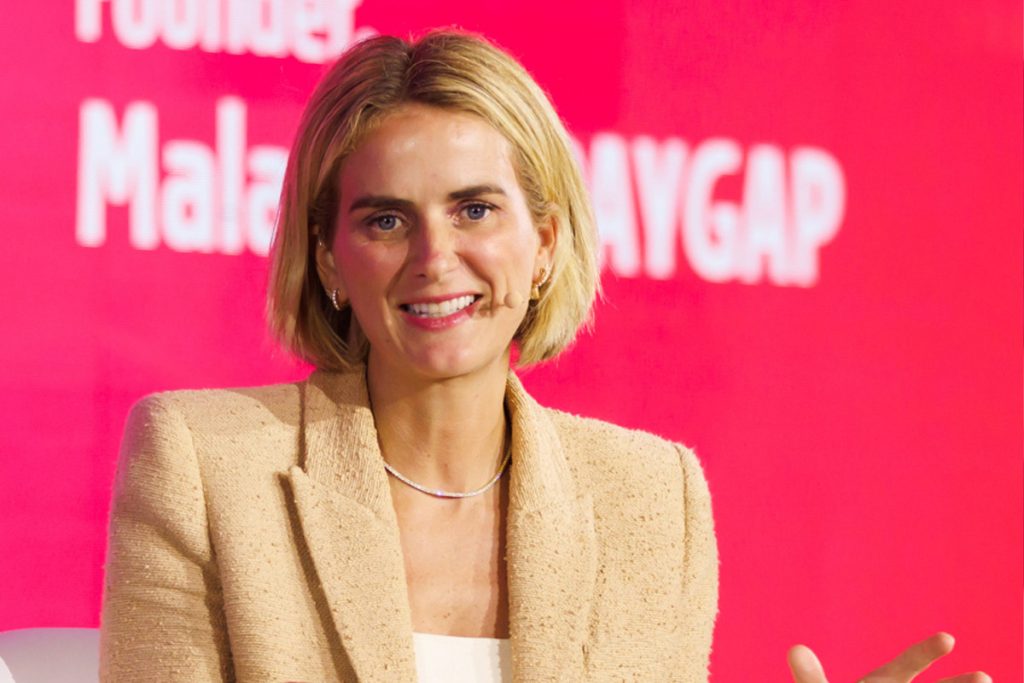
Google’s Hermoine Joye may not have proposed a saleable item for Google’s successful online mapping department – but she did attract audible cheers from the audience, when she suggested during her panel’s rapid-fire session, that one innovation she’d like to see in travel was “a map of the world of places where there are no influencers”.
The Loneliest Generation of Ghosts
Because travel-technology is the industry at hand, there are moments when we appear to be the source of both the problem and the solution at once. So, it was during the ‘Experience Surge: The Quest for Personalisation, Meaning and Communities’ session, when Tushar Kandewal, co-founder of TourHero, memorably observed that due in part to isolating technologies like mobile phones and social media, we are in fact, more cut-off from each other than ever.
“We live in the loneliest generation”, observed Kandewal somberly, a claim about Gen Z that is supported by research. “I call this generation ghosts,” he noted chillingly. Yet thankfully, though technology may be somewhat to blame, travel can still save the day, he argued: “The antidote is getting together in person.”
From The Sound of Silence To The Science of Scaling
Barry Smith, co-founder of Skyscanner, had his own generational challenge during his panel session, ‘The Social Surge: Discovery, Influence & Commerce’. For several long moments, the polite gentleman sat through group exchange after exchange on social media trends and practices, without being invited to contribute.
Fortunately, this slightly anti-social situation – innocent though it was – found its conclusion when from the floor, Yeoh Siew Hoon cut in to ask Smith a question of her own. Despite a relative lack of runway during that session, he still did do a remarkable piece of ‘social selling’ of his own, recommending a business book [‘The Science of Scaling’ by Dr Benjamin Hardy] which he says he recommends to every member of his staff. The great news for Dr Hardy? There’s nothing like a book endorsement from a co-founder whose company sold for £1.4 billion.
Art And Nature: People Still Want The Real Thing
For Kristian Schmidt, Photographer and CEO for the Livingstone Club, capturing a close encounter between a deep-sea diver model and a whaleshark would become an event that would changed his life and career. “I was diving with a charity called Wild Date”, the fine art photographer describes, “and decided I really wanted to do this photo shoot,” he recalls. His partners recommended a location in the Philippines.
Having earlier met an underwater model in Miami, the shoot was soon in play. “You get an enormous amount of respect for animals and elements,” he describes of this work. “I’ve even been whacked by whale shark fins, but nothing extreme: mostly you just learn how to work with them.” Now that the work has bought him a level of fame he hadn’t been used to, Schmidt – who is in fact film star Ingrid Bergman’s stepson – is at least confident that AI won’t disrupt his work. “People who buy what I do, don’t want anything fake.” His advice to others seeking similar ways to find their own creative outlet? “Step outside the box and do your own thing”.
The Good Geeks Can Sell Us The Dream
The technology industry has not had the best of times in the public imagination in recent years, and perhaps for good reason. Gone are the days when tech leaders were brandished as having the sort of ideas that are universally good for the world, and not just good for their business elite. Yet just as we once fell in love with the ‘geeks’ who first built this internet-driven dream – or at least with their sense of possibility – so we must remember that many of them still represent the dreamers and doers who can inspire us to dream big.
This was definitely the case when Agoda’s CEO Omri Morgenshtern and CTO Idan Zalzberg shared their own vision for ‘The Next 20’ onstage. Indeed, you could feel a surge of positive recognition, when Zalzberg affirmed that technology now has the power to boost travel for all: “We’re going to make travel more available to everyone, and it will happen much more. The passion to travel, this idea that ‘I want to explore’, is so rooted in being human, that we believe it will become more and more of how we spend our time – and then it’s about, Do we have the right technology to support it?” Here’s to us all making that new dream happen.
The Unique DNA of Travel Founders
One of my all-time highlights during an early edition of WiT was watching Expedia co-founder Richard Bangs speak onstage, and later memorably share with me his take on the ‘Call of the Wild’. [“It provides sort of a mental cleansing… It’s a dialling back to a more primitive state of grace”]. One of the co-founders that Bangs would have enjoyed meeting I’m sure, is Jacinta Lim, co-founder of Seek Sophie. I asked her during her mentoring session at the Next Generation Leaders event, what it was about her and co-founder that made them keep going, pivoting and re-iterating, even during the heart of the Covid pandemic, while maxing out their credit cards to keep the business afloat.
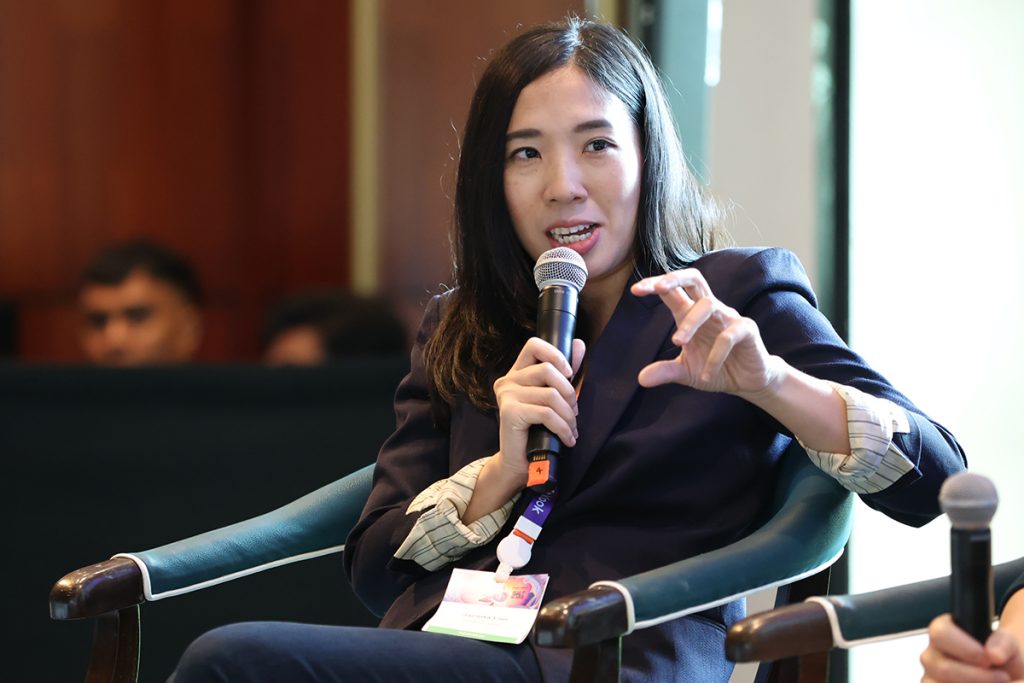
What qualities do they have that others could learn from? “I mean, to me, I’ve got no choice,” smiled Lim. She recalled her determination to move forward after giving up her legal practice,. “A lot of my friends who quit law, they kept their practicing certificates,” she recalled. Not Lim. “I wanted to burn every path – no lifeline. And I think for the really big moments, like the pandemic, for those literal on-the-floor moments every single day – you just kind of remind yourself that ‘Look, you have to do this’, and then you’ll see where it takes you.”
Business And Purpose As A Channel for Grief
Every successful founder of a travel business is grateful for what the experience has given them. But for Simon Wong, co-founder of Singapore Sidecars, his business truly was an escape from something far worse – the loss of his beloved young wife to cancer. “I think initially it was really a lot to do with being a channel for grief,” Wong reflected on the process of building the business in the years following her loss.
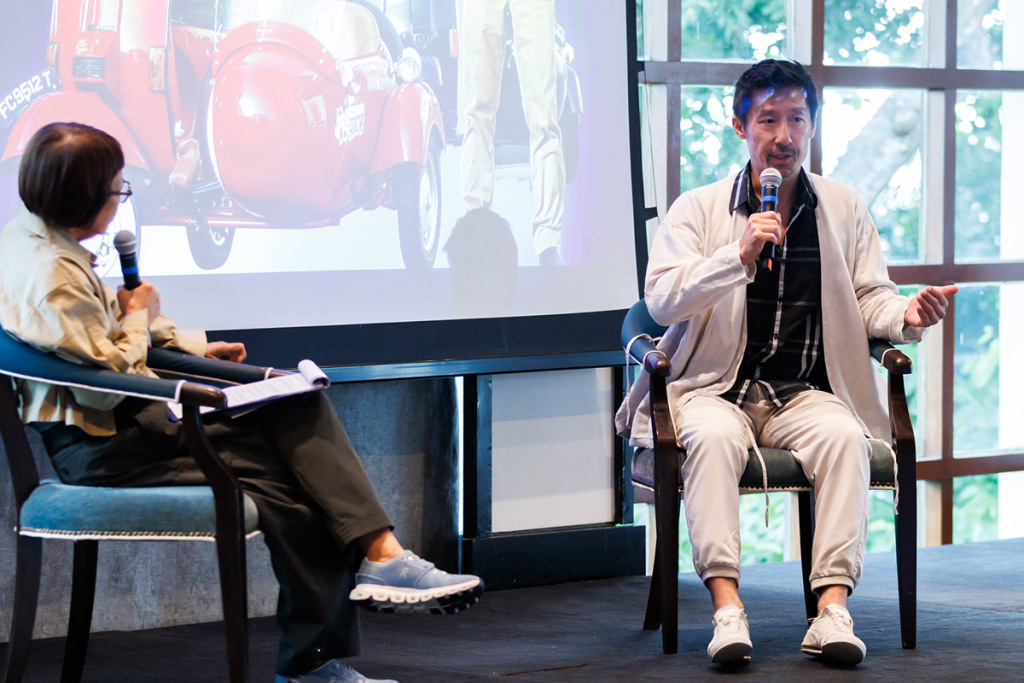
Eventually, he realised that his new pursuit had invested him with a cause. “I’m going to live a life even better than before – and just keep making things better.” As such, when you meet Wong in person, and appreciate the positive energy he radiates, you have to feel that his new mission has been a success.
Unfiltered Moments Prove why AI Could Never Run Great Events
The WiT conference clearly has sponsors and commercial elements just like any other. But what keeps it relevant and fresh is that it also hosts genuine human conversations, and more than occasionally, some excellent unfiltered moments. A couple from ‘The Next 20’ come to mind immediately: the first was in the investment session, ‘Capital in Action: Flow For The Next Age’, when moderator Chris Hemmeter of Thayer Ventures, rightly observed: “We’re in an AI bubble – whether it’s productive or not, remains to be seen.” He asked Susli Lie of Monk’s Hill Ventures, might it burst in the next 24 months?
Lie was unsure of the timeframe but said she was looking forward to a time again of “good old-fashioned companies that are not flaunting their AI crap”. The audience was suitably amused. My second favourite unfiltered moment? Photographer and Livingstone Club’s Kristian Schmidt stepping onto the stage, only for Yeoh Siew Hoon to welcome him onstage by telling him he had a “nice butt”. Both quickly moved forward with the interview.
Meet The Man Who Defines The Long Game
For those who bemoan the amount of time that it takes to get a travel business moving, talk first to Aloke Bajpai, Chairman, MD & Group CEO of ixigo. Luckily, Bajpai has a strong and optimistic spirit, because in his company’s case, India’s travel market would surely test that spirit. For the first 10 years, ixigo built utility apps, and made zero ticket sales.
Yet to Bajpai, this decade was a drop in the ocean compared to the promise ahead. “This tiny bit of focusing on pain areas gave us growth that we never imagined.” In 2024, after 17 years, Bajpai finally took the company public. “We managed to pre-empt some of the changes in the market,” he said, “and to create something way bigger than we could have imagined.”
The Moment Arrives When You Get That Call
Some phone calls are fated to change your life. For Carolyn Choo, CEO & Managing Director of Worldwide Hotels Group, that call came from her legendary father and businessman, Choo Chong Ngen, in 2022. “He just asked me, point blank, ‘Can you come back now?’ And without hesitation, I agreed.”
Instantly stepping into the role of an “accidental hotelier” meant taking on the successful family business, and helping modernise a mid-market brand, in turn presenting Singapore with a bold vision for the future. “We define the ‘lean luxury’ concept in Singapore,” she explains. “To us, it’s about luxury that truly matters.”
Don’t Forget To Stop And Take A Good Look Around
For a generation that is at times obsessed with nostalgia, we still often spend too many moments in a way that John Lennon once described: “Life is what you’re doing when you’re busy making other plans.” For all the fervour for the future and its array of opportunities, many of us in travel are also becoming well aware that many of the most precious parts of our travel experiences, especially the cultural wonders, can be but a short-term thing.

“The only thing we can do is slow down – and just try to be more authentic,” says Prestine Davekhaw, Documentary Photographer, Disappearing Cultures. “This is the last generation that will know authenticity as we know it.”
Travel’s Responsibility to Reinvent And Spread Benefits
“The reason I joined Expedia was that it was successful in reinventing travel,” Alfonso Paredes, President B2B of Expedia Group said at WiT Singapore. “We have to do that again.” Now commanding a B2B network that produced 135 million room nights in 2024, one challenge for the company now is not only to grow, but also to diversify.
For Expedia as with all major travel brands, part of this is the imperative of spreading tourism’s benefits, especially given that 80% of travellers currently go to 10% of destinations. “It’s on us to explore what else we can do to help that,” says Paredes. “We all have a responsibility.”
Aviation’s Real Revolution Arrives in 2045
Few people have observed, analysed and influenced the airline industry as acutely as Peter Harbison, Chairman of GreenerAirlines.com. Yet as he reminded WiT delegates during his session titled ‘Aviation: The Next 20’, the sector doesn’t get the close attention it would seem to deserve. “Every one of you depends on aviation, but we don’t often think about it,” he noted.
Frustratingly, even the stakeholders who matter aren’t paying enough attention to aviation’s expansion: take for instance, a tripling of seats expected in the next 25 years: “And yet, there really isn’t much of a plan.” Thankfully, one massive breakthrough should help transform the industry in the next 20, when improvements in battery power bring us electric flights, likely by 2045.
Let’s Help Business Travel Do The Basics Well
As an industry, while travel has delivered growth and geographical expansion in an abundance, it still has not done as well when it comes to some of the most basic disruptions that affect business travellers especially. “If something happens during travel, it’s still incredibly difficult to change your flight,” says Filip Filipov, chief operating officer for OAG.
So, what would success on this front look like? “If we imagine a world where my flight is cancelled, your booking system offers to change flights for me – and I say yes, that’s when the system works,” noted Filipov.
From These Next Ashes, The Real AI Revolution Will Come
Ever the man to provide a tight contextual summary of something most of us would flap about with, Timothy Hughes, Vice President, Corporate Development for Agoda helped reassure many of the young travel professionals gathered for the Next Generation Leaders event. After all, walking into an industry dominated by discussion of AI disruption, yet equally aware of a potential ‘AI-bubble’ expected to burst upon the investment community within around two years, could well be disconcerting to many young recruits.
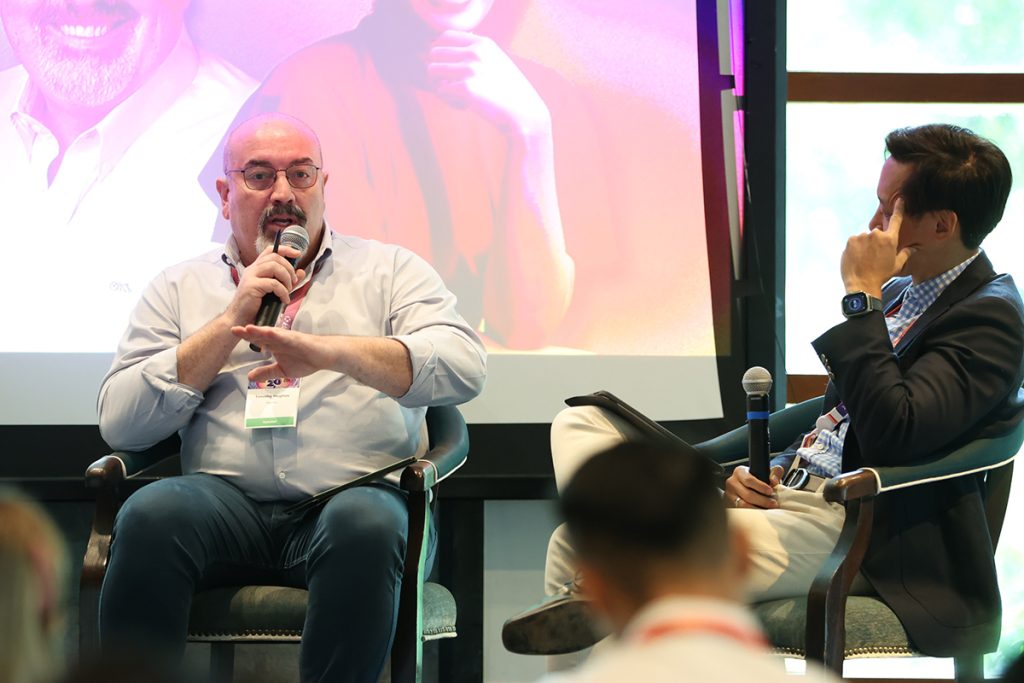
To Hughes, a veteran of the early dotcom years, this is all part of the process. “We have a history of proving time and time again that travel is unstoppable,” he assured them. “AI is going to change things: and content is going to change the way we search for travel,” he noted. “What we don’t know is how consumers will change the way we book.” He reminded us all, that it took 11 years for mobile technology to change bookings. There would be a similar story with AI. “We’re building a thing now, to fail, to then build it again.”
It’s Still Rock and Roll to Me
When your dogs have over the years been named Dylan, Bowie and Florence, it is no stretch to assume that if Yeoh Siew Hoon wasn’t onstage every few weeks of the year presenting WiT around the world, she’d very likely have ended up in a career onstage playing rock tunes. Those familiar with WiT through the last few years will know that music as a thematic element is never far away from this curator’s mind.
And so, how appropriate that Day 2 onstage be ‘hijacked’ by a recognisable cast of WiT co-conspirators, with a fabulous mock-up album cover of The Beatles’ Sgt. Pepper’s Lonely Hearts Club Band, featuring a cast of even more WiT co-conspirators [including her dog], and their own live rendition of ‘All You Need is Love’. The expression “only at this event could this ever happen” has a proud 20-year tradition – and this was another perfect surprise example. Bravo.