There’s more than one way to see a city, as Melbourne makes its case for incentive travel
I’ve been to Melbourne a few times but never for work. Having friends and family in a city often means you never get to be a “tourist” per se because you’ve got locals to show you the ropes. I thought I knew the city pretty well. But a couple of months ago I attended Australia Next in Melbourne with my journalistic goggles on, and it had a funny way of reminding me that Melbourne still has cards up its sleeve, especially when you look at it through the lens of incentives.
That became clear early on in my conversation with Julia Swanson, CEO of Melbourne Convention Bureau, who framed Melbourne not as a one-size-fits-all destination, but as a city that thrives on range. “Melbourne is a very well-rounded destination that can cater for a lot of different markets,” she said. “We’re a large city, urban, very sophisticated, very multicultural, and so we really cater for people from all different backgrounds and size and scale.” That breadth matters in incentives, where groups can range from a tight-knit leadership retreat of 20 to something on an entirely different scale. Melbourne, she pointed out, does both. “We work with groups as small as 20 people, all the way up to very large ones like Amway China, where we had 16,000 people over five waves. That was Australia’s largest ever incentive group.”
There’s always another layer
Accessibility is part of the equation. Melbourne’s direct flights from key Asian markets make planning easier, especially for incentive buyers managing large numbers. “Most key destinations in Asia are a direct flight to Melbourne,” Swanson noted. China, India and Singapore remain core markets, but she also flagged continued momentum from Southeast Asia. “KL, Indonesia, and we’re getting some growth out of Vietnam as well,” she said, adding that Vietnam and Korea are growth markets as air capacity continues to build.
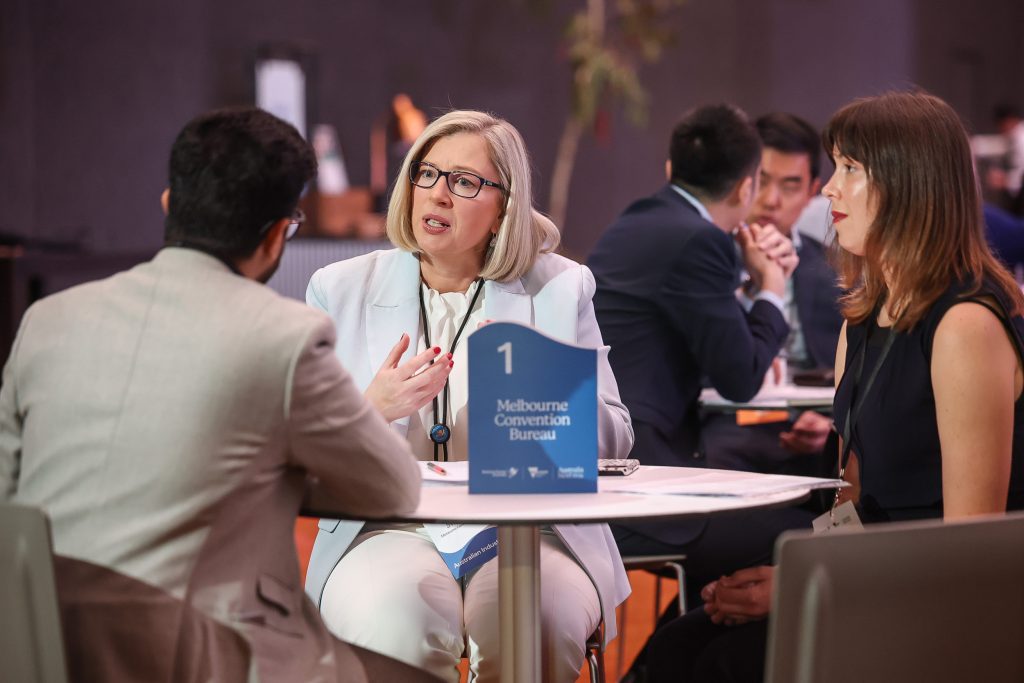
Julia Swanson (CEO, Melbourne Convention Bureau): “We work with groups as small as 20 people, all the way up to very large ones like Amway China, where we had 16,000 people over five waves. That was Australia’s largest ever incentive group.”
What’s really changed, though, isn’t where groups are coming from, it’s what they want when they arrive. “People are wanting really immersive experiences,” Swanson said. “They want things that are different, and they want things that are new.” The old model of bus tours and surface-level sightseeing has faded. “The days of long bus tours and sightseeing, I think, are over,” she said plainly. Instead, incentive programmes are becoming more intentional. “They’re really thinking about what they want their delegates to feel, and what memories they want them to take back.”
That focus on emotion and memory is where Melbourne plays particularly well. Swanson talked through experiences that continue to resonate with incentive buyers, riding the open-sided Puffing Billy steam train through rainforest, hot air ballooning over the city or Yarra Valley, and private wildlife encounters at Phillip Island. “That’s not an experience open or available to many people in their home country,” she said. “It’s really unique and incredibly amazing.” Just as important is the city’s food story. “People are also willing to be a bit more adventurous in terms of food and wine,” she added. “They’re asking us, what’s something different I can do? What’s a different cuisine?”

Destination bureaus and hospitality owners meeting with travel planners and media during Australia Next in Melbourne last year
In a city where you can move from Ethiopian to Taiwanese to modern Australian in the space of a few blocks, that curiosity is easy to satisfy. And it’s not just about escaping to the regions. “People love getting out and experiencing Australian wildlife,” Swanson said, “but they’re also quite inspired by urban, sophisticated city experiences.” Melbourne’s edge is that it can do both, often in the same programme. “It’s a 24-hour city. It’s got a good vibe. Arts, culture, live music, events, all those options are available.”
“We’ve got the Australian Open, the Formula One Grand Prix, food and wine festivals, fashion festivals, comedy festivals,” Swanson added. “There’s something in the calendar all year round, so you can really choose your own adventure.”
The element of surprise in a city that sets the stage
That idea, choosing your own adventure, stayed with me as we took a boat across the river later that day for the Media Lunch at the Playhouse, Arts Centre Melbourne. On paper, it was lunch. In reality, it was a much-needed reminder that there’s more than one way to experience a city.
Those in-the-know were tight-lipped about the day’s agenda, and for good reason. The setting alone was unexpected. Instead of a private dining room or function hall, us media folk were seated inside a working theatre. And by that, I mean we were welcomed by an elaborate song-and-dance number by Playhouse performers who also doubled as our chaperones. Then, a 14-seater table was lowered from the ceiling onto the main stage, turning the stage itself into a dining room. Between courses, dancers appeared. Live performances unfolded around us. At times, it felt less like lunch and more like being inside a production that were equal parts playful, theatrical and slightly surreal.

A dining table being lowered from the ceiling during the Australia Next Media Lunch. Bon Appetit!
I’ve covered many media programmes over the years, but this one landed differently. It wasn’t about excess or spectacle for spectacle’s sake. It was about perspective. Here was a cultural venue most people experience from the stalls, reimagined as an intimate, high-touch incentive setting.
Here was lunch reframed as a story.

And that’s when Swanson’s earlier point about creativity clicked into place. “People are prepared to invest budgets where they can do something different,” she had said. “Something that’s got a wow factor.” The Media Lunch became a microcosm of Melbourne itself; unorthodox, confident, and a not-so-subtle nudge for planners to think beyond the obvious.

Tunes from ‘Wicked’ over lunch, anyone?
ROI is on a spectrum of metrics
It also reflected a softer shift in incentive design that Swanson touched on which is wellbeing and balance. “Coming out of COVID, people are thinking a lot more about their priorities and their health and wellbeing,” she said. Victoria’s growing wellness offering, from Peninsula Hot Springs to Daylesford’s mineral baths, is increasingly being woven into incentive programmes. “You can have an action-packed experience,” she said, “but you can also have some time out as well. Slow life down a bit.”

The closing gala dinner for Australia Next 2025 in Melbourne was held at the UNESCO World Heritage-listed Royal Exhibition Building
Melbourne’s strength, ultimately, is its depth. “It’s big enough and there’s enough diversity that every time people come back, there’s something new to see and do,” Swanson said. That’s why incentive travellers often return as leisure visitors. “They fall in love with it and say, ‘I really want to come back and bring my family.’”
Watching a dining table descend from a theatre ceiling, surrounded by music and movement, I understood why. There are more ways to discover and rediscover the same city, especially when someone shows you a different way in.