
While it started out as a jet lag app, there is a bigger ambition driving the co-founders – to build a circadian technology platform that impacts overall health and well-being.
It’s early morning in New York but Mickey Beyer-Clausen is looking bright and chirpy, and wearing a hoodie that says “get your SHIFT together”. The Danish co-founder of Timeshifter looks like the kind of guy who would not experience jet lag – well, at least since he started the “jet lag” app business in 2018.
“Look,” he says, smiling, when I asked him if he’s mastered it. “I’ve mastered it in my own way – if I have a dinner I need to go to, and Timeshifter tells me to go to bed and sleep, I might go to that dinner because it’s not going to disrupt my life completely. I try to do the best I can.
“That’s why we tell people, just take it easy. Try to follow the advice as much as you can. You’re going to get benefits, even if you don’t follow it 100%. The point is, we’re giving people guidance, we’re empowering people with a way to control their circadian rhythms that they’ve never had before.”
Clearly, something must be working because Timeshifter recently raised additional capital bringing total funding to $5.3 million. The raise was led by Skip Capital and included participation from additional independent investors including Nico Rosberg, a Formula 1 world champion, and Brian Kelly, founder of The Points Guy.

Inflection point – downloads accelerating, partnerships rolling out
Beyer-Clausen believes Timeshifter has reached inflexion point. It has passed 1.6 million downloads, with approximately half a million of those coming in the most recent year alone, a sign of acceleration.
Its partnership roster includes United Airlines, Lufthansa Group and the latest – a global pact with InterContinental Hotels, where guests will receive a complimentary jet lag plan as part of every booking.
English-speaking markets such as the US, UK and Australia dominate for now and he’s keen to expand to new markets such as Asia and is in talks with several airlines and hotel groups in the region.
The company is only now arriving at its real moment, he asserts, pointing to two reasons.
First, the launch of TimeShifter’s second product: a shift work edition, built for the estimated 670 million people working non-standard schedules worldwide.
He says the problems of shift work go well beyond fatigue – decades of research link it to elevated rates of diabetes, heart disease, certain cancers, and virtually all chronic disease. “There are too many accidents. Too many errors. And the long-term health problems are real,” he says.
Second, the decision by co-founder Dr. Steven Lockley, a Harvard Medical School professor with over 30 years of clinical research in circadian and sleep science, a NASA circadian advisor, and someone who has worked with Formula One teams, to join Timeshifter full time.
“That is a huge deal,” Beyer-Clausen says. “There is so much to do on the scientific side.”
The ambition is to become “somebody’s personal circadian rhythm advisor across their lives”, covering travel, shift patterns, athletic performance, and ultimately healthcare.

Building the AI moat
On defending itself against AI – why wouldn’t travellers just ask AI for jet lag advice, I asked – he argues that current large language models perform poorly on jet lag advice, trained as they are on the mass of popular misconceptions online.
“Garbage in, garbage out,” he says. “All the misconceptions about food, exercise, so the information coming back is just not reliable in any shape or form.”
He is confident that as AI matures, the moat Timeshifter is building – a proprietary dataset of hundreds of thousands of real-world jet lag experiences, combined with Dr. Lockley’s scientific rigour – becomes increasingly valuable and difficult to replicate.
The Amazon analogy
Beyer-Clausen first met Dr Lockley a year before they co-founded Timeshifter, bringing in Jacob Ravn as CXO. That meeting with the professor crystallised something he had been circling around: the difference between a problem and a platform.
“If you think back to when Amazon started out, they were the world’s largest bookstore. But what they were really building was the most advanced e-commerce platform in the world. That’s what they were really building. They just started in one category.”
The same logic applies to Timeshifter. “Timeshifter is not a jet lag app. It is a circadian technology platform. And with that platform, we can create different solutions that address different problems but all caused by an underlying circadian issue.”
So while jet lag is the entry point, the roadmap extends into shift work, peak performance where it works with professional athletes to align their biological peak with competition time, and healthcare – medication timing, treatment preparation, and the growing body of evidence that circadian misalignment sits beneath a range of chronic diseases.
Did they pick jet lag because it was the most obvious commercial category, I asked.
“We chose jet lag because it’s a very succinct, specific event and so provides the best learning environment,” he says. “We can test it within days. We have hundreds of thousands of post-travel surveys confirming a lot of things we knew but also giving us new information the scientific world doesn’t even know yet.”
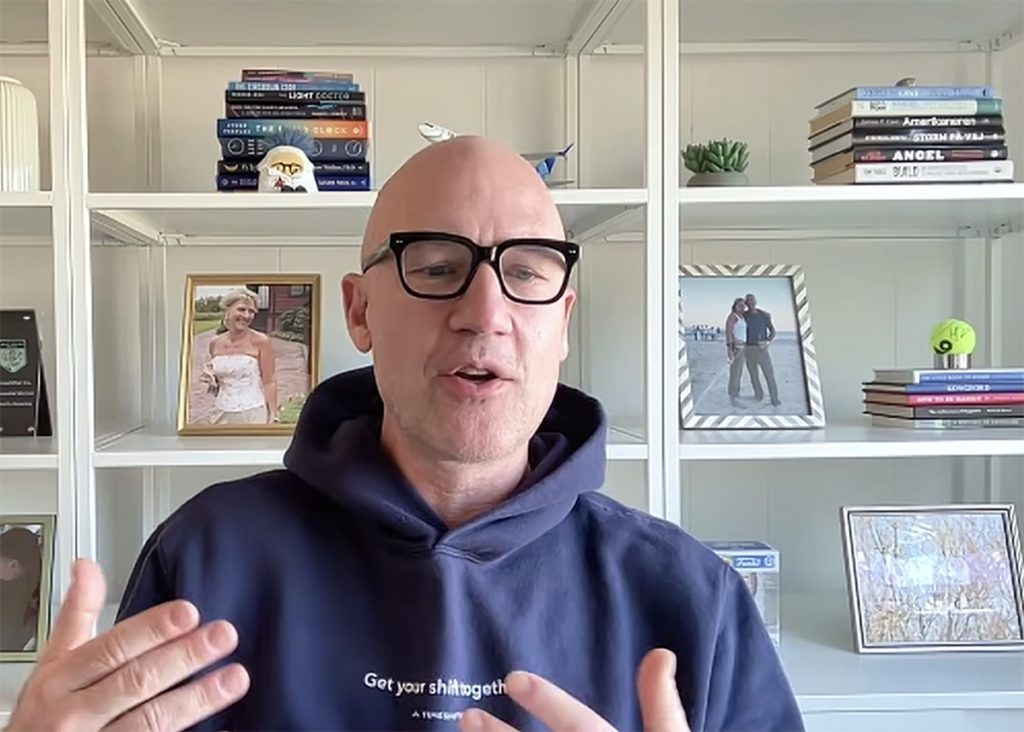
Mickey Beyer-Clausen: “Look, I’ve mastered it in my own way – if I have a dinner I need to go to, and Timeshifter tells me to go to bed and sleep, I might go to that dinner because it’s not going to disrupt my life completely. I try to do the best I can.”
What everyone gets wrong about jet lag
We are all familiar with it – all the advice on how to deal with jet lag – sleep on the plane, drink water, avoid alcohol, go for a jog when you land. It makes Beyer-Clausen wince.
“People still think jet lag is about sleep, that’s already half the battle lost,” he says. “It has nothing to do with sleep, everything to do with circadian misalignment of all the clocks in your body.”
Every major organ contains its own circadian clock. TimeShifter focuses primarily on the SCN, the central circadian clock located in the brain, because it acts as “the conductor of the orchestra”, directly regulating sleep, alertness, performance, mood, and hormones.
“Some people say they don’t feel jet lagged,” he notes. “Well, let’s bring you into a lab and see how many of your organs are jet lagged. Because the definition of jet lag is not that you’re feeling tired. That’s just one of the many symptoms.”
The implications are counterintuitive, even for seasoned travellers. Sleeping on a plane at the wrong time – even in a lie-flat business class seat – can actually make jet lag worse. “If they slept at a time when they should have seen bright light, they have shifted further away from the new time zone than they started out with,” he explains, “making it even more difficult to adapt.”
Light exposure and crucially, light avoidance is the most effective tool for shifting the circadian clock. Timing matters more than duration. This is what Timeshifter’s algorithm calculates, personalised to each user’s chronotype, normal sleep pattern, and specific itinerary.
Closing the awareness gap – jet lag, sleep, both in the same bucket
There’s a frustration Beyer-Clausen returns to more than once, and it speaks to the larger awareness gap his company is trying to close.
“CEOs of the largest travel brands in the world don’t know what jet lag is scientifically,” he says. “We are in a world where health and wellness is a trend that’s here to stay. People want to be healthier. And yet the CEOs of these big companies have no idea. It’s like, yeah, I go out and do a jog. That’s not helping with jet lag.”
Part of this, he thinks, mirrors what happened with sleep 15 years ago when executives took pride in running on five hours a night, treating the need for rest as weakness. “There’s a little bit of that still lingering with jet lag,” he admits. “It makes leaders feel vulnerable.”
“I think circadian science is where sleep science was 15 years ago,” he says. “In five years from now, we’re going to look back and say: I can’t believe we didn’t know.”

Starting with happiness
Before he got into Timeshifter, Beyer-Clausen was like any entrepreneur building a commercial business. His first company a domain name business called Ascio Technologies was a success, but something nagged at him.
“It was a pure commercial startup,” he recalls. “It was solving a problem in the market, but I didn’t feel I made a real difference in the world.”
That led him, in 2002, to establish the Happiness Foundation. It was born from the observation that philanthropy had plenty of room for money, but almost no infrastructure for knowledge.
“If you were a lawyer or an accountant, yes, you could help a charity with your skills,” he explains. “But people like us, how do we get involved beyond sending money? How do we use our network, our knowledge, our creativity to help nonprofits scale what they’re doing?”
The Foundation connects professionals – strategists, marketers, operators – with nonprofits worldwide, working on specific, measurable goals. Projects have spanned Afghanistan, collaborations with the UN, and partnerships with institutions like the Rockefeller Foundation. Today it runs almost entirely on volunteers. It asks not for donations but for expertise.
What drives it, Beyer-Clausen says, is something he considers one of the most reliable unlocks of human happiness he’s ever encountered.
“The moment you do something nice for other people; you are going to be happier yourself. End of story. And it doesn’t need to cost you a dime.”