
The slot machines get you first. That relentless ding, ding, ding as you walk into the ARIA lobby, the raucous laughter from the bars, the crowds hunched over gaming tables – I can’t be anywhere else but Las Vegas.
I’d come off two full flights from Singapore via San Francisco, and the Strip wasn’t helping. I walked past Paris, took the obligatory photo of the Eiffel Tower, breathed in the weed-scented desert air. Lights everywhere – BTS Arirang tour, a lawyer named Dimopoulos who claims he always wins.
Well, in Las Vegas, everyone wants to win.
I had one night to recover before Explore 26, marking 30 years since Rich Barton dreamed up Expedia inside Microsoft. I knew I had to have my wits about me. This was the big one – to mark this grand milestone and to usher in an even grander future.
Two days of sessions, workshops and media conferences later – including an on-stage interview with Alfonso Paredes, the new president of Expedia’s combined B2B and supply business – I left with one overriding impression: this travel juggernaut, which just posted its highest first-quarter results in company history, is moving at a speed that is both exhilarating and slightly vertiginous. It wants to own the infrastructure of travel and the consumer brands, the plumbing and the dream, the front door and the back – in other words, it wants to win it all.
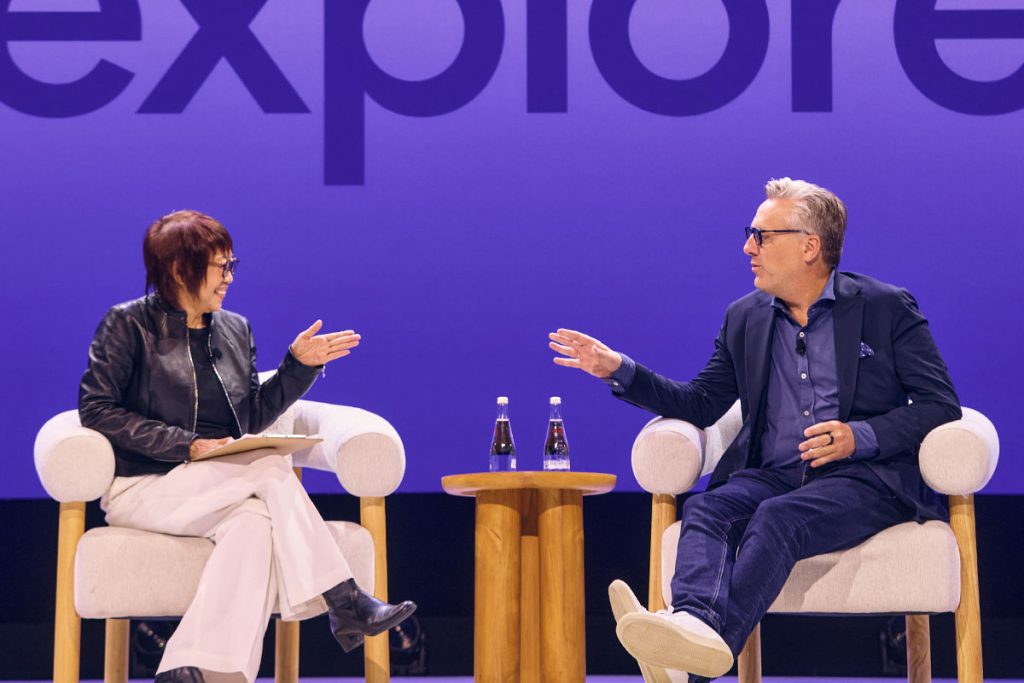
Yeoh Siew Hoon (left) interviewing Alfonso Paredes, the new president of Expedia’s combined B2B and supply business
But underneath all the announcements and the agentic architecture and the AI road maps, I sensed an underlying “vibe” – to use the word of the season – a quiet argument about what travel – and perhaps technology itself – is actually for.
First, the disenchantment
Thirty years ago, Barry Diller spotted a small ad for a website called Expedia and had a revelation. It’s so obvious,” he told the audience. “Travel is the easiest, simplest thing for the Internet to colonise.” He made his offer to Microsoft circa 2001, and the rest became history.
At Explore 26, Diller and Barton sat together to reflect on that history, and neither sounded like a man still in love with technology.
Diller went first. “We used to have a very optimistic view of technology,” he said. “Now that’s changed.” He referenced the moment Google’s Eric Schmidt was booed by students when he mentioned AI – a signal, Diller felt, that disenchantment with big tech had well and truly set in.
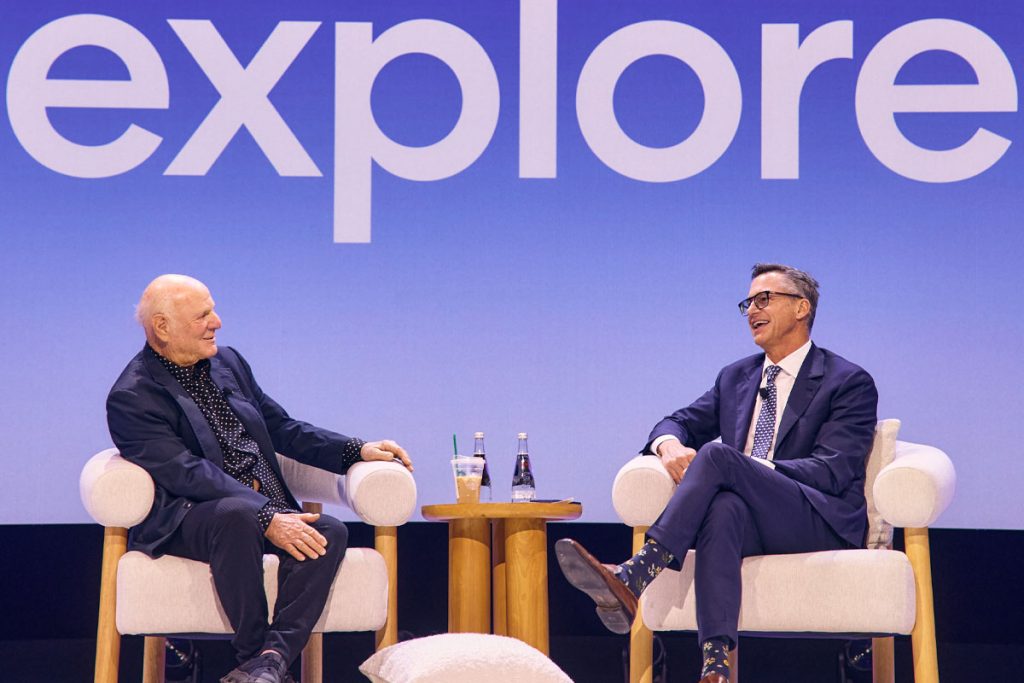
“We used to have a very optimistic view of technology,” said Barry Diller (left). “Now that’s changed.” Joining him in this session was Rich Barton, who dreamed up Expedia inside Microsoft three decades ago.
He’s had enough of the debate about what AI will or won’t replace. “Nothing will replace human activity,” he said flatly.
To prove the point, he’s rebranded his company IAC as People Inc. “I just wanted to say – people. Let us not forget that. I do not want to be led by anybody, let alone tech lords who essentially want to take over everything. I am investing in people, in the convention of people, entertainment, events. At MGM, I don’t have to think about technology other than how to run it more efficiently.”
The fact that Explore 26 was held at the ARIA, part of the MGM group, was not lost on anyone in the room.
Barton followed with an anecdote of his own. As a Stanford University trustee, he’d observed something striking: for the first time in 15 years, computer science and engineering enrolments were declining.
“The humanities is coming back,” he told the audience. “At Stanford we have this long-standing joke about techies versus fuzzies – and techies have always been winning. Now they are calling it the revenge of the fuzzies.”
It felt oddly ironic – two men who built their fortunes on technology, sitting on a stage in Las Vegas, cheering for the humanities.
The believers and what they are building
And yet, on the same stage, Diller’s own company unveiled a sweeping AI-first vision that would make any big tech recruiter envious.
A panel featuring three recent hires from big tech – Rachel Been, SVP of design, formerly Airbnb, Google Home App, Nest App; Ritcha Ranjan, SVP of core platform and experience, formerly Microsoft, Google; and Xavi Amatriain, chief AI and data officer, (Google, Netflix, LinkedIn) – offered the clearest window yet into how Expedia is thinking about its future.
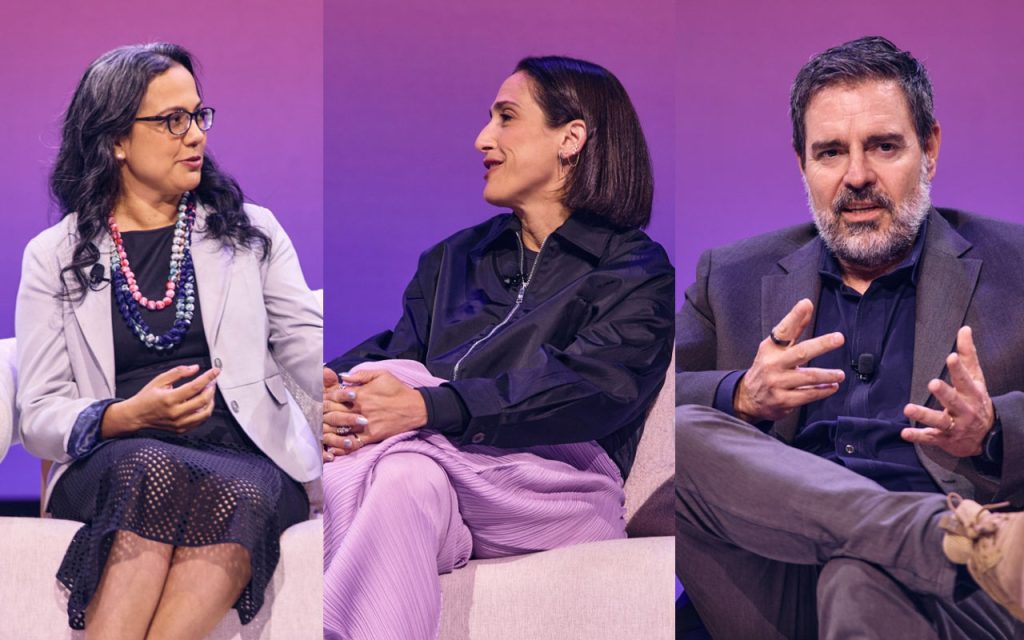
From left, Ritcha Ranjan, Rachel Been and Xavi Amatriain – from big tech to Expedia, and they all say they made the move because of the joy of travel and their desire is to ensure the joy remains – in trip planning, in particular.
Their approach is not to automate everything in sight. Trip planning, they argued, is something people actually enjoy – the dreaming, the browsing, the imagining. AI should extend that phase, not short-circuit it, it should handle the logistics quietly in the background while amplifying the joy.
On architecture, Amatriain described not a single all-knowing super-agent but a team of specialised micro-agents – expert in car rentals, properties, activity planning – that work together on a traveller’s behalf from the dreaming stage through to in-trip support as companions, not commanders.
Been spoke about what she called “designing for infinity” – the fundamental challenge of building AI-driven travel experiences when a natural language interface opens an essentially unbounded range of inputs. Unlike traditional linear UX, you cannot anticipate every conversation. Her answer: richer visual experiences, maps, imagery, weather data, destination “vibes” and a deliberate move away from today’s text-heavy AI interactions toward something more immersive.
Amatriain’s most pointed message, though, was for partners: get your data AI-ready, now. He said Expedia’s 30 years of proprietary data is a significant competitive moat, and the team is converting it into MCP (Model Context Protocol) services that agents can directly consume. He echoed Uber CEO Dara Khosrowshahi’s earlier observation that Uber had to scrap its entire customer service policy library and rewrite it from scratch because the old policies were too convoluted for AI agents to follow. Better to start clean than to patch the past, was the advice.
Ranjan cautioned: AI has a real cost and should only be deployed where it solves a genuine, large-scale problem. Natural language trip search is a true unlock, deploying AI to demonstrate capability is not.
Building the B2B connected marketplace
Beyond the philosophy, the deals and product launches kept coming.
The planned acquisition of CarTrawler for its cars and trip protection capabilities, the launch of an Intelligent Experience Platform, the deployment of its Rapid Flight API with Despegar, the acquisition of Tiqets – all reinforce what Paredes described as Expedia B2B’s core ambition: to be the connected marketplace where anyone who wants to sell travel comes to first.
It is a business already operating at considerable scale. B2B revenues reached $1.2 billion in the first quarter, up 25% year on year. Close to 70% of that business comes from outside the US, with Asia Pacific among its fastest-growing markets. The platform now serves 75,000 partners across industry verticals, 200,000 travel advisors, and processes 21 billion API calls a day.
When I asked Paredes whether more acquisitions were ahead to fill any remaining gaps – for example, the partnership with Uber which he negotiated, would he see something similar in Asia, like with Grab – he was measured: the priority right now is consolidation and integration. ‘We have plenty to keep us busy for now’ seemed to be the message.
Karen Bolda, B2B Chief Product and Technology Officer, made the case for why AI has been transformative specifically for B2B: it finally solved the brand differentiation problem that had long frustrated partners.
“This is a highly flexible experience layer,” she said of the new Intelligent Experience Platform. “Brands can launch a site that is genuinely differentiated. This is exactly what our partners have been asking for.”
Hello, B2A
One panel pushed further into the future.
Jochen Koedijk, Expedia Group’s CMO, sat alongside Kelly Covato of Trade Desk and Mahak Sharma of OpenAI to discuss B2A: marketing not to humans or businesses, but to AI agents.
As travellers increasingly use AI throughout their planning journey, the argument goes, agents are becoming a distinct audience in their own right – one that must be reached in parallel with consumers and trade partners. Expedia has already formed a dedicated team focused on how their supply appears when an agent is reasoning on a traveller’s behalf.
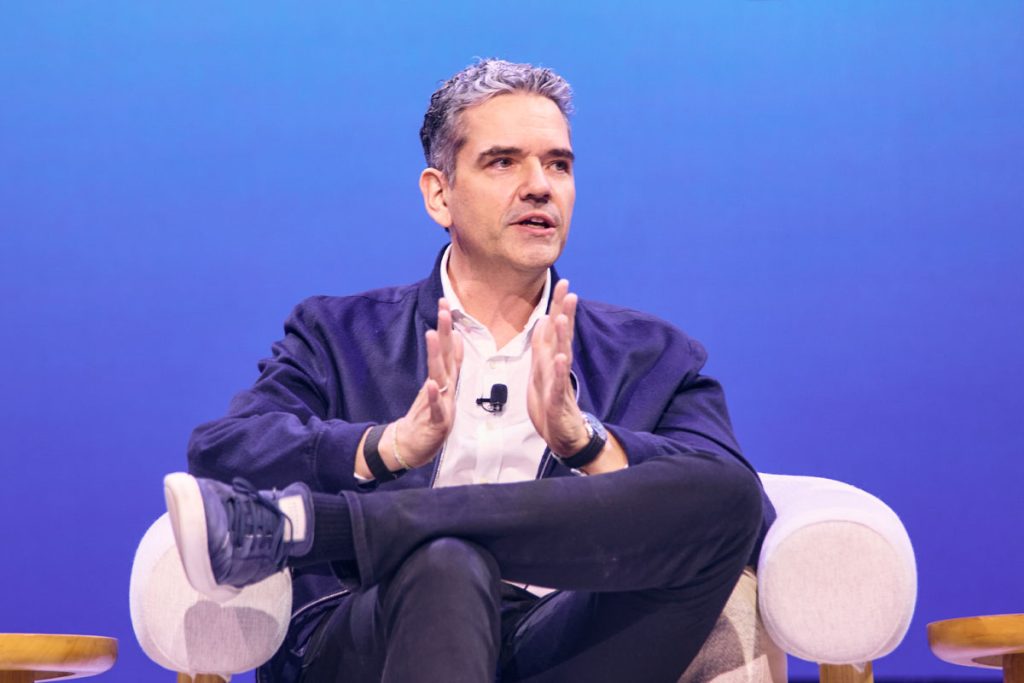
Jochen Koedijk, Expedia Group’s CMO: Next year, we’ll be talking about A2A.
Sharma’s point was clear: in an agentic world, simple data availability is no longer enough. Agents have near-infinite reasoning capability and will surface genuinely differentiated content. What makes a property or partner unique – rich descriptions, specific amenities, personality, policy clarity – matters far more than it ever did in the era of keyword search.
And next year? Koedijk didn’t hesitate: “A2A – agents talking to each other.”
I wondered what Diller would say to that.
Trust in the balance
In the end, though, it comes down to trust – the most human of emotions – a message that was delivered by Expedia Group CEO Ariane Gorin at the opening and closing.
“Travel is not like buying a T-shirt,” she said. “When something goes wrong, you can never get that time back. Trust comes through service – and we are making technology investments in human service.”

Expedia Group CEO Ariane Gorin
Turns out you need both the techies and fuzzies to work together to create a company that can operate at scale – 21 billion API calls a day – and yet mean something to someone, personally.
Diller would probably approve of that.