
When Xing Xiong, Chief Operating Officer of Trip.com Group, took to the stage at its Airline Global Conference in Amsterdam last week, he did so with the perspective of someone who has watched the travel industry and the technology underpinning it transform beyond recognition, and along with it, the group’s growth.
“Not too long ago,” he recalled, “we were a very small player in the international market. We were a group of engineers and business people who could barely speak English.”
Today, Trip.com Group stands as one of the world’s largest online travel platforms, and Xiong’s address, spanning AI’s evolution, distribution challenges and the rise of corporate travel, offered a candid, technologist’s view of where the industry is heading.
A recovery that held, until it didn’t
Xiong opened his presentation, “Travel Into The New World”, with a frank assessment of global travel’s post-pandemic trajectory. “The recovery from 2021 to 2025 had been very steady, kind of predictable,” he said. Cross-border growth was driving the industry forward, easing earlier fears about deglobalisation. “From the industry point of view, the world continues to be more and more connected.”
Then came disruption. The Middle East conflict that escalated from March of this year has already left a visible mark on the data. Year-on-year RPK growth slowed sharply in March, with international travel already in negative territory. April and May figures, not yet fully available, are expected to be worse.
“I’m quite sure that number will be negative,” Xiong said. Yet he struck a note of cautious optimism: “We still believe this impact will be short-lived. We continue to believe in our industry and in people’s resilience.”
The AI timeline and power shifts
The centrepiece of Xiong’s presentation was a personal framework for understanding how AI has evolved and where it is now. He walked the audience through what he described as a sequence of landmark moments.
The end of 2022 marked the “ice-breaking wonder” of Large Language Models, when for the first time a machine could converse with the fluency of a human. 2023 was the year OpenAI’s ChatGPT commanded global attention, briefly rattling Google’s stock price and forcing the wider tech world to reckon with what was coming. 2024 brought multimodality, the ability for AI systems to understand and generate not just text, but voice, images and video. “This was something very, very striking,” Xiong said. “More and more money got in.”
By 2025, Google had reasserted itself. With Gemini’s successive iterations, and the structural advantages of the world’s largest compute infrastructure and most comprehensive dataset from decades of search, Google “came back as the king”.
Anthropic’s Claude, meanwhile, carved out a distinct identity focused on problem-solving and agentic capability – the ability for AI to carry out complex, multi-step tasks on a user’s behalf. “AI starts acting like agents on behalf of human beings,” Xiong explained. “AI is here to help me do complicated tasks that I cannot do before.”
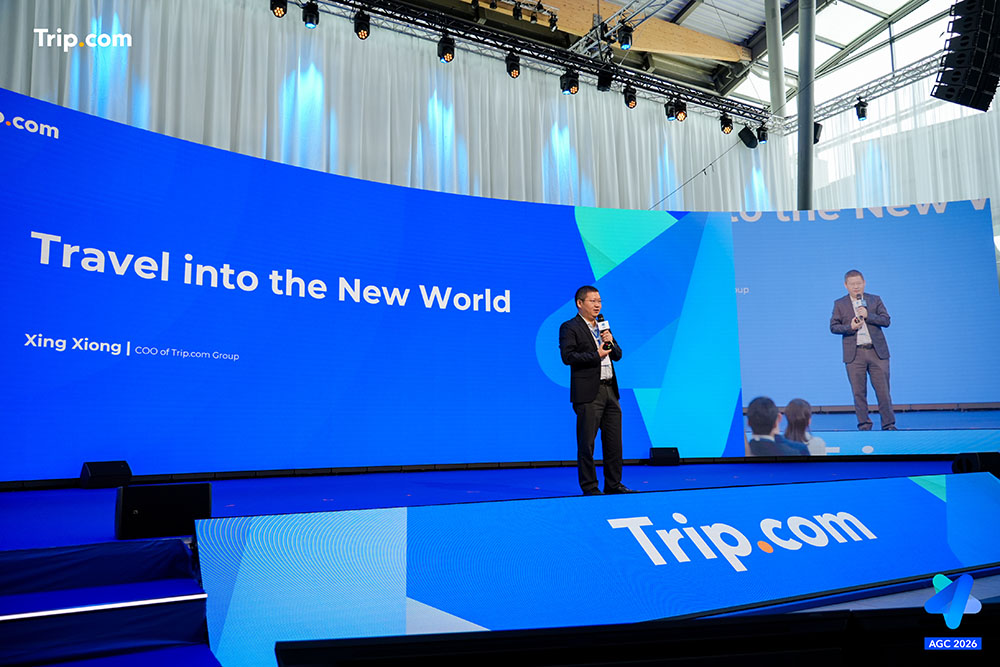
Xing Xiong: “We finally see AI become something productive, extremely valuable, and beneficial to everyone, if you can catch up.”
The harness era: Inflection point
If there was one concept Xiong wanted the room to take away, it was what he called “the harness” – the moment AI capability became productively accessible to the rest of the world through open APIs.
“A few companies have packaged their AI capabilities into APIs so that every other company, including ourselves, can leverage their intelligence and build it into their own systems,” he said. AWS, Google and Anthropic are, in his assessment, the leading forces making this possible –each with different strengths, each opening up their infrastructure at “a very affordable cost for the rest of the industry to leverage and build on top of”.
For Xiong, this marks a genuine inflection point. “We finally see AI become something productive, extremely valuable, and beneficial to everyone, if you can catch up.”
His message to the room was direct: “If your team has not yet reached the harness, challenge your technology teams. This is something you cannot afford to miss.”
He was equally clear-eyed about who is leading the pack. AWS has built what he considers the most complete harness layer, with investments across OpenAI, Anthropic and others. Google brings unrivalled compute power and data quality. Anthropic is distinguished by its agentic approach and problem-solving focus. OpenAI retains the largest user base – over 300 million daily active users – though Xiong noted it continues to grapple with the economics of scale, citing the costly closure of Sora, its AI video generation product, as an illustration of the commercial realities even the most impressive AI products must eventually face.
AI at Trip.com: What’s working, what isn’t
Refreshingly candid about the gap between AI’s promise and practice, Xiong walked through where Trip.com has made genuine progress and where it has not.
“We did not spend billions training models,” he said. “But we followed every single product and achievement in the industry to figure out which ones work for us best.”
That pragmatism has yielded real results in three areas.
Customer service and post-booking automation has been the standout success. Contact rates – the proportion of orders that require a customer to reach out for support – have fallen from nearly 40% to 7%. “We believe it will continue to come down,” Xiong said.
Self-service rates are rising, and processes like refunds, itinerary changes and cancellations are increasingly automated. One striking example: Trip.com has built a real-time fare error detection system capable of identifying pricing mistakes by airlines – such as a $40,000 ticket mistakenly listed at $2,000 – and taking the product offline faster than the airline itself can act. “We had cases where airlines were very thankful for what we had done,” Xiong noted.
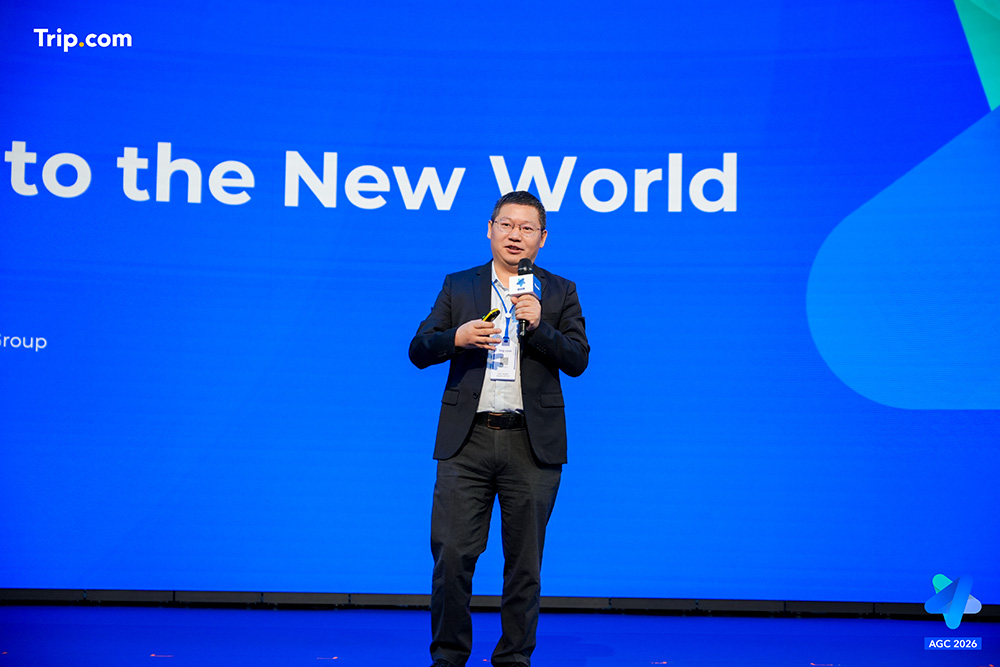
“AI’s accuracy is at best 98%. If someone told you there’s a 2% chance you’ll miss your flight at the airport, how comfortable are you with that?”
Analytics and operational intelligence is the second area of meaningful deployment, with AI supporting everything from route discovery to precision marketing and operational adjustments.
Trip Genie, the group’s AI travel assistant, is more of a work in progress. A live demonstration on stage showed voice-driven hotel search and booking – a user asking for a family stay in Singapore, receiving tailored options and completing a booking conversationally. “The new habit is here. We are here to accommodate. If you don’t, you will be behind soon,” Xiong said.
But he acknowledged that on the discovery and inspiration side, the results remain below expectations. “The world is so diverse, and in the legacy world we were only able to work with structured data. AI is extremely good at digesting and reusing unstructured information, that creates a future for inspiration. We are still working on it.”
On the question of agentic booking – AI completing transactions autonomously on a traveller’s behalf – Xiong was sceptical. “AI’s accuracy is at best 98%. If someone told you there’s a 2% chance you’ll miss your flight at the airport, how comfortable are you with that?” For discovery and inspiration, 98% accuracy is more than sufficient. For high-stakes transactional tasks, it is not.
The engineer question
Xiong also dismissed the narrative that AI will hollow out engineering teams. “On average, approximately 10 to 15% of an engineer’s time is writing new code. This is the area AI is extremely good at and yes, we already see AI helping write new code across all our engineering teams. But don’t forget, that’s only 10 to 15% of their work.”
Trip.com, he said, will make no net reductions to its engineering headcount. Instead, engineers will be asked to take on more – “more wonderful things which they cannot do before.”
Distribution: The scalability crisis ahead
Turning to the NDC (New Distribution Capability) landscape, deliberately dropping the word “new,” he noted, because “it’s no longer new”, Xiong issued a warning.
Traffic generated by AI agents and bots is growing exponentially, while backend infrastructure capacity improves only incrementally. “Year-over-year capacity may grow 3 to 5%. Agentic AI-generated traffic, if it doubles every year, I wouldn’t be surprised. People are saying it doubles every month.” The implication is a widening scalability gap at the core of airline and OTA distribution systems.
Against this backdrop, he highlighted what Trip.com has built and proven in partnership with carriers. Eleven airlines are now live on Trip.com’s NDC solution, with results Xiong described as spectacular: response times down from eight seconds to one second, meaningfully higher conversion rates and improved bookability. For LCC partners on a separate tier, search times have been cut from over five seconds to under one second.
His pitch was straightforward: “Instead of exploring brand new notions which may or may not work, we already have something here, proven, working, resilient to the AI world, for you to explore.”
Corporate travel: The next frontier
Xiong closed with a prediction about corporate travel, a segment he believes is on the cusp of a structural shift driven by AI.
Today, the TMC (Travel Management Company) market remains deeply fragmented. No single player operates at anything close to the scale of the major OTAs. “We have many famous TMC names. None of them are very big,” he said.
The reason, in Xiong’s analysis, is structural: the technology stack for corporate travel is fiendishly complex, customisation requirements are demanding, and clients have significant switching power. “The technology is very challenging. The supply system is very challenging. And corporations have very strong negotiation power.”
AI changes the equation. “A lot of customisation work can now be done in a very economic way, because writing new code is something AI is extremely good at.”
Trip.com’s own TMC arm, Trip.biz, accounts for just 5% of revenue, but already places it among the world’s top five by volume. “Something bigger will start emerging with the power of AI. This is one of the predictions I want to share – the TMC world will continue to be a technology play, and AI is finally making it more viable.”
Embrace, or be left behind
Xiong concluded on the note that threaded through the entire presentation: AI is not a threat to the industry, but it is a test of it.
“AI will enable us. Everybody should embrace it and get involved, because otherwise you will be left behind.”
The companies best placed to thrive, in his view, are those that stop waiting for AI to mature and start building on top of what is already available and affordable – the harness, the APIs, the agentic frameworks.
“AI excels in creating demos. But eventually, business matters. Those companies will come and go based on whether they can make the commercial part work.”
For a room full of travel industry professionals, the message was both sobering and energising. The tools have never been more powerful. The question is whether the industry moves quickly enough to use them.