
If there was one message that came through at the Trip.com Airline Global Conference in Amsterdam, it was that the willingness is there to “co-create value with intelligence, trust and partnership” but numerous obstacles stand in the way.
The closing panel featuring CT Ooi, CEO of Flights, Trip.com and Heinrich Lange, VP Digital Retailing, Lufthansa Group offered a candid view on what was holding the industry back on co-creating value with the traveller as the North Star.
Ooi identified two foundational pillars. The first is data. “We hold our own data as assets. You are not wrong, that is the correct way. But there is a way for us to share data bilaterally, data that is allowed to be shared, that will help us make a more seamless fundamental shift to our customers.”
He was direct about what that unlocks: better upselling, higher yield, more effective packaging, demand signals flowing from OTA to airline and back again. “If we are really able to sit down together and talk about this, I can guarantee you I can upsell you so much better. I can increase your yield. But because the communication isn’t transparent, it’s difficult for us to actually understand how to deliver that to the end consumer.”
The second pillar is technology – developed collaboratively from the outset, not handed over as a finished product. Ooi cited the approach taken by Trip.com in its NDC work with Lufthansa Group as the model: “They engaged OTAs and agencies into their ecosystems and started asking what are the challenges, how do we fix it together at the beginning, instead of arriving with a product and saying, here it is, take it.”
Lange added a dimension that often gets skipped: the commitment phase. “Once you have those nice slides of prioritised joint KPIs and targets, you actually need to commit to freeing up the resources and getting the teams together to get stuff done.”
He recalled the early workshop sessions behind Trip.com and Lufthansa Group’s NDC shopping solution – not management meetings, but rooms full of engineers and product people working through the actual problems. The results bore that out: response times cut dramatically, conversion up, bookability improved.
“It’s a great story from conceptualisation to putting in the effort to actually seeing the results.”
Displaying the product properly: A missed opportunity at scale
One of the most commercially pointed exchanges came when Lange raised the question of how airline products are actually presented to customers through OTA platforms. Lufthansa Group invests billions in fleet, cabin products and onboard experience. But if a customer browsing a travel app cannot understand what they are buying, that investment is invisible.
“I still find it mind-boggling that we partially have four or five-digit prices for premium cabins, but if customers cannot see what they are actually buying, how do we expect that to be a great experience?” Lange said.
The answer, in his view, lies in OTAs and airlines working together on presentation – combining the airline’s deep knowledge of its own product with the UX capability of a platform like Trip.com.

CT Ooi: “We hold our own data as assets. But there is a way for us to share data bilaterally, data that is allowed to be shared, that will help us make a more seamless fundamental shift to our customers.”
Ooi’s response was grounded in data: on Trip.com’s own platform, only 40% of customers buy the lowest available fare. The other 60% buy up.
“If we are able to demonstrate the value of the airline’s product correctly, together, for the right consumers in the right way, you can see that customers are willing to pay.”
He added a note of caution about rigidity: airlines that specify exactly how their product must be displayed risk missing the localisation nuances that determine whether a market responds or not. “You only start to understand the markets when the market will only react to you. So, it’s a dialogue.”
Where does it break down?
The session’s most candid passage came when the moderator asked both panellists to identify where co-creation most commonly fails. Is it technology? Leadership culture? Misaligned KPIs? Trust?
Lange pointed to trust as the most fundamental failure mode, because without it, none of the other issues can be surfaced and addressed openly. “If you have a good trust base, you can very openly address topics like, hey, this doesn’t work for us right now because of different priorities. We found a really good way in trustful partnerships to address those topics.”
He also noted a structural challenge in the current environment: as the industry enters periods of uncertainty, the natural tendency is to contract into short-term, reactive mode, shrinking the bandwidth for longer-term collaborative work.
Ooi’s answer was more specific: data. “The data airlines are seeing and the data OTAs are seeing is different. That’s where miscommunication is created. That’s where trust breaks down.” He pointed to the Order/Booking/Customer record layer emerging from NDC as one mechanism for beginning to close that gap – bringing all parties, including the customer, to a shared, accurate view of a transaction. The alternative, he said, is a situation in which the customer sees one version of the truth, the OTA sees another and the airline sees a third. “That’s where all this mistrust happens.”
A pointed aside from the moderator illustrated the point beyond the airline context: checking into the conference hotel as a loyalty programme member, having booked through an OTA, and being told no points would be awarded.
Ooi’s response was direct. “Thank you to the airline industry for understanding that the incentive is for the customers, not for the OTA. The discriminating practice is not the right way to acquire or retain customers. At the end, who gets the pain? The customer. Not just the OTA, the end user.”
What would progress look like in two years?
Both panellists were asked what they would want to be able to say, looking back in two years, as evidence that the industry had genuinely moved forward.
Lange offered three markers. First, customer satisfaction data: had the industry measurably improved the end-to-end travel experience, particularly in areas where it currently receives poor grades? Second, recovery management: in a world where disruption is not going away, had servicing use cases matured to the point where NPS was visibly improving? Third, AI at scale: had the industry moved beyond pilots and demos to AI-assisted discovery, inspiration and servicing that demonstrably creates value?
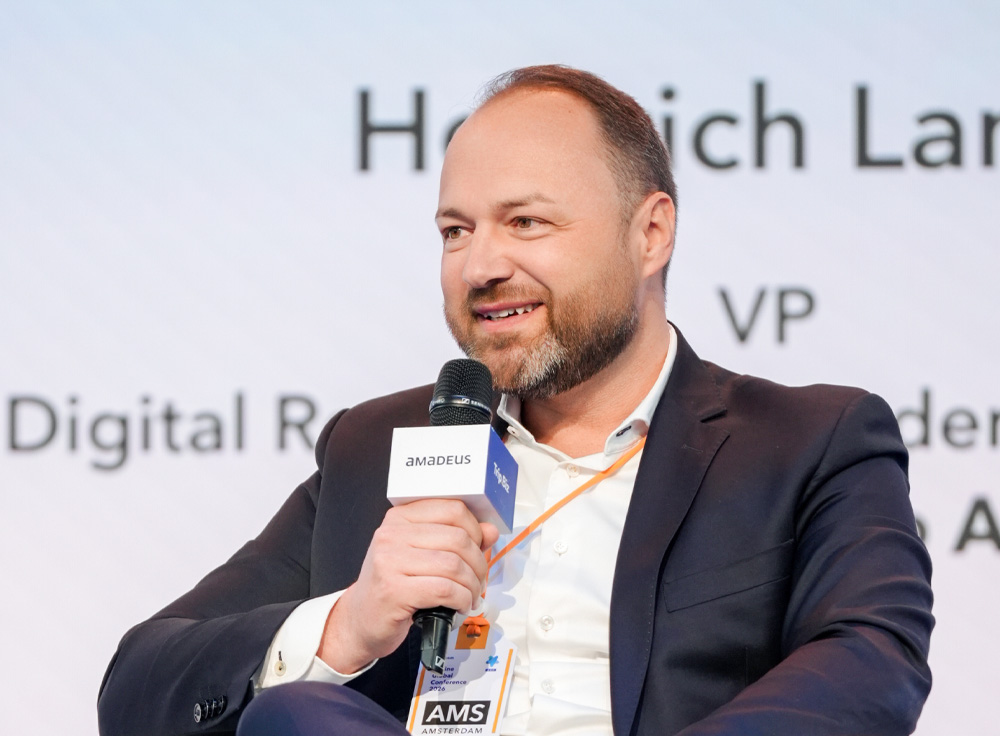
Heinrich Lange: “I still find it mind-boggling that we partially have four or five-digit prices for premium cabins, but if customers cannot see what they are actually buying, how do we expect that to be a great experience?”
Ooi wanted to see a shift in the nature of the OTA-airline relationship itself. “I am not just transactionally selling tickets. How do we create additional value to resolve the customer travel value chain? I’m going towards an airline-host think collaboration – not just staying at the GDS level.”
He was honest about the gap between stated intent and actual action, rating his own industry’s current follow-through at roughly 50%. “The intent is ten out of ten. The action, I would love to see at nine or eight. Right now, honestly, I think it’s 55%.”
He closed with a principle he returned to several times during the session: “Travellers are sovereign. They are not owned by anybody. We need to co-create value for them at all the points when they travel. We have to do it together.”
A closing poll and a shift in the room
The session ended with a callback to the poll that had opened the conference. At the start, attendees had been asked how they felt about AI and its impact on travel – excited, terrified, or steady as a ship. Twenty-four hours later, the needle had moved: the terrified contingent had dropped from 4% to 2%, the excited group remained substantial, and the largest share of the room now sat in the “steady as a ship” camp. Not complacent, but grounded.
It felt like an appropriate metaphor for the tone of the closing panel. The willingness to co-create is genuinely there. The proof points – from NDC shopping solutions to voice-enabled AI booking – are real and growing. The gaps, in data transparency, product presentation, and follow-through on collaborative commitments, are equally real and clearly understood by both sides.
The traveller is waiting.