
Data, mindsets, resident sentiment and the uncomfortable truth about who really wants redistribution
The question of how to spread tourism more evenly across Japan, away from the overcrowded golden triangle of Tokyo, Kyoto and Osaka and into the rural towns, regional communities and hidden landscapes beyond, has been discussed for years.
What is changing is the urgency and the quality of the thinking. The panel at WiT Japan on destination redistribution brought together a data strategist, a rural operator, an alternative accommodation platform, and a destination marketer who has lived through Europe’s most acute overtourism crisis.
Here’s a summary of the discussion that moved past the why – everyone agrees redistribution matters – and into the harder territory of how, and for whom.
The data: redistribution is already happening, unevenly
Tomotaka Hirabayashi of EY Strategy and Consulting opened with a preview of fresh data on inbound traveller behavior across four key source markets: South Korea, China, the US, and Australia. The headline finding was that repeat visitors are significantly more likely to venture beyond metropolitan areas than first-timers, and the shift is measurable in overnight stays.

Tomotaka Hirabayashi of EY Strategy and Consulting
Australian travelers showed the most dramatic redistribution curve: first-time visitors averaged 10 nights in metropolitan areas and two in regional ones; repeat visitors had shifted to seven metropolitan nights and five regional. South Korea and China showed gradual but consistent movement in the same direction. The US pattern was more stable, with metropolitan stays holding roughly steady while regional overnight stays crept upward with visit frequency.
To him, the data showed marketing Japan to first-time visitors and directing them to Tokyo may actually be counterproductive from a redistribution standpoint. “Why should we market to first-time visitors to Tokyo? Shouldn’t we be marketing to repeat visitors? Because it seems like with repeat visitors you have a greater chance of increasing regional business.”
Mindset over markets: Catalunya’s redistribution model
Raul Guerra, regional director, APAC, of Catalunya Tourism Board, brought a new framework to the panel, forged, he made clear, under pressure. Barcelona’s overtourism crisis forced Catalunya to rethink its entire approach to market segmentation, and what emerged was a model built around visitor mindsets rather than markets or demographics.
He illustrated thus: two hypothetical visitors, identical in every measurable demographic – age, income, education, nationality, marital status – but with entirely different travel dispositions. One seeks landmarks and density; the other seeks discovery and quiet. They appear to be the same person on paper, different in what they need from a destination. “Recently, we are not looking at markets as a country. We are looking at the mindsets of the people, wherever they live.”
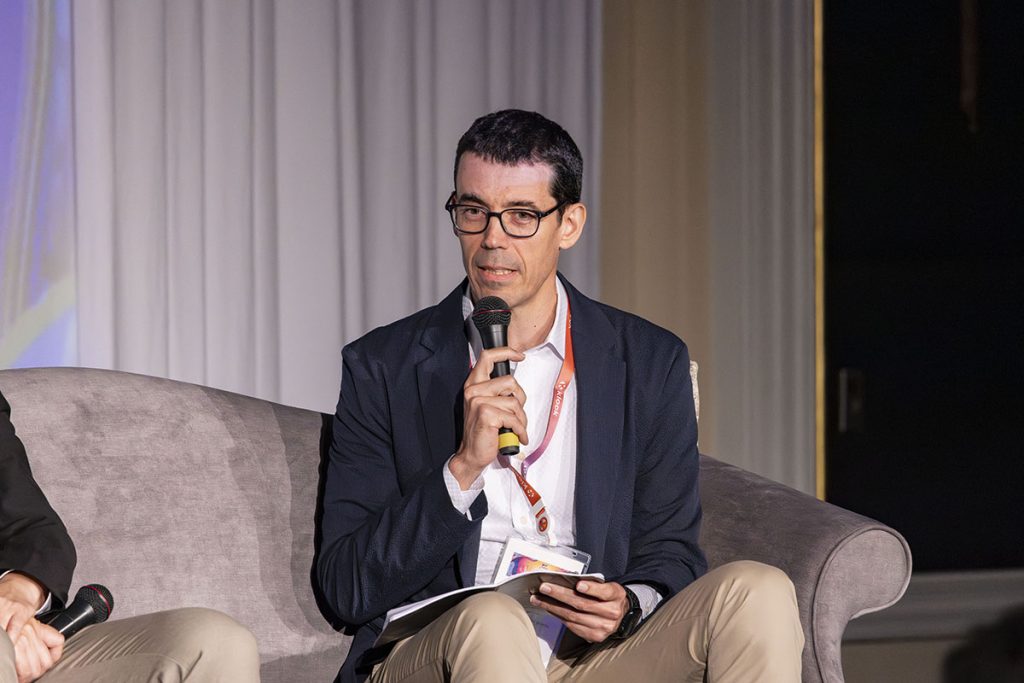
Raul Guerra, regional director, APAC, of Catalunya Tourism Board
The practical application is a quadrant of mindsets mapped against a portfolio of destinations within the region, matching the psychology of the traveller to the character of the place.
Crucially, Catalunya has also identified the mindsets it does not want at its more fragile destinations and simply does not market to them. “We are not going to say ‘you are not welcome’ like Amsterdam did. But we know the mindsets we don’t want, so we do no marketing activity that would stimulate those people.”
The measure of whether this is working: resident sentiment. “Resident sentiment is now the center of our strategy.”
The rural reality: fax machines and monster hotels
Mike Harris, chief refreshing officer, of adventure travel company, Canyons, who lives and works in rural Japan, brought the ground-level view that data cannot fully capture. While he jested that local innkeepers in some of the areas he works in are still figuring out how to use the fax machine, his remark captures the infrastructure gap between Japan’s metropolitan tourism economy and its rural equivalent, which he said, is real, deep, and in some places generational.
The specific texture of the problem varies enormously by location. Some rural onsen towns, he noted, have been left with the oversized hotel infrastructure of Japan’s bubble-era domestic tourism boom – “monster hotels” that need breaking down and replacing with something more suited to contemporary inbound demand. Others are already feeling capacity strain, not from accommodation but from restaurants. “The capacity for accommodation in some of these towns is fine, but the restaurants aren’t enough. So the sentiment of the locals will be that it’s overtourism, but it’s probably not overtourism. It’s just not enough restaurant capacity.”

Mike Harris, chief refreshing officer, Canyons
Harris was careful to separate two problems that are frequently conflated under the overtourism banner: one is a shortage of services and infrastructure, which can in principle be built; the other is the impact of tourism-driven housing costs on local residents, which is a different and more intractable problem.
Barcelona’s impending ban on Airbnb, he and Guerra both agreed, is primarily a response to the second problem, driven by housing politics more than visitor numbers per se.
Airbnb, regulation and the Barcelona question
Moderator Morris Sim (Montara Hospitality) put the Barcelona question directly to Atsuo Mori of Airbnb Japan: should the platform be concerned that what happened in Barcelona, an outright ban on short-term tourist rentals by 2028, could cascade to other cities?
Mori said that Airbnb Japan works closely with national and local government on licensing compliance; Japan’s framework caps short-term rentals at 180 days annually in Tokyo, which Mori described as a workable regulation rather than a ban. The platform is already seeing 30% growth in rural area listings and a 20% increase in stays in those areas, evidence, he argued, that distribution is happening organically through the supply side.

Atsuo Mori, Airbnb Japan
Guerra observed that the lesson for Japan is to build regulatory frameworks before the pressure becomes acute, not after.
Harris added the nuance that matters most for redistribution: there is a meaningful difference between a local resident using their home as an occasional Airbnb, a genuinely cultural, community-embedded form of hospitality, and an investor buying up rural properties as short-term rental assets.
The first supports redistribution and community income. The second extracts value without contributing to it. “How you differentiate those two things is always a difficult question,” he said.
Who actually wants redistribution?
Sim then asked – do travellers actually want to be redistributed, or is redistribution something destinations want and are trying to impose on travellers who would rather go to Kyoto?
Harris took both sides: destinations clearly want to direct flow, and first-time visitors almost invariably gravitate to the known landmarks. Guerra was firmly in the traveller-wants-it camp: “Travellers do want to be redistributed. The point is they don’t know there is a possibility. The responsibility is on the destination side, but travellers definitely want to discover new places their friends haven’t been.”
Hirabayashi went to data: the behavioral evidence shows repeat visitors distributing themselves more widely, which suggests the desire is there once travelers have enough context to act on it.
Sim offered this observation – the risk of destination-led redistribution is that it simply moves the problem rather than solving it, creating the next Kyoto somewhere less equipped to manage the pressure. “Be careful what you ask for, because it could overload infrastructure that is nonexistent.”
What Japan needs to work on
The panel’s closing round asked each panelist for a single recommendation to Japan’s tourism board on redistribution strategy.
Guerra was crisp: stop counting arrivals and start counting distribution. “Stop thinking about how many people you can attract and start thinking about how they are distributed – the concentration ratio in specific periods, in specific cities. Focus on those indicators. And don’t think about moving the people who already arrive. Think about connecting the mindsets that fit specific destinations within the country.”

Moderator Morris Sim (Montara Hospitality)
Hirabayashi pointed to existing success cases within Japan – local communities that have achieved redistribution and whose residents are genuinely happy with the outcome. “It’s very important for communities to function. Redistribution is not so easy by one destination. Government should think about building strategy for a wide range of areas, including those that don’t have much budget, because combined they form a corridor that can attract international tourists.”
Mori emphasised the community layer: education for hosts and local residents, clear communication about what tourism brings to an area, and genuine partnership with local government rather than compliance alone.
Harris brought it down to earth.“A lot of government grants have really good initiatives, but unrealistic time frames – everything has to be finished by February, starting in August. Make longer-term projects. The first year should be all about planning, community-based sustainability planning, making sure you get the right people involved.”
In other words, he said, redistribution is not a campaign, it is a structural change and that change in communities that have operated a certain way for generations, takes longer than a fiscal year.