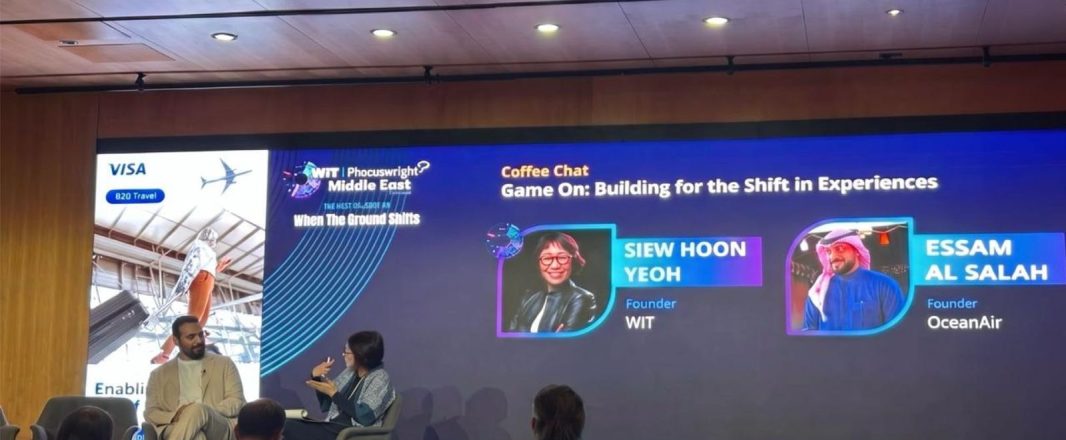
Essam Al Salah remembers the moment it clicked. It started with building a small website to start selling tours. In the early days, like most operators, he worked with the companies already in the market, the ones selling seat-in-coach packages. He booked through them, sold through them, and watched.
And the more he watched, the more something nagged at him.
He wasn’t happy with what was being delivered, so he decided to step in himself, to get on the ground. But even then, going through the motions of the same itineraries, he realised that “guests were being taken through Dubai without ever really experiencing it.” he said at WiT Phocuswright Middle East. “I started advising that I should be taking customers to local experiences how, as a local, I experience the real Dubai.”
Eventually, Essam Al Salah realised that was not working well and decided to build his own company.
OceanAir Travels was founded in 2010. Today, it spans desert safaris, luxury domes, heritage dining, cultural tours, and a chain of Emirati restaurants with four Michelin awards, operating across the UAE, Abu Dhabi, Doha, and beyond.
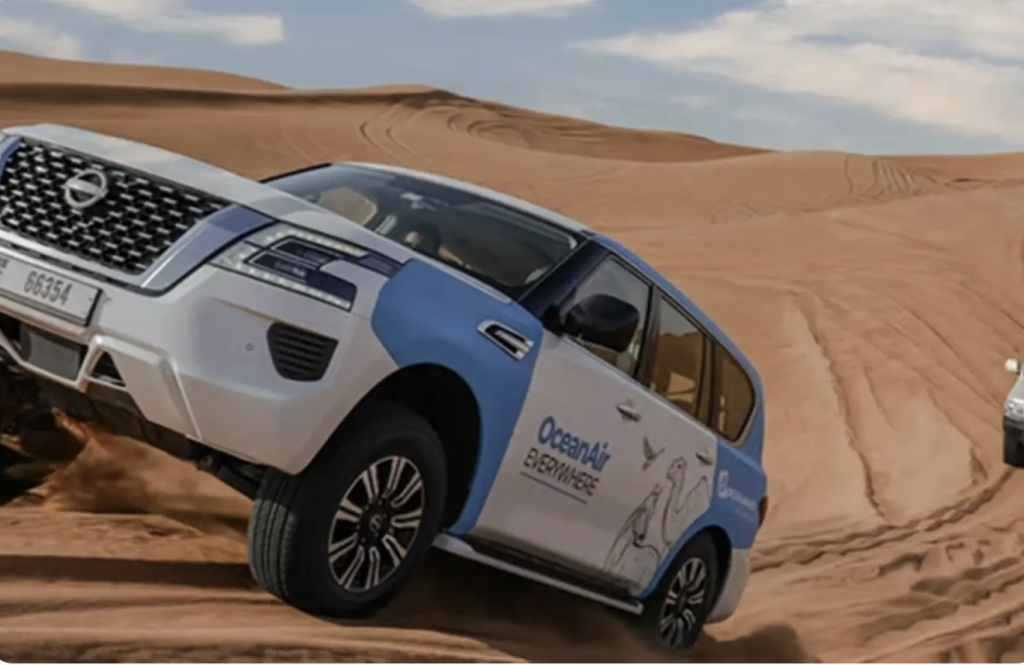
OceanAir’s desert safaris: Photo credit: OceanAir Travels
The experience tour concept shift
Sharing the early days of OceanAir Travels – he picked the name because it symbolises “boundless, global exploration and the seamless, fluid nature of international travel” – he said the travel industry in Dubai at the time was built around seat-in-coach tours, concierge referrals, and the path of least resistance. Guests would wait two hours for pick-up, spend the day on transportation, and arrive home having technically ticked off the sights.
He found this deeply dissatisfying. “I finished the day, and they go home. I had to make people happy at the end of the day. I realised it’s not about the information, but about what they expect as a real local experience in Dubai.”
His first act was selling himself as a tour guide, taking small groups to local sites, convincing them that this was the real thing. At first, they were happy, and then they asked about the desert safari. “Some of them were just looking for non-traditional entertainment,” he said with a wry smile. “That’s not us.”
But he listened, and made a deal with himself: he would give them the desert safari his way. What followed was a shift to authentic, traditional entertainment, the grace of a camel show, the pageantry of an Arabian horse show and the artistry of falconry, spectacle, but rooted in the culture, in addition to the drama of a fire show.
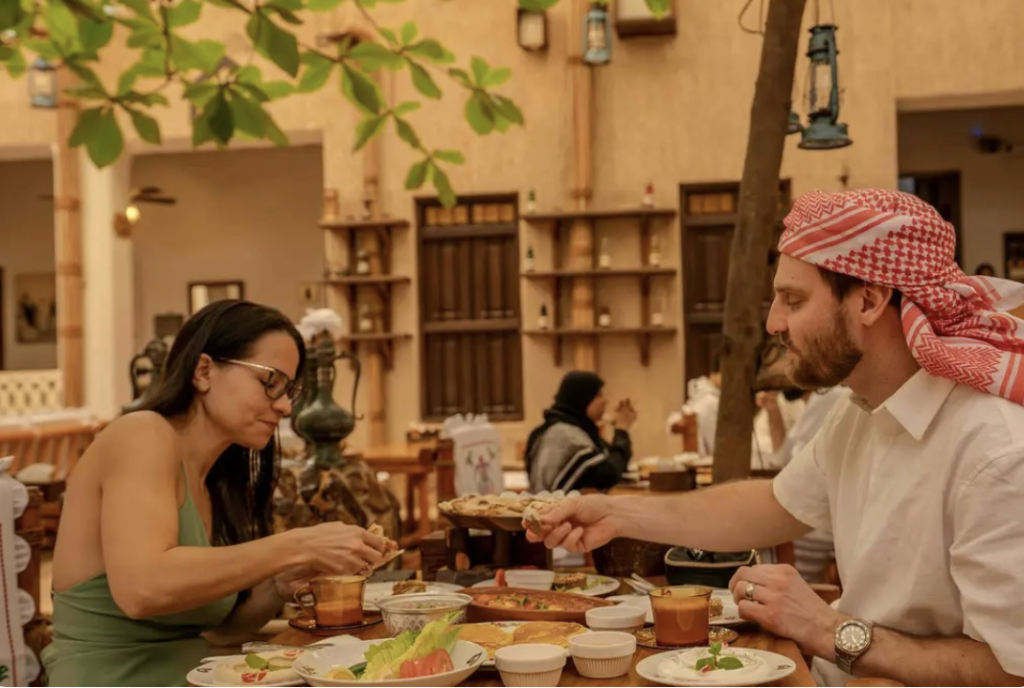
Emirati Dining Experience at Al Khayma Heritage House. “That’s when I found that food is culture and culture is food.” Photo credit: OceanAir Travels
The camp that changed everything
He built a desert camp, as authentic as it could be, a majlis where guests sat on the floor, were welcomed by a local host, drank Gahwa coffee and ate dates the way any Emirati family would. The experience extended to a buffet of Emirati dishes, the first of its kind to be presented in the desert in its truest form. And when Al Salah opened his own restaurant in 2020, the camp that started it all would now be catered by his very own kitchen.
Winning awards wasn’t part of the plan, his focus was to leave every guest genuinely satisfied. He believes it was that commitment to authenticity that travellers responded to. He got Number one on TripAdvisor Worldwide Traveller Choice, then after, winning three times in a row, the media requests came – CNN, BBC, Khaleej Times. Then the Dubai government called and asked, “What’s next?”
The answer came from his own tour guide, who rang one day with a message from a guest at the desert camp. They had loved the luqaimat – the little fried dough bites – and wanted to know where they could find them in the city. Al Salah looked for Emirati restaurants to send them to, then ended up opening one himself.
“That’s when I found that food is culture and culture is food – if you go to Dubai and you don’t see the food, there is a problem.”
That restaurant now has five branches across the UAE, each in a location that tells its own story: the biggest house in Dubai’s old town; inside Abu Dhabi Grand Mosque as the only Emirati restaurant; at Sheikh Zayed Festival; inside Qasr Al Watan, the royal palace visitor precinct in Abu Dhabi. Four Michelin awards.
“I made sure that you leave happy and recommend this enough to your friends and your community. If you leave a review, that means we went beyond expectation.”
Scaling without hiring trainers
I then asked the next question – how do you scale something this personal across multiple countries?
His answer: “I’ve never hired a trainer. I always bring the best-performing person that I know, and I’m close to my people – what are you facing, what can we do better?”
The people who train others at OceanAir are the ones who have actually done the job at the highest level. Knowledge flows from practice, not from a training manual, he said.
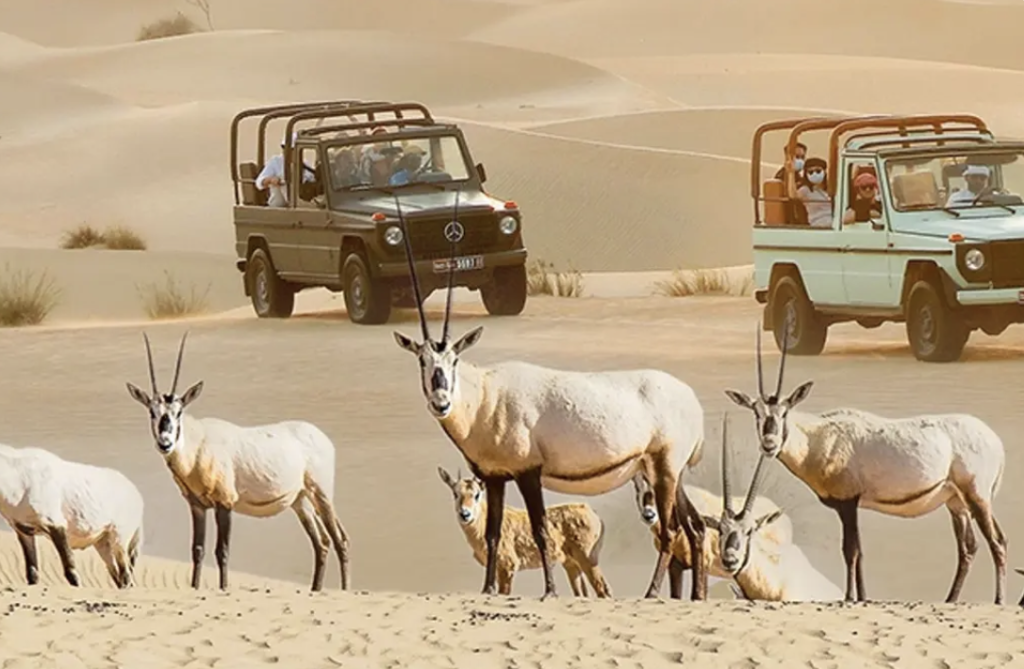
Evening Heritage Safari at Al-Marmoom. Photo credit: OceanAir Travels
The GetYourGuide bet and the commission he doesn’t mind
Al Salah entered digital distribution early, partnering with GetYourGuide in 2015 when the platform was still young and largely unknown. The path there was not smooth. He had built his own website, opened an office in India for tech operations, and ran Google ads himself. None of it scaled the way he needed.
“My core business is to create great experiences. I don’t care if the app will be successful or not, that’s not my case.”
His first email to GetYourGuide went unanswered. The second bounced – the domain on his email address didn’t match the right entity, so the system rejected it. Once he sorted the domain, they responded. And a relationship began that has lasted over a decade.
On the question of commission, Al Salah said matter-of-factly, “I hate commissions. I love to ask you one question: you’re going to ask for 30? Was it 20? You want 30? Okay, I’m fine to give you 35. But let’s discuss what you’re going to offer me. What value are they adding?”
In his case, technology, reach, and distribution infrastructure he would otherwise have to build and staff himself. “I’m not hiring tech people. Okay?”
His distribution philosophy now is deliberate balance. OTAs provide 50-60% of the desert safari business. The restaurants and venues – which are majority walk-in, driven by social media and reputation – provide a different kind of cash flow that he controls directly. “If you cannot make that 50/50, you would be in danger. We made sure that the venues are the majority of the cash flow.”
Building in a crisis, every time
Al Salah founded OceanAir in 2010, the year of the global financial crisis. He opened his restaurant chain in 2020, during COVID. His luxury desert domes were built immediately after the pandemic. The current uncertainty, he said plainly, is impacting the business, but his response is the same one it always is: build something new.
While the period of uncertainty reduced inbound travel, he has kept moving, deepening his business roots in the UAE with new restaurant branches, luxury domes in the desert, and sandbag houses, while extending his reach globally, exploring new opportunities in China, Japan, Rome, and Dubrovnik.
His reason is simple: a deep trust in the UAE’s leadership and an unshakeable belief that the country will emerge stronger than before. “We never stopped building, that confidence in our government and our leaders is what keeps us moving forward,” he said.
Taking OceanAir from Dubai to the world has always been the plan. With some directors less operationally stretched, Al Salah deployed them purposefully, sending them to these markets to lay the groundwork for what comes next.
He analysed data and found that the 5.8 million visitors to the Abu Dhabi mosque wanted a cultural experience nearby but couldn’t find one. He went to the mosque’s office and asked for the biggest space available. He is now building a Heritage Cultural Centre there.
“If you look at a person like me, who’s always building during those crises – I trust our government, I trust our leaders, I trust the defence system. All I did was find the next thing.”
The luxury domes – 25 in total, each with its own infinity pool and ice bath – were charging AED 5,600 a night in normal times. During the current downturn, he halved the price to support local business. The result: the domestic market grew faster than he had planned.
The experience, the destination, the advice.
On a travel experience that won’t exist in 20 years, Al Salah picks museums as they are. “They’ll be different. People want to really experience. But when you bring a few pieces of monuments and gather them in a spot, I can’t really experience it.”
On a destination people will be talking about: Oman. “It has everything but is not yet on the map. As travellers increasingly search for authenticity, it will come.”
On advice for a young Emirati who wants to build something: “Find the gap, find the need, what people are looking for that does not yet exist. You’re lucky that you’re the only one who sees it. Start it today, not tomorrow.”
It is, essentially, his own story told back to someone else – a tour guide who saw a gap between what was being offered and what travellers actually needed, and who did it his own way.