



Amid all the gloom and doom around us, it’s good to get a little happy news now and then, and yesterday Booking.com launched its Travel Happiness Index, which shows that 98% of APAC travellers associate travel with positive emotion, 84% say it helps them reset mentally, and, most tellingly, nine in 10 would rather adapt a trip than cancel it when disruption hits.
The inaugural study of 10,136 travellers across 10 APAC markets was unveiled by Laura Houldsworth, Managing Director, Asia Pacific, who framed the shift as travel having moved from indulgence to necessity.
“It’s not the dessert,” she said. “It’s the ingredients, the nutrients, the vitamins that people are needing.”
Where the industry once marketed travel as something earned – a reward for surviving the daily grind – the data now suggests travellers see it as something closer to maintenance for their emotional wellbeing.
That shows up starkly in what travellers say actually makes a trip worthwhile. Not the bucket-list moment, not the most expensive line item on the itinerary but natural scenery, time with travel companions, and simple, unmediated experience.
Houldsworth pointed to her own recent trip to New Zealand to attend WiT Queenstown: when people ask what stood out, “it’s literally what I saw. It was the landscapes.”
Family looms largest of all – 59% of respondents say family trips give them their happiest moments.
The science of anticipation
In a panel discussion that followed, Yeo Sha-En, founder of Happiness Scientists, brought in to unpack the psychology, located the emotional payoff earlier than most operators think to look.
Anticipation, she explained, activates dopamine reward circuits – travellers mentally rehearse the trip before it happens, and that rehearsal is itself a source of joy. It’s part of what she called the “savouring cycle”: anticipation, presence, and reminiscence, each stimulating positive emotion independently.
Asked how long that dopamine effect can be sustained – relevant, given booking windows across APAC are lengthening – Yeo cautioned against reading it as an infinite high.
Happiness, she said, is “a fleeting emotion” that comes and goes; what sustains it isn’t the anticipation itself, but the meaning attached to the destination or the people the traveller expects to be with.
She also drew a sharper line than the report’s language suggests between “joy” and “happiness” – the latter a retrospective, evaluative judgment (“was I happy on this trip, yes/no”), the former a harder-to-articulate alignment with one’s sense of self.
Her practical takeaway for travellers battling the pressure to document everything for social media: the compulsion to curate is an external, performance-driven impulse, whereas joy comes from asking an internal question – what am I actually here to do.
Removing self-inflicted friction
Teong Wah Kung, General Manager, Parkroyal Collection Pickering, brought the operator’s view, and it was unusually candid: much of the friction travellers experience, he argued, is manufactured by hotels themselves – standard operating procedures, artificial checkpoints, upsell tactics dressed up as service.
“We have built too many hurdles… to make people unhappy,” he said, citing the industry habit of nudging guests toward paid early check-in rather than simply removing the wait.
His fix has been to pair data with cross-trained staff: Parkroyal Collection Pickering has moved toward “specialists” – employees trained across multiple functions rather than confined to a single SOP-driven role – while automating back-of-house tasks thus, freeing staff for guest-facing roles.
He also referenced a four-day work week trialled for front office, call centre and security staff, and a hotel-wide research partnership with several Singapore universities and institutes, including NUS (National University of Singapore, to validate AI tools like neural-perception-based room recognition.
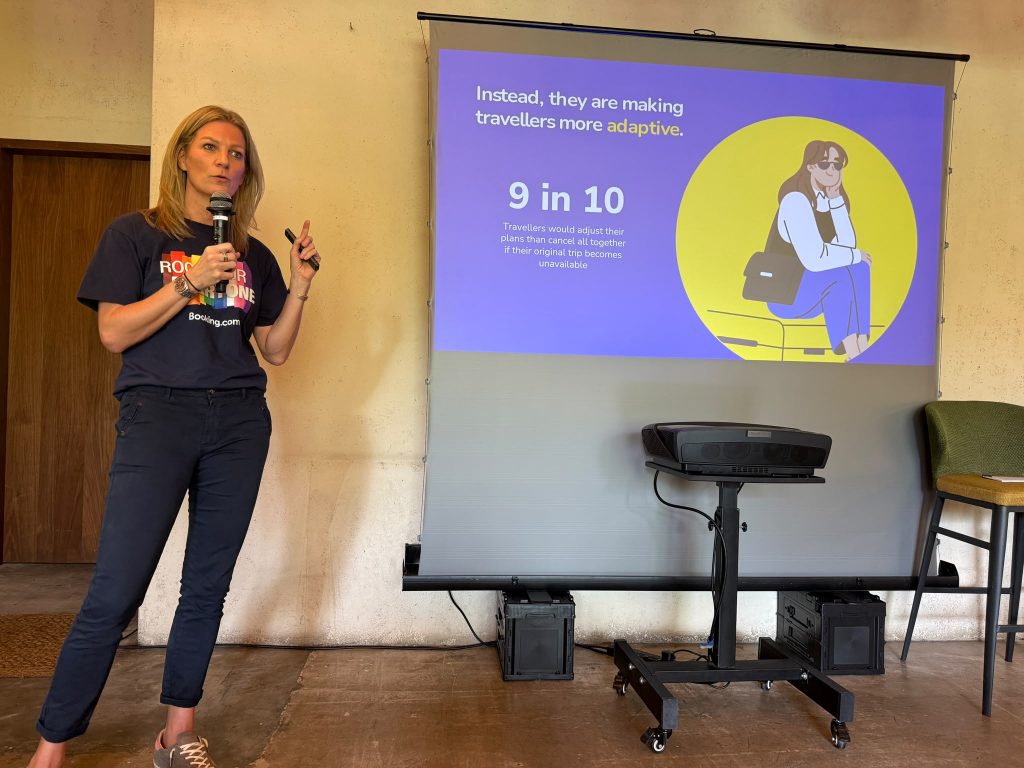
Laura Houldsworth, Managing Director, Asia Pacific, says travel has moved from indulgence to necessity. “It’s not the dessert,” she said. “It’s the ingredients, the nutrients, the vitamins that people are needing.”
Confidence, not perfection
On the report’s finding that 88% of travellers feel more at ease booking through a trusted platform, Yeo reframed what travellers are actually buying: not a guarantee that nothing will go wrong, but assurance that if something does, there’s a clear next step.
Unresolved uncertainty, she said, activates the brain’s threat response – the amygdala – and travellers effectively freeze until that threat is deactivated, whether by a backup plan or a real person on the other end of a phone line reassuring them.
That distinction – between disruption travellers can plan around versus disruption that threatens basic safety – is where she located the report’s finding that 90% of APAC travellers adapt rather than cancel: most people expect friction. What they can’t tolerate is friction with no path through it.
AI: Copilot, not autopilot
The media questions turned repeatedly to AI, and the panel’s answers converged on a single word: copiloting. Houldsworth pointed to Booking.com’s own data showing surging traveller enthusiasm for AI in the discovery and inspiration phase, but a persistent trust gap at the booking stage – travellers still want a human or a trusted platform behind the transaction, partly because AI tools can’t yet be called when something goes wrong, and partly because hallucination risk is real – she cited an example of a traveller told incorrectly by an AI tool that no visa was required for Vietnam.
Yeo added a psychological read: humans are “pleasure-seeking and pain-avoidant,” so AI’s appeal is largely about removing the drudgery of research but travellers still crave the human, off-the-beaten-track recommendation a friend or trusted source can offer, in a way current AI recommendations, when outdated or generic, cannot replace.
Kung offered an operator detail: his team now actively tests and refines the hotel’s own content against multiple AI models — Claude, ChatGPT, Gemini, Copilot — as a form of generative engine optimisation (GEO), rewriting press releases and web copy to be more discoverable by AI search tools, since no established GEO playbook yet exists.
The premium-for-unplugging question
I threw in the question of whether travellers might pay a premium for genuinely unplugged experiences. Yeo’s answer: appetite exists but likely bounded to short stretches (a few days rather than weeks), and works best when travellers are somewhere novel and stimulating enough that reaching for the phone loses its pull – not simply in a city, where the phone remains functionally necessary.
Kung, for his part, described building phone-free “farm-to-table” lunch experiences for club guests at his property, and – unprompted – named a recent seven-hour phone-free stretch during a workday as his happiest moment of the year.


