VIDEC Consultants, a boutique travel research and M&A consultancy firm, shared insights from its latest study on the GCC and Egypt markets. Titled ‘VIDEC’s GCC & Egypt Travel Market Sizing & OTA Benchmarking Study, 2019-2030’, it provides in-depth insights into the fastest-growing travel segments, market projections, and key distribution trends shaping the seven constituent markets.
Highlights
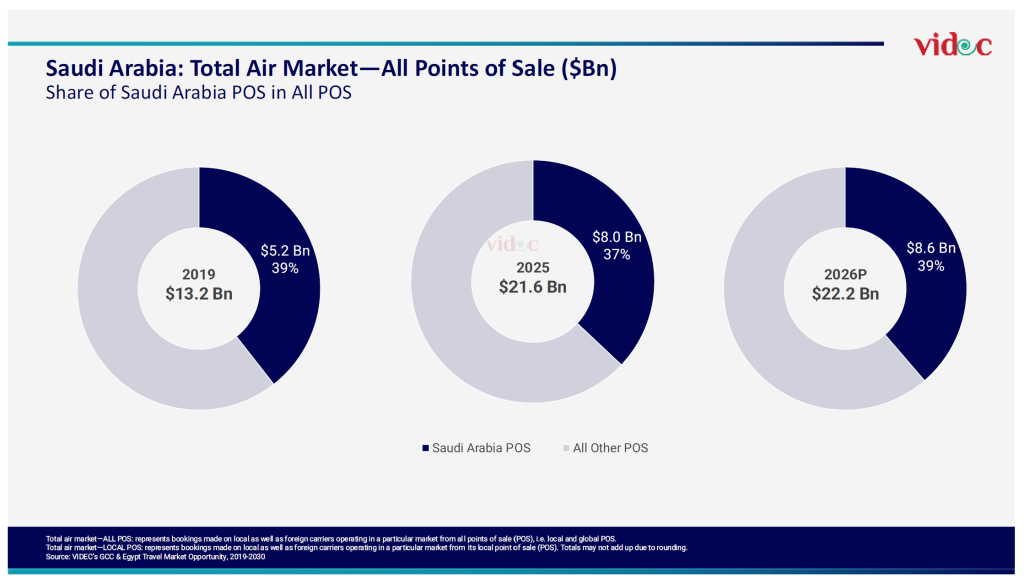
- Air market outlook: Projected to expand 8% and reach $8.6 billion in 2026, despite softer passenger volumes, supported by higher fares and strong local point of sale (POS) at 39%—the highest in the region.
- IPO aspirations and market consolidation in the OTA category: The OTA travel market is projected to reach $6.1 billion in 2026 as compared to $5.6 billion in 2025. Almosafer, Almatar and Wego OTA led the OTA air segment while Booking.com and Agoda combined cornered three-fourths of Saudi’s hotel OTA market.
- Faith-based strength: Religious travel to remain the cornerstone of the Kingdom’s travel demand.
This has been a year of disruption across the GCC region, yet the Saudi Arabian air market is expected to hold firm. Despite lower flown passenger volumes, market growth in dollar terms is forecasted to sustain, led by higher fares. VIDEC estimates the total air travel market to reach $22.2 billion in 2026, compared to $21.6 billion in 2025. This represents the gross booking value (GBV) of the total airlift servicing Saudi Arabia and sold from local as well as global points of sale. Similarly, the hotel category is projected to decline to $23.2 billion in 2026 from $27.6 billion in 2025, despite the tail winds from the domestic demand.
Retailers in Saudi Arabia, both offline and online, cater predominantly to domestic and outbound demand. VIDEC uniquely sizes the market using a demand-side methodology, referencing bookings made from the local point of sale (POS). With local POS share projected at 39%—the highest in the region—the Kingdom’s air market is expected to reach $8.6 billion in 2026, up from $8.0 billion in 2025. Looking ahead, the Saudi air market is forecasted to reach $13.3 billion by 2030, supported by collaboration between airlines and OTAs, growing at 11% CAGR from 2027–2030.
With the launch of Riyadh Air, the Kingdom’s air capacity will continue to rise. During 2019-2025, full-service carriers expanded in teens (58 million in 2019 vs. 65 million in 2025), while low-cost carriers, led by flynas and flyadeal, recorded multi-fold growth, from 18 million in 2019 to 43 million in 2025. Saudi Arabia’s travel market remains one of the most resilient globally, underpinned by strong domestic demand and a singular faith-based moat.
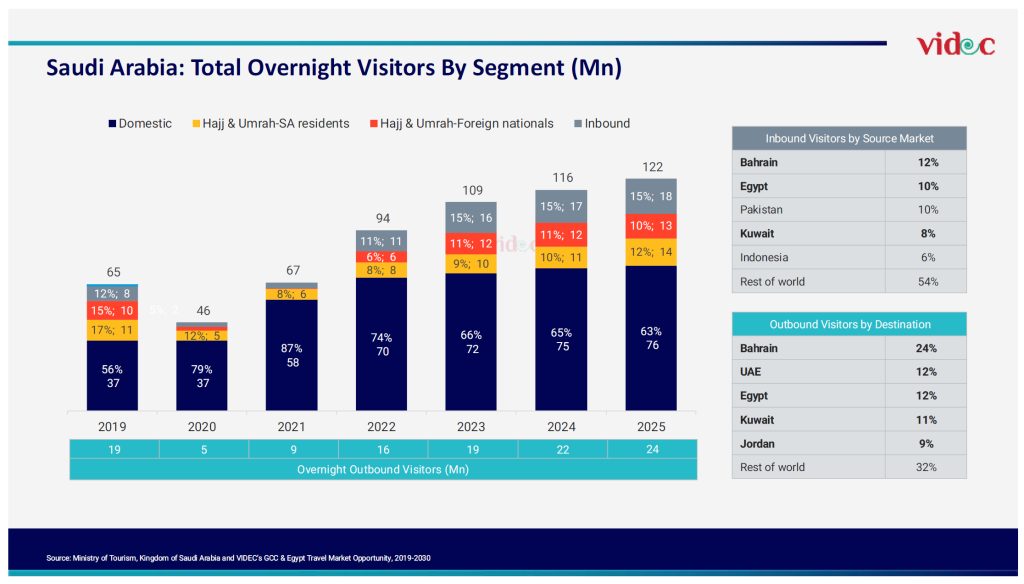
Domestic visitors accounted for 63% of the total overnight visitors in 2025, doubling from 37 million in 2019 to 76 million in 2025. Religious travel shall remain a cornerstone: Saudi residents accounted for an additional 12% of the total overnight stays in 2025, while inbound religious travel contributed to another 10%. The 2026 Hajj season closed at par with 2025, reaffirming that the faith-based demand is not slowing down. The remaining 15% of the visitors included inbound traffic spanning across business, leisure, VFR, and other segments.
Commenting on the key trends, Virendra Jain, CEO and co-founder of VIDEC, said, “Saudi Arabia has had travel and tourism at the forefront since it first chalked out the vision of being a non-oil-dependent economy. It’s a shining example of capitalistic modern outlook embracing the pristine cultural and experiential immersion. The Kingdom’s capex towards building infra and its tourism destinations will not only grow international visitors but will also beef up the domestic demand. The proclivity of denizens for local brands and language makes the homegrown OTAs a favourite and continues to reap rewards for Wego, which went Arabic first almost a decade ago. The capital markets in the region are still in in infancy. But as Almosafer get listed, and more companies aspire, the M&A and investment activity would naturally follow.”
Amid this growth, the Saudi Arabian travel market has become the latest gold rush, sparking once-in-a-lifetime financial activity across global, regional, and homegrown online travel agencies.
The publicly listed Seera Group plans to spin off its platform business Almosafer — Saudi Arabia’s largest OTA — as a separately listed entity. Meanwhile, Almatar, founded by the prestigious Al Rajhi family, also has IPO aspirations. Both Almosafer and Almatar have grown significantly over the past two years, underscoring the natural momentum of homegrown players. Wego Group, the region’s largest online air intermediary, has made a decisive pivot into transactional OTA business model, and now ranks among the top three air OTAs in Saudi Arabia.
Among the global OTAs, Booking.com, is the clear market leader in the hotel category as it continues to benefit from being the category builder. Its sister brand, Agoda has been one of the fastest-growing hotel OTAs in the region at the back of its aggressive pricing strategies.
Last but not the least, the newest entrant to the OTA benchmarking order, global giant
Trip.com, has quickly made its presence felt across both air and hotel categories. Making its foray in Saudi Arabia in late-2024, it now grosses upwards of $200 million in air GBV from the local POS, while also expanding into the region’s hotel OTA segment.