On the flight from Singapore to Bangkok, the captain’s voice stopped me. A woman’s. I hope one day I won’t notice anymore, but it’s still rare enough that I do. A quick search: 102 female pilots across the Singapore Airlines Group, including Scoot. That’s 2.8% of 3,676.
On the way back, from Sofitel Sukhumvit to Suvarnabhumi, my Grab driver was also a woman, at the wheel of a Chinese electric car.
Those two moments bookended my trip to GetYourGuide’s Unlocked Summit, and they set me thinking about how much has shifted in travel over the past two decades. Okay, 21 years, to stay on-theme with WiT’s “21: A New Beginning”.
Shifts in who travels and who serves them. Shifts in how we get there. And the question that kept coming up at both the WiT Singapore conference the summit: why we go at all.
The shifts that happen overnight
Some shifts are instant reactions to the news.
The Singapore Airlines crew told me weekend flights to Bangkok were full. Singaporeans were escaping the haze, which is back with a vengeance this year. Think about that: Singaporeans flying to Bangkok for cleaner air.
At the summit, I met the founder of a Chinese travel tech company who lives in Paris. Worried about his wife and kids amid the riots, he’s flying them to Abu Dhabi for a week’s holiday. Think about that too: the Middle East, right now, feels safer than Paris.
He would never have considered Abu Dhabi before. Now he’s done his homework and found plenty for the whole family. We even talked about a road trip on to Dubai and Muscat.
The how: new routes, new ways to book
Since February 28, the start of hostilities in the Middle East, travellers have been finding new routes to get where they want to go. Tao Tao, GetYourGuide’s COO and co-founder, is flying to Sydney for the company’s first Unlocked Summit there via Abu Dhabi. “The airfare is around US$2,000, why wouldn’t you do that?”
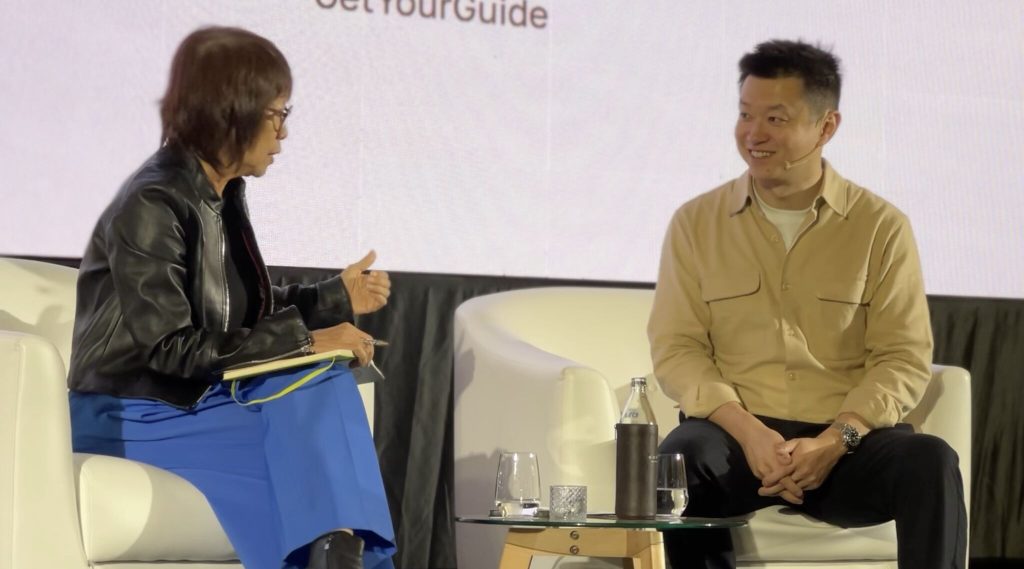
Tao Tao, GetYourGuide’s COO and co-founder, (right) at the Unlocked Summit in Bangkok recently
Price isn’t the only thing shifting. So is how we book. Let me tell you a story, because I think it captures something real about where the human–agentic AI relationship is heading.
This week I started planning my trip to Phocuswright in Florida, November 17-19. First stop, the Singapore Airlines website. No flights available on my dates, in any class.
Curious, I called the hotline. The agent confirmed: nothing. She suggested flying via Europe but couldn’t book it because another airline flew the Europe–US leg. Try a travel agent, she said.
I did. The agent came back with five options. One of them was the very SIA flight I’d wanted.
Now intrigued, I asked a friend at SIA to check the internal system. At least six business class seats, she said.
So I called the PPS hotline. Yes, seats available. She could book me to Newark, but Newark–Miami would need a separate ticket because it was on United.
“Aren’t you both Star Alliance? Why can’t you put it on one ticket?”
“I don’t know. The system doesn’t allow it.”
What, then, is the point of an alliance?
Meanwhile, I’d opened a chat with Instinct, the new AI agent that’s taken the world by storm. Its founder claims at least US$1b transactions, half of which is travel. And 40% of people have shared their credit card information, myself included.
I asked, “Find me the best and cheapest options from Singapore to Miami.” It came back with routings via Europe, flight times, transit times and prices, ranked. Cheap, but far too long.
“Try Emirates,” I said, since the travel agent had offered two Emirates options, one via Kuala Lumpur and one from Singapore. Instinct found both, laid out in a graphical interface I rather liked. I asked it to watch the fare on one. Within ten minutes it was back: the price had jumped $1,000. Did I want to book?
I thought of the travel agent. She’d taken more than 24 hours to reply the first time, and her second option would have routed me through Kuala Lumpur, Doha, Miami, then back via Abu Dhabi. Still, I felt I owed her another go. I sent her a screenshot of the Instinct offer and asked if she could book the same flights. She could – I clicked the Book Now button and the price turned out to be $100 cheaper.
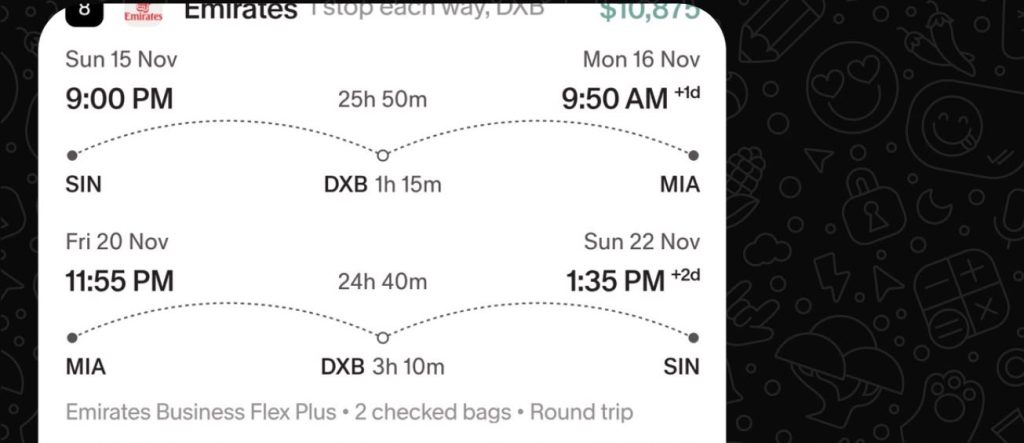
I told Instinct what I had done, I felt almost apologetic. It replied, “Nice one! I’ll stop watching the fare then. Enjoy Miami.”
In the end I booked with the human. Not for the $100, but because she’d done some of the work, and as a fellow human I felt I should root for our species.
But look at what actually happened. This should have been a direct booking win for SIA. Its own systems couldn’t see, or couldn’t sell, the seat. I tried a couple of OTAs too, and found the choices and fine print bewildering. Instinct was simply easier, like a personal agent in my pocket.
Shifts like these in the how don’t stay novelties. Over time, they bake themselves into how we behave as travellers.
The why: experience first
Then there are the slower, deeper shifts in why we travel.
At the summit, Tao Tao, COO and co-founder of GetYourGuide, spoke of travellers becoming increasingly experience-led, and of a future where travel is experience-first. That, he says, is GetYourGuide’s next chapter. (See related article.)
On stage, what struck me most was the passion of the operators who deliver that why. Two in particular: Trung Quang Dong, tour-guide-turned-founder of Saigon Adventure in Ho Chi Minh City, and Taweesak “Kung” Numee of Go Samui Cook on Koh Samui.
GetYourGuide’s research shows the number one reason customers come back is the guide. Trung spent about eight years as a guide and tour leader, for Vietnamese and foreign travellers alike, before starting his company 11 years ago. Guiding could earn a good living, he realised, and he wanted that for a younger generation while Vietnam was still developing.
“I believe the soul of a tour, the biggest heart of a successful tour, is the tour guide,” he said. He’s built a training ladder, with distinct levels for drivers, tour leaders and professional guides, and that structure, he says, is what keeps the company strong in a crowded market.
For Kung, who has guided on Samui for nearly 30 years, the difference is authenticity. The island has no shortage of cooking classes, he said, but few teach genuine southern Thai food. Almost everything in his class is cooked with coconut milk, and most of the herbs come from his own garden.
Listening to him talk about food made me hungry. It also made me feel lucky to be in an industry where, however fast the how is changing, the why and the who keep travel unabashedly, unchangeably human – whether it’s a woman in the cockpit, a woman at the wheel, or a man in his herb garden on Samui.