
He has seen every cycle travel can throw at an industry. Now JTB’s chairperson says he can smell something different in the air and it isn’t another round of digital transformation. It’s a rebirth, and it starts with the human being at the destination.
Most executives treat the step up from CEO to chairperson as a cue to ease off. Eijiro “Eddie” Yamakita has done the opposite.
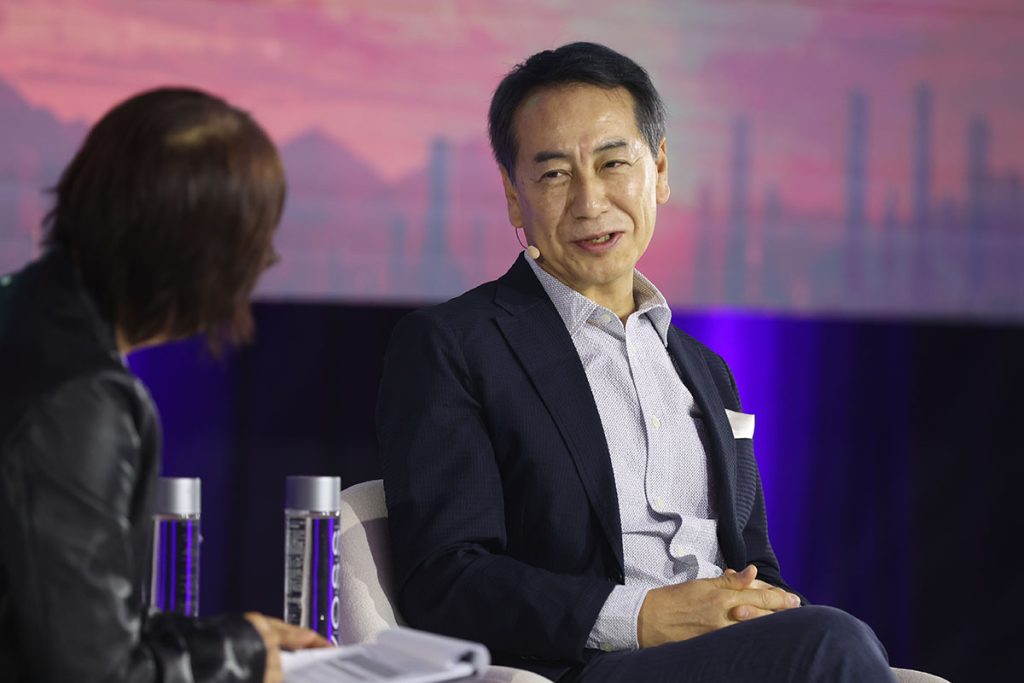
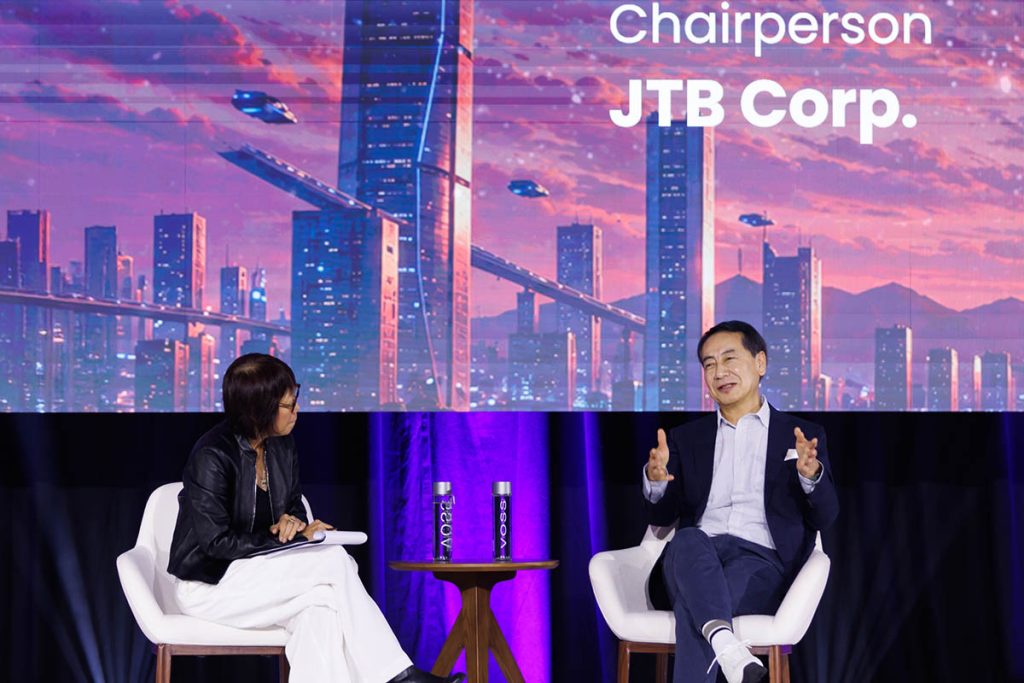
A year ago, he was on the WiT stage as CEO of JTB. Today he is chairperson. He is also vice chairman of the Japan Association of Travel Agents and vice chairman of the World Travel & Tourism Council. He had just wrapped Tourism EXPO Japan, and after WiT Singapore, he was heading to Malta.
So, what’s driving all this? “First of all, I’m still young,” he told WiT founder Yeoh Siew Hoon in a coffee chat at WiT Singapore, admitting to one drink too many the night before. “And secondly, I have a little more time to travel.”
He is using that time to travel “aggressively”, because for him the destination is the whole point. “We’ve been talking a little too much about digital transformation,” he said. “It’s good, but we tend to forget what human beings are doing at the destination, and the people who are welcoming them.”
Call it human transformation or renaissance, and Yamakita is fully behind it.
One DMC network, three different playbooks
Firstly, he spoke about JTB’s expansion. As Japan’s largest destination management company with a global presence, it added in May EXO Travel, one of South-east Asia’s leading DMCs, founded in Vietnam in 1993.
Why EXO? “It’s a very unique company,” Yamakita said. “They’ve built luxury travel handling, mainly B2B, and they have rich experience as a DMC. We have offices around Asia, but this is what we were lacking. It’s a very good match with the JTB network.”
Asia, he made clear, is not being run off the European template. In Europe, JTB bought a Scandinavian specialist, then added a coach business as its European window, building destination management at scale. “Europe is now complete with this kind of large-scale destination management,” he said. “In Asia, each country is very different. It needs more focus on the experience at the destination.”
The US calls for a third approach. The market is spread out, and the business tilts towards MICE, activities and adventure travel. JTB has its Hawaii operation and recently added a MICE specialist on the mainland, which he says is “boosting the US business”.
Next on the radar: sports and entertainment, a segment Yamakita, a former baseball player, has a soft spot for.
“Try not to be conservative”
The numbers behind all this sit in Open Frontier 2035, the growth plan Yamakita announced and his successor, Aomi Tomo, now has to deliver.
“I gave him a big task,” Yamakita said. “I told him: try not to be conservative. Be aggressive.”
Tomo took him at his word. He has since announced a very large investment programme. It covers destination development, including hotels, and partial stakes in sports and entertainment. It also covers investment in local communities and in marketing intelligence, “like we do with Northstar”. (JTB owns Northstar Travel Group, WiT’s parent company.)
Where the money is going
Yamakita’s bets come in a few clear areas. Each one is less about distribution than about what a traveller actually feels on the ground.
Spirituality and wellness: three days without food
The case for spiritual travel, he argued, gets stronger as AI gets better. “We need to focus more on human happiness, and the spiritual part is essential,” he said. “In the future, when AI is introduced and everything is done by AI”, that is when it will matter most.
He has tested the idea on himself. In Aomori, in Japan’s rural north, a new wellness hotel, ReLabo Medical Spa & Stay, run with Japan Railways put him through a three-day fasting programme. The price was around ¥160,000, roughly US$1,000, and it came without meals.
On the first night he sat in an elegant French restaurant eating a single small dish while other guests dined around him. On day two there was nothing to eat at all, only 100ml of vegetable juice every hour. Then came spa treatments and Ayurveda.
The hotel is owned by JR, but it is run by a medical institution, with professional consultation throughout. Most of its guests come from elsewhere in Asia. “I was given a lot of instruction,” he said. “My life changed after this.”
For the better, he confirmed.
Gastronomy: someone has to fund it
JTB has made a partial investment in a food-led villa in the suburbs of Fukuoka, in southern Japan, chosen for its cuisine and its relaxed pace.
The logic is refreshingly blunt. “Everybody talks about gastronomy, but investment is limited and somebody needs to fund it,” Yamakita said. “We’re not expecting a return from this investment. But somebody needs to support gastronomy development. That’s why we did it.”
Yeoh asked if he felt the same about Northstar, not expecting a return. The answer was laughter.
Innovation: a university in Takayama
For all the talk of human transformation, Yamakita is no technophobe. JTB is backing CoIU, the newly established Co-Innovation University in Takayama, central Japan, through an investment vehicle called the Co-Innovation Alliance.
The idea is to pull in partners from around the world and let “chemical reactions” happen. Local communities sit alongside venture investors and academia, so that what gets invented there benefits the place it is invented in.
The missing interface between traveller and town
That brought the conversation to local communities. Intrepid Travel CEO James Thornton has argued the industry spends too much time thinking about the traveller and too little about the people at the destination.
In Japan, Yamakita said, communities are eager to welcome visitors, even as overtourism bites. The problem is a lack of imagination about how travellers actually experience a place.
Technology has made it worse, not better. “There’s a lot of technology-driven marketing, but no real interface with the customer,” he said. “Even less communication with the customer, because they feel they’re getting enough marketing data. But they never met the customer.”
JTB sees its job as closing that gap: connecting traveller and destination, advising destinations on how to match what customers want, and developing the content itself.
The Japanese government is pushing the same way. It is imposing tougher criteria on destination management organisations. “Lots of DMOs were established, but there’s no capability,” Yamakita said. JTB is working with government to professionalise them, building marketing skills, content development and real engagement with local communities. It is happening across Japan right now.
Omotenashi is a mindset, not a process
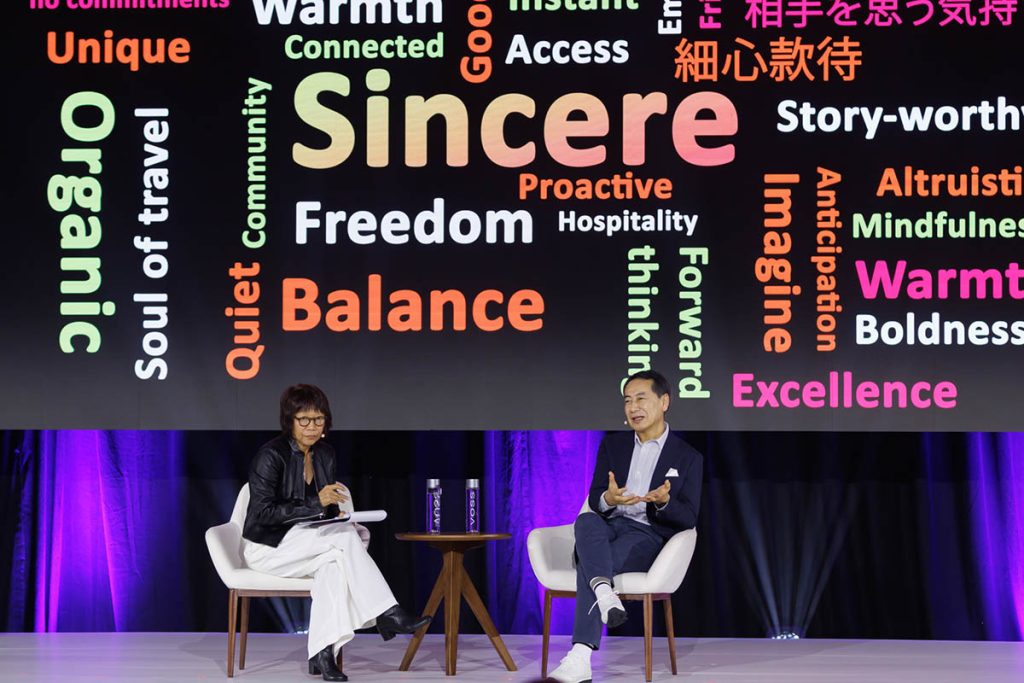
Yamakita was asked if Japan could support “omotenashi”, the Japanese spirit of hospitality. He doesn’t believe there is a single formula. “This is not a process. This is a mindset,” he said. “To entertain people, to make people happy. That is the omotenashi spirit. As long as you have that spirit, it can be adapted in a different form in each country.”
114 years, and a birthday gift
With JTB at 114 years old, in a country where the number of centenarians keeps climbing, he was asked, what is the secret of its longevity? “Just human capital, and an ecosystem to raise the people,” he saud.
And asked what he would give the travel industry as a gift for its 21st birthday, he said, “Renaissance. It means reborn. Not just changing. We need to be reborn, keeping the original essence of tourism but transforming the way we behave. That is the most intelligent process of human beings, and AI cannot do it.”
Watch the full session: