
Five uncomfortable truths from the Global Travel Tech Thinktank
From the promise of the “Magic Complete Trip” to the threat of AI agents dismantling distribution moats, travel leaders at the Global Travel Tech Thinktank 2026 confronted a difficult question: If the technology is ready, is the industry?
What’s possible today that wasn’t possible five years ago? And to make it happen, what uncomfortable truths must the travel industry confront?
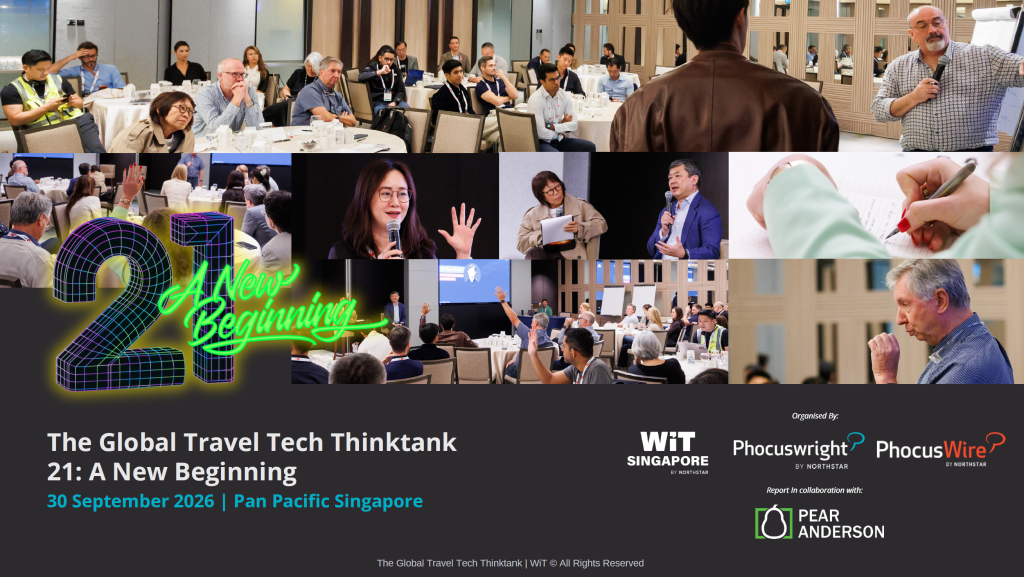
That was the question posed to industry leaders at the Global Travel Tech Thinktank, held on September 30 as part of WiT Singapore 2026, themed “21: A New Beginning”.
Organised by WiT in collaboration with Phocuswright and Phocuswire, the invite-only gathering brought together leaders from across travel, technology, hospitality, investment and distribution to explore not just what AI could make possible, but what might stand in its way. And while the possibilities were exciting, the uncomfortable truths proved even more revealing.
Four possibilities emerged: the “Magic Complete Trip”, agile back-end systems, an anywhere front door and industry collaboration. Each came with its own dilemma.
Here are five takeaways from the newly-released report.
1. The technology is ready. The plumbing isn’t.
For years, the travel industry has talked about delivering the seamless, connected, end-to-end trip. Now, with AI agents capable of anticipating disruptions, coordinating bookings and acting on behalf of travellers, that vision is closer than ever.
Imagine a flight delay automatically triggering changes to your hotel arrival, restaurant reservation and airport transfer, without you having to lift a finger.
“Flight’s delayed, let’s inform the hotel, let’s inform the restaurant, delay my car. That is the vision that we need to bring to life for travellers,” said Laura Houldsworth, Managing Director, Asia Pacific, Booking.com.
The problem? The systems underpinning travel remain fragmented, disconnected and weighed down by legacy technology.
Martha Waslen, CEO and founder of DayAway, described the hotel technology landscape as years of accumulated fixes. “It’s been bandaid over bandaid over bandaid for years. There’s so much fragmented legacy tech in hotels that until it’s consolidated and streamlined, they can’t effectively leverage AI to improve the guest journey in any meaningful way.”
And Nadia Omer, CEO of AirAsia MOVE, offered this revealing observation. “Humans are remarkably good at working through complexity, so good that we stop seeing what it costs them. AI doesn’t do that quietly. It charges for every extra step. When automation put a price on our complexity, we finally fixed it.
“It made me wonder what else our people are quietly carrying that we haven’t yet seen.”
In other words, AI is exposing the hidden costs of complexity that the industry has tolerated for decades.
Rajnish Kumar, Co-founder and Group Co-CEO of ixigo, brought the conversation back to what actually matters to travellers: Was the reservation honoured? Were changes handled smoothly? How quickly did the refund arrive? And when something went wrong, was it resolved?
The uncomfortable truth? We may have spent too long using people to compensate for broken processes, rather than fixing the processes themselves.

Martha Waslen, CEO and founder of DayAway: “It’s been bandaid over bandaid over bandaid for years. There’s so much fragmented legacy tech in hotels that until it’s consolidated and streamlined, they can’t effectively leverage AI to improve the guest journey in any meaningful way.”
2. The next battle for distribution may be about opening doors or protecting moats.
What happens when the screen is no longer the primary gateway to travel? Timothy O’Neil-Dunne, Principal at T2Impact, said: “The screen is no longer either the exclusive or even the dominant front door.”
In an agentic world, travellers may no longer need to visit an OTA, search through pages of hotel listings or navigate multiple booking platforms. They could simply tell an AI agent what they want and let it do the work.
Booking could become asynchronous, happening in the background while the traveller gets on with life.
This creates enormous opportunities for new entrants, specialist travel agents, voice-enabled commerce and more accessible ways of booking travel.
But it also presents an existential dilemma for established travel companies. Open up inventory and systems to AI agents, and you risk turning travel into a commodity, inviting new competition from technology companies with formidable consumer reach and product capabilities.
Keep those systems closed, and you risk becoming invisible to the next generation of travel discovery and distribution.
Dr. Kuo-Yi Lim, Co-founder and Managing Partner of Monk’s Hill Ventures, ventured: “If someone can become the first go-to agent… I’d be very worried as a Booking.com.”
Rajnish Kumar of ixigo offered a more expansive view. “If we as an industry make our inventory accessible to AI agents, we open the door to more competition at the consumer layer. But that is not necessarily a bad thing. It is good for consumers, and it can also be good for travel companies.”
His argument is that reducing booking friction could grow the overall market, turning more travel intent into actual bookings. Reliable providers could benefit as agents learn which companies deliver on their promises.
The real danger, he warned, is dependence on a single dominant AI platform. The market could expand even as individual travel companies lose bargaining power.
His prescription? Open inventory to external agents while building proprietary assistants that help customers plan, book and manage trips, including changes, cancellations and refunds.
The uncomfortable truth? The same technology that could democratise access to travel inventory could also dismantle the competitive advantages that travel companies have spent decades building.
And closing the doors may be just as risky as opening them.
“Travel companies should do both: let external AI agents book their inventory and build their own assistants that help customers plan, book and manage a trip, including changes, cancellations and refunds. To earn direct usage, those assistants need to handle travel better than a general-purpose assistant can. That gives customers a reason to come back directly, and gives travel companies a business that does not depend entirely on another platform deciding who gets the booking.” –
Rajnish Kumar, Co-founder and Group Co-CEO of ixigo
3. Travellers don’t necessarily want frictionless travel. They want worry-free travel.
Perhaps one of the most interesting discussions concerned the assumption that travellers want every aspect of their journey automated. Do they really?
Nadia Omer challenged the industry’s obsession with convenience. “We overrate convenience …travellers just want it ‘worry free’.”
She noted that travellers enjoy planning their journeys. What they want is for everything to work once they have made their purchase.
This distinction matters. Travel is not like ordering groceries or replenishing household supplies. The anticipation, discovery and occasional surprise are part of its appeal.
Iain Manley, CEO and founder of VoiceMap, warned against a future in which travellers move from driverless cars to staff-less hotels, passing through destinations without meaningful human interaction. He described such a possibility as “kind of a horrific one”.

Dr. Kuo-Yi Lim, Co-founder and Managing Partner of Monk’s Hill Ventures: “If someone can become the first go-to agent… I’d be very worried as a Booking.com.”
Instead, he argued for AI that delivers serendipity, helping people discover experiences they might never have considered themselves, rather than simply reinforcing consensus choices.
There is also a commercial upside to getting the less glamorous parts of travel right. As Alice Goh, Head of Commercial at HeyMax, observed: “You win a customer forever if you fix the problem”.
And Tan Bee Leng, Chief Commercial Officer of The Ascott Limited, offered a useful reminder to an industry obsessed with technological superiority. “Sometimes the best tech doesn’t necessarily win the race… The way people want to travel will decide the winner, not the fanciest AI tool.”
She argued that companies must be deliberate about which parts of the experience they automate and which they protect.
The uncomfortable truth? In our rush to remove friction, we risk removing some of the very things that make travel worth taking.
The opportunity is not to automate everything. It is to know what should never be automated.
4. Trust is becoming a question of data, money and control.
At the 2025 Thinktank, trust emerged as the new battleground. A year later, that conversation had become much more practical.
How much personal data will travellers willingly share with an AI agent? How much authority will they give it to make decisions, spend money and act on their behalf? Will travellers trust an agent to make the right choice when something goes wrong? And perhaps just as importantly, how much will travel companies trust one another to share the information needed to deliver a truly connected journey?
These questions take trust beyond consumer confidence into the mechanics of payments, data access, accountability and commercial relationships.
A traveller might happily ask AI to research a holiday. Giving it access to a credit card, personal preferences and permission to make autonomous purchases is another matter altogether.

Nadia Omer, CEO of AirAsia MOVE: “Humans are remarkably good at working through complexity, so good that we stop seeing what it costs them. AI doesn’t do that quietly. It charges for every extra step. When automation put a price on our complexity, we finally fixed it. It made me wonder what else our people are quietly carrying that we haven’t yet seen.”
Meanwhile, the rapid adoption of generative AI is changing consumer expectations. Tushar Khandelwal, CEO and Co-founder of TourHero, noted how quickly even people outside the technology industry are embracing ChatGPT for everyday tasks, including travel. “The rate is staggering,” he said.
Yet the people sitting in the Thinktank room acknowledged that they were hardly representative of the average traveller, who might take only one or two trips a year.
The uncomfortable truth? The future of agentic travel depends not only on what machines can do, but on what humans and businesses are prepared to let them do.
And the industry’s technology leaders must remember they are designing for travellers who do not necessarily think, behave or travel like them.
5. Everyone wants collaboration. Nobody wants to give up the customer.
If there was one recurring tension throughout the Thinktank, it was the industry’s difficulty in working together. AI promises to connect the fragmented travel ecosystem, but the commercial incentives that created that fragmentation have not disappeared.
Who owns the customer? Who services the customer? Who controls the data? And who gets paid?
These questions have been debated since the earliest days of online travel. AI is making them more urgent, not less. “We’re lousy collaborators, both vertically and horizontally,” said Timothy O’Neil-Dunne. “And AI is going to be so omnipresent, we need to collaborate in order to bring the context of travel domain knowledge into the use of different systems.”
Yet there may be areas where collaboration is both possible and necessary.
Rajesh Magow, Co-founder and Group CEO of MakeMyTrip, pointed to credit card fraud as an example of a shared problem where cooperation benefits everyone without necessarily compromising competitive advantage. “If I share that data, everyone benefits,” he said, suggesting the industry identify areas where commercial interests do not stand in the way.
Luke Clark, Co-founder of The Reset Practice, took the discussion into more uncomfortable territory. With the travel industry facing threats ranging from AI disruption to political violence and other large-scale incidents, he proposed using AI to simulate worst-case scenarios, examine their consequences and identify what the industry should be doing now to prepare.
It is the sort of work nobody particularly wants to do, but one where AI could help the industry anticipate problems before they become crises.
The uncomfortable truth? The industry may be more willing to collaborate over shared threats than shared opportunities.
Perhaps that’s where it should start.

Rajesh Magow, Co-founder and Group CEO of MakeMyTrip: “If I share that data, everyone benefits,” he said, suggesting the industry identify areas where commercial interests do not stand in the way.
The emerging-market opportunity and reality check
The Thinktank also examined what these possibilities mean for emerging markets, where fragmented supply, uneven digital infrastructure and cost constraints can make the promise of an all-knowing personal travel agent especially difficult to deliver.
Rajesh Magow warned against underestimating the complexity of building agents capable of servicing every use case in markets with highly fragmented supply.
At the same time, younger companies unencumbered by decades of legacy technology may have an advantage.
For them, AI offers the opportunity to leapfrog systems and business models that more established players are still trying to untangle.
But investment discipline remains essential. How much should companies spend on AI? How fast should they move? And how do they distinguish genuinely useful technologies from the daily flood of vendor promises?
As Ascott’s Tan Bee Leng pointed out, those investments still need to be justified to the CFO. “I need to justify this to my CFO on an almost monthly basis… How much is too much?”
Her approach is pragmatic: be a purposeful early adopter, rather than chasing every new technology, and accept that some of today’s investments will eventually become obsolete.
That may be one of the more important lessons for companies navigating this new era: The winners may not be those who adopt AI first, but those who understand where it creates lasting value.

Ascott’s Tan Bee Leng said her approach to new tech is pragmatic: be a purposeful early adopter, rather than chasing every new technology, and accept that some of today’s investments will eventually become obsolete.
A new beginning, but what should we protect?
For all the discussion about agents, automation, APIs and distribution, the Thinktank ultimately returned to the traveller.
Not the hyperconnected, frequent-flying industry executive who attends travel technology conferences, but the ordinary traveller who takes one or two trips a year, wants things to work and expects travel to deliver something beyond a transaction.
There was recognition that the industry must protect the joy of planning, the pleasure of discovery, the human touch and the sensory experiences that make travel memorable.
“We travel for our senses, and that’s something that AI doesn’t have,” said Dan Christian, Host and Founder of the Travel Trends Podcast.
Technology should enable those things, not erase them.
Which brings us back to the central question posed at the start of the Thinktank. What is possible now that wasn’t possible five years ago?
Quite a lot, it turns out. What’s stopping us? Not necessarily the technology.
The Global Travel Tech Thinktank 2026 report explores four possibilities – the “Magic Complete Trip”, agile back-end systems, an anywhere front door and collaboration – along with the dilemmas, competing perspectives and uncomfortable truths that accompany each.
The biggest takeaway: AI is forcing the travel industry to confront problems it has long known about, but never had sufficient incentive to solve.
The question now is whether this new beginning will finally give it the courage to do so.
As the report concludes: “AI can reimagine travel, but only we can fix what’s broken — and protect what makes it human.”
What becomes possible when AI removes the technological limits and what happens when the industry’s commercial realities get in the way?
Explore the four possibilities, the debates among travel leaders and the questions every travel business needs to confront as it prepares for an agentic future.
Download the full Global Travel Thinktank 2026 Report here
The Global Travel Tech Thinktank is an exclusive, invite-only collaboration between WiT, Phocuswright and PhocusWire. The 2026 edition, themed “21: A New Beginning”, was held on September 30 at Pan Pacific Singapore, as part of WiT Singapore 2026.