
One sells a single hotel room, replicated everywhere, down to the light bulb. The other runs 17 brands across every price point. At WiT Singapore 2026, Hotel101 Global’s Hannah Yulo-Luccini and Ascott’s Tan Bee Leng made the case for two very different futures of hospitality, both built from Asia.
You could not find two more different models. Yet the two women on stage share a back story: both came into hospitality from real estate. Tan Bee Leng, Chief Commercial Officer of Ascott, came up through marketing and communications at CapitaLand. Hannah Yulo-Luccini, CEO of Hotel101 Global, spent 25 years in finance and property development in the Philippines, home of fast-food giants Jollibee and Mang Inasal.
So what excites two real estate people about hospitality right now?
For Tan, it is the obvious two-letter word, and its opposite. “AI is extremely exciting and terrifying,” she said. “But hospitality right now is the voice for the human. It is an industry that can credibly own this space about the need for human in the loop, and why the human is extremely important, if not the most important, in the hospitality trade.”
For Yulo-Luccini, it is the product itself. “Hospitality is bringing a product that people really love, and it speaks for itself,” she said. “Most developers find operating hotels very daunting. But it shouldn’t be that way. If you design the product that will delight your customers, there is very little left to do.”
The Big Mac of hotels
Hotel101’s mission is to bring fast-food principles to hospitality: one product for the world, simple, consistent, scalable. And to take Filipino hospitality global with it.
The company listed on NASDAQ on July 1, 2025. Its ride since has been bumpy: high volatility and trading halts, real revenue and operational proof points, but also real losses and high leverage. Yulo-Luccini was unfazed.
“Rapidly growing businesses that are disrupting industries are very often misunderstood early on,” she said. “Look at Airbnb, the last big disruptor in hospitality 20-odd years ago. They only started making money a couple of years ago.”
Her argument is that Hotel101 makes money twice. First as developer: it sells individual hotel rooms on a freehold basis to retail real estate investors and earns a development margin while it builds. Then as operator: once the hotel opens, it runs it for the next 50 years, with full autonomy, under its own brand.
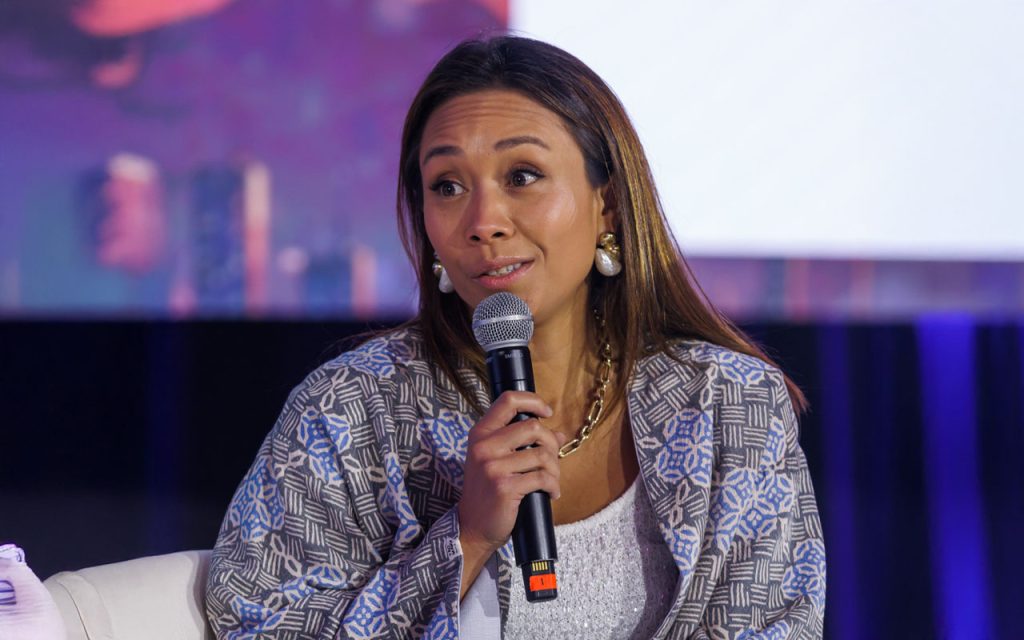
Hannah Yulo-Luccini, CEO of Hotel101 Global: “Rapidly growing businesses that are disrupting industries are very often misunderstood early on.”
One room, one light bulb
The model rests on one room design replicated everywhere, from the Philippines to Madrid, Niseko, Los Angeles, Milan and Melbourne. Not everybody likes a Big Mac, of course.
“But it’s probably the most eaten burger in the world,” said Yulo-Luccini. “Everybody has a preference. But count how many times you ate a Big Mac versus your favourite burger.”
The discipline goes deeper than the room. “We drill down on efficiency so hard we have one type of light bulb in the entire property. From the room, the lamps, the hallways, the all-day dining, the lobby, all the way down to the parking. It’s a one-light-bulb hotel.”
The numbers back her up. The Madrid hotel, opened less than six months ago, has 680 rooms and just 30 direct hires. It already has more than 8,000 online reviews, rated 9.1 to 9.4. “That’s a thousand people there a day. And just overnight, they came.”
The closest parallel, she said, is the budget airline. Southwest launched with one type of seat and no frills, and it did not just eat into the market of the legacy carriers. “They ate into the market of the people taking buses.” That is the market Hotel101 is after.
Owners who don’t argue about revenues
The owner proposition is just as stripped down. Unit owners receive 30% of gross room revenue, pooled per property, with no deductions. They are paid on the 16th of every month, and thousands of them have been paid this way over the last decade.
Because every room is identical, every owner gets exactly the same amount. “There’s no fight about ‘how come my room was only used two nights this month?’ Nobody cares. You bought exactly the same room,” said Yulo-Luccini. “We can spend what we want on a professional GM and all of these things. But nobody can argue about revenue.”
And when a partner asks for something different? “We don’t want a Big Mac, we want Kentucky Fried Chicken. We hear that all the time.” Her answer is that standardisation plus scale brings unbeatable efficiency. She points to Uniqlo, whose motto is to completely ignore fashion. “That’s what we do. We bring irresistible value to consumers by completely ignoring all the rest.”
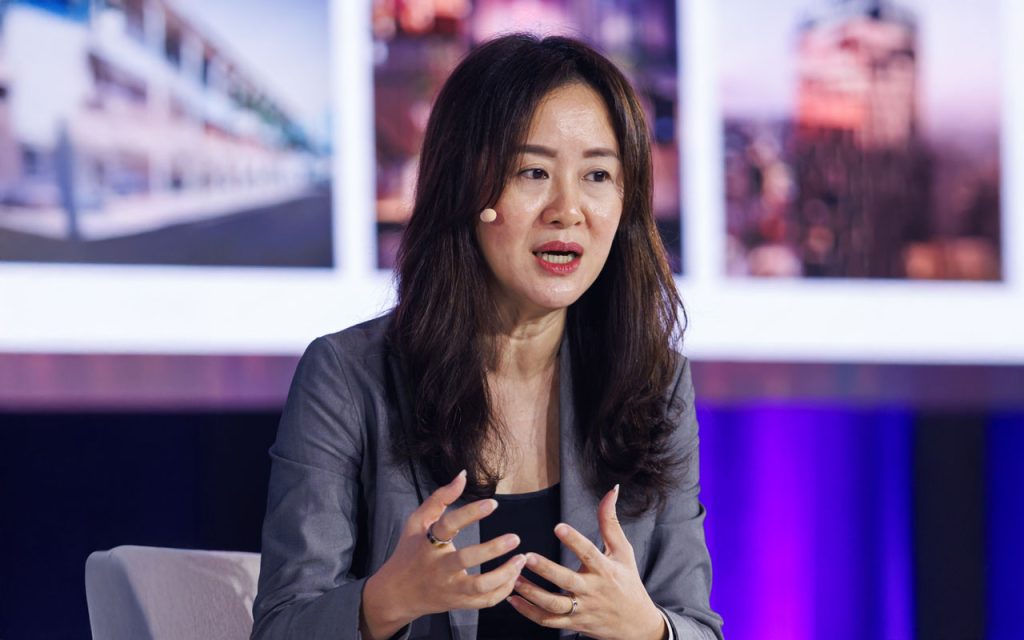
Tan Bee Leng, Chief Commercial Officer of Ascott: “AI is extremely exciting and terrifying. But hospitality right now is the voice for the human. It is an industry that can credibly own this space about the need for human in the loop, and why the human is extremely important, if not the most important, in the hospitality trade.”
From 99% owned to 1%
Ascott’s first transformation was the move from owning its assets to asset-light, the only way it could scale. Still wholly owned by CapitaLand Investment as its lodging arm, it began the switch some 15 years ago. Today, only about 1% of its properties are owned.
“Extremely hard,” said Tan of the shift. “We had to change our mindset from an owner-operator into one servicing third-party owners.”
That meant building websites, launching a loyalty programme and rethinking distribution. Above all, it meant moving everyone’s focus from asset appreciation to operating performance, so that value is extracted for every third-party owner.
Where Hotel101 has one product, Ascott has 17 brands spanning a wide range of price points and markets. Asia Pacific is its home ground, Citadines its biggest portfolio, and its flagship brand, The Ascott, has more than 90 properties worldwide.
As for what happens when owners come to the business development team with an asset and a vision, and say, none of the 17 fits, does Ascott create a new brand? Responded Tan, “New brands tend to be very new and shiny, and everybody likes them. But from an investment perspective, it takes a lot of time and a lot of resources to build brand equity.”
So instead of launching more brands, Ascott uses what it calls multi-typology: keep the brand DNA and the brand promise, but take it into different formats. The Ascott brand, built on long stay, is now going into business hotels, full-service hotels and resort locations. “Stretching the brand DNA across typologies lets us have a better conversation with owners.”
Each asks the other
Tan admires the Hotel101 model for its consistency. “The discipline needed to enforce that consistency is amazing, and something I totally respect.” But Ascott wants to appeal to many more customer segments, so she had a question. “Do you think you’re leaving value on the table, because certain segments may be willing to give you a lot more money?”
“That’s a really fair question,” said Yulo-Luccini. “We don’t have to be everything to everyone. But we can be a wonderful thing for a lot of people, and that’s good enough.”
That means focusing on the mass market and giving travellers certainty from country to country. “They know where the light switches are. That takes me five minutes every time. They wake up and won’t know where they are unless they open the window.”
Then back to the burger. “When I’m travelling at 11pm in some strange country and I order a Big Mac, I know exactly what I’m going to get. There’s something comforting about that.”
Yulo-Luccini returned the question. She loves Ascott’s brands, she said, but not only Ascott: all the big hotel groups keep adding brands and, in her view, segregating their clientele. “I understand two or three brands, for high end, mid-market and super mass market. But why 17?”
“Fair question,” said Tan. “I know we don’t have to win everybody. But in most businesses, we try to win everyone.” Ascott has brands across every chain scale, from economy to upscale. “We see these customers as individual swim lanes that don’t necessarily overlap. We want a designated brand experience and guest journey designed for each segment.”
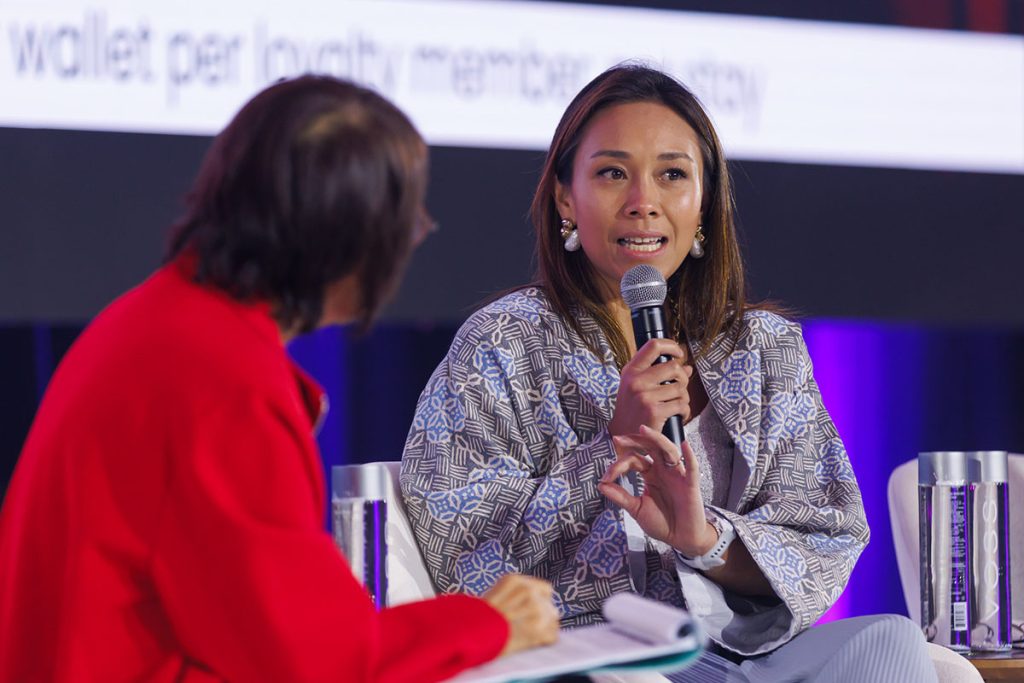
“We don’t have to be everything to everyone. But we can be a wonderful thing for a lot of people, and that’s good enough.”
Robots, jobs and OTAs
Hotel101 calls itself a proptech, but it integrates systems such as RMS Cloud rather than building its own. One room type, Yulo-Luccini argued, puts it at the front of the queue for automation.
“Take robot housekeepers. We would be the first to be able to do that, because you programme it once and it literally goes from room to room to room,” she said. “There’s wonderful, exceptional hospitality technology out there. We just need to integrate what’s right for us. With such a simple business model, and being young and nimble, that is very accessible.”
But if Hotel101 is exporting Filipino hospitality with only 30 direct hires per hotel, what about jobs? Its direct staff are the customer-facing ones, she explained, because the brand promises five-star service at a mass-market price. A 680-room hotel still employs hundreds through partners: housekeeping run by large agencies, F&B run by a Michelin-starred restaurant operator who “has more employees than we do”.
And there is a bigger shift. “As we move from country to country, Filipinos are seen not just as employees, but as employers, as investors.”
The agentic orchestration layer
For Ascott, AI is the second transformation. The goal is agentic AI that delivers a seamless guest experience from pre-stay to in-stay to post-stay, lifting loyalty and direct bookings. What keeps Tan awake at night is knowing what to invest in, at what stage, and how much.
“Agentic commerce is everyone’s hope and desire, but there is a lot of uncertainty and a lot of unknowns,” she said. So Ascott is focused on the foundation: an orchestration layer. Hotel systems were designed in silos, for different teams of humans to manage. Agentic AI needs them to talk to one another. “The inventory system, the reservation system, the payment system, the loyalty system. They all need to come together like an orchestra and create beautiful music in harmony.”
And that is one hotel group. Breaking the silos across airlines, hotels, transfers and destinations to orchestrate the whole trip is more daunting still. Yet that is the promise of agentic AI: an assistant that can flatten it all.
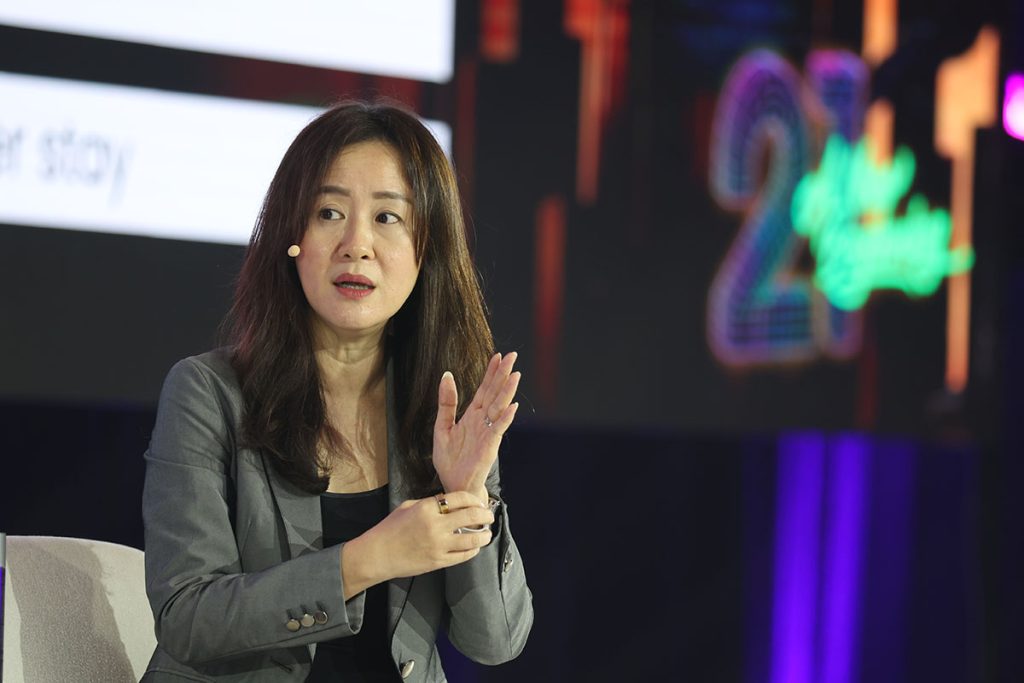
“Agentic commerce is everyone’s hope and desire, but there is a lot of uncertainty and a lot of unknowns.”
“Our commission is our marketing”
On distribution, the two again part ways. Yulo-Luccini doesn’t care where her bookings come from. About 90% of Hotel101’s bookings come through OTAs today. “We don’t spend on marketing. Our commission to the OTAs is our marketing. They do what they do best, and that brings us direct bookings.” Hotel101 has its own loyalty programme, but she conceded its value won’t show until the network is there.
Ascott’s OTA share? “Thirty, max,” said Tan, and she intends to keep it low.
Resilience and empathy rule
The session ended with the question – in a moment when hospitality can amplify what is human, what do women bring?
“Resilience,” said Tan. “We play many different roles, and every role requires resilience and grit. We need that in this era.”
Yulo-Luccini’s pick: “Empathy. We nurture, we care, we understand. That will give women the edge in understanding how hospitality should feel.”
Watch the full session: