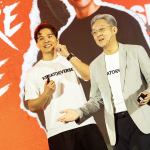

His journalist friend Ken Jalleh Jr said in the personal tribute he read out on awards night, “STB finally got it right” with this choice. I suppose what he meant was that Foo comes from outside the establishment and thus, this recognition is all the more sweeter.
Foo, who’s known as the Comeback Kid to friends, has had more ups and downs in his career than Sylvester Stallone but has proven that where it counts – stamina and staying power – he’s got what it takes to not only last in the cut-throat competitive world of nightlife and entertainment but also make a profound impact in Singapore’s nightlife scene.
Today, he’s the CEO of St James Power Station, which runs several of Singapore’s most happening nightspots.
Meet the man who changed Singapore’s nightlife – at least the part of it that’s legitimate and acknowledged by authorities to be the face of Singapore’s entertainment scene.
If Foo had his way, he’d want to change all of it and bridge the two sides of nightlife – the other, being the darker, seedier side where operators often have to, and do bend the rules to attract customers (more of that later) – but for now, he’s basking in the glory of the award.
Saying he was “overwhelmed” by the award, he sees it as validation of some of the things he’s done.
Foo was born into food & beverage. As a young boy, he would help out behind the bar, serving drinks, in the family café started by his grand-father. His father took over the business and turned it into a coffee house, serving western food. He renamed it Europa Lounge & Restaurant.
When his father passed away in 1981, he left Europa to the young Dennis. His last words? “Take care of it.”
And he certainly did. He battled for two years to secure an alcohol licence for Europa Lounge & Restaurant which was located in a Housing Development Board estate. There was no precedent for serving alcohol in a public housing area. He also fought for an entertainment licence to introduce live music. Again, there was no precedent.
“The long road is always there, you can’t give up,” he said. “It’s my passion. I enjoy live music.”
Later, he introduced an outdoor beer garden at Changi Europa. “There was no alfresco dining at that time and I always wanted a beer garden.” Again, he fought to get the necessary permits.
Not all his ventures succeeded. When he took the Pirates of the Caribbean ride in Disneyland in the 1980s, he got so excited by the “stars, moons and pirates” that he started the first theatre lounge, Peppermint Park, in Parkway Parade on Singapore’s East Coast.
When you walked into the club, you could hear the sound of crickets and thunder and lighting. He brought in new technology – a total of 11 speakers were placed on the ceiling. To recreate birdsong, he went to Jurong Bird Park to record the feathered creatures. “I was obsessed.”
He also created Atlantis, an underwater-themed theatre lounge. He brought in a man named Daniel Flannery who had worked with Disneyland to design the place.
When the recession hit in 1985, the two businesses bombed. Peppermint Park cost him S$1.4 million and Atlantis, $2.86 million.
In debt, he went back to Changi Europa to lick his wounds. That’s when he knew he had to “corporatise”, as he calls it. He joined forces with three partners and by 1996, they had built Europa into the biggest pub and bar chain in Singapore.
Emboldened by the success, the partners made a $100 million bid for a plot of land in Bukit Timah which then became the Raffles Town Club. That venture landed him in one of Singapore’s biggest courtroom dramas which he walked away from.
The “Comeback Kid” then started Devil’s Bar and in 2009, St James Power Station.
“I’ve had lots of ups and downs. I don’t know if the “Comeback Kid” is a compliment or not,” he laughed.
He feels though that he hasn’t achieved his real goal yet for Singapore’s nightlife. “Whichever way we develop our business, it’s about hospitality, hospitality is about people, people create value and value become assets. If you are prepared to share these assets, then your growth can be phenomenal.
“Why I wanted to get the company listed is to create a vehicle big enough to fulfill a lot of the goals and dreams of people in my life.
“There are three things that can make you successful. Heart, you have to do it from the heart; passion – you have to have passion and that’s different from heart; and unity – doing it with like-minded people who are good at what they do.
“This can create a powerful vehicle for transformation.”
Foo was also a supporter in bringing in casinos to Singapore. He recalled the day – April 18, 2005 when the Prime Minister made the announcement that casinos would be allowed in Singapore. He brought his team to the Devil’s Bar to watch the news and to celebrate.
“I told them this was an important moment,” he said.
And although gaming is definitely competitive to nightlife spots like his – “it is the most powerful entertainment there is for Asians and a higher strata form of entertainment” – he said the upside was the casinos would bring in more tourists which would mean more customers for people like him.
He also believes that if any place can strike a balance between casinos and society interests, Singapore can. “If you look at the most extreme form of vice, it’s drugs and Singapore has effectively clamped down on that. This will cut off the revenues to fuel other elements of vice.”
And while the casinos are currently attracting more locals than tourists right now, Foo believes this can be corrected easily. “Tourists have to be the primary target and locals, the secondary target.”
As for what he calls the “final frontier”, he’d like to see the bridging of the two worlds of Singapore’s nightlife – the above-board operations and the sleazier side – to create a level playing field for everybody.
“Right now, tourists can get confused. They walk into a bar in a seemingly okay area of town and find themselves in situations some might feel uncomfortable with,” said Foo. “These operators use tactics to lure customers, tactics that operators like us don’t wish to resort to even though we operate under the same licence.
“It’s out there, it’s growing and we need to address it.”
Foo has made a controversial suggestion that perhaps Singapore should introduce a legalized red light district as in Amsterdam or Hamburg but “Singapore is not yet ready for that, the political price will be too high”.
“But we need some sort of zoning so that anything outside this zone should not be condoned. That way, operators get a level playing field and customers know what they are getting.”
Featured image credit : http://www.goasia.co