
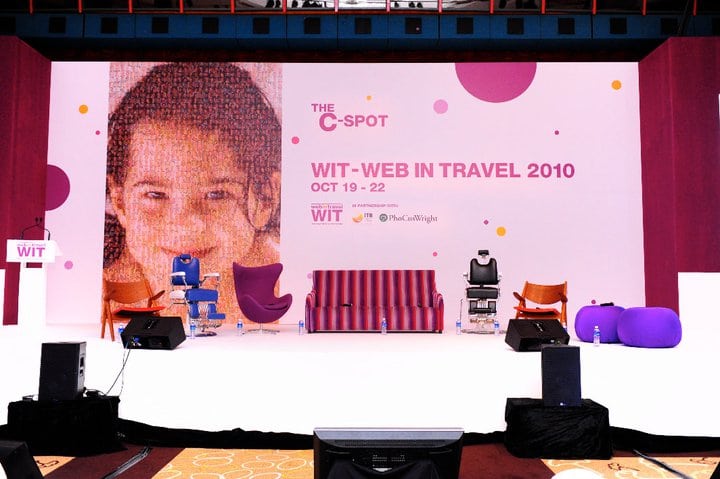
 It’s been a couple of weeks now since we were all at WIT. Siew Hoon’s had her decompression trip to Phuket, and just today I saw a wonderful compilation video from the event. Oh and, of course, WIT won the Trade Conference of the Year in the Singapore Experience Awards 2010.
We all enjoyed a lot of great content, discussion, love (only some of it tough) and some not too shabby evenings of generous hospitality.
Two key themes still resonate with me – two themes, which I think, will and should still be resonating with us all as we move towards WIT 2011. These are the notions of ‘innovation’ and (user) ‘experience’.
The idea of innovation was introduced at the WITovation Entrepreneur Bootcamp on the day before the main conference with an “Innovation Exchange’ where the panelists were asked (amongst other things) to define ‘innovation’. There was some consensus from the two Tims around innovation being ‘getting great ideas implemented’ and Brett Henry suggested that innovation could be something about looking at good ‘western’ models and implementing them to work well in a ‘local (Asian) context’.
As far as I could tell, the notion of ‘experience’ came up as part of other discussions (rather than being formally introduced) with one example coming from Morris Sim (at the WIT Ideas Lab) who introduced the audience to the ‘Four E’s’ (an evolution of the ‘Four P’s’) of which ‘E’xperience is one.
We are moving away from an ‘information’ economy towards an ‘experience’ economy – an economy where the emotion and feelings (the overall experience) created and evoked around the interactions with a brand, a product or a service will become the differentiating factors that will form the new consumer yardsticks.
I should be clear at this stage that when I talk about user ’experience’ I’m not just talking about an online ‘ecommerce-type’ experience with optimized service delivery and channels (although this could be a large part of it). Rather I’m talking about a broader experience that permeates all the touch points with online, of course, being the one that gives us the greatest new opportunities – new opportunities for real innovation.
There is enough data out there. I have enough of it on all of my computers and mobile devices. And I still have all the more traditional sources that still manage to hold on to their existence – newspapers, the radio and the TV.
There was a lot of talk at WIT about the importance of ‘content’ and it being attributed (rightly or wrongly) the accolade of ‘King’. Well, to coin a phrase, ‘The King is dead. Long live the King’. This new King? – Experience.
Someone at WIT described ‘innovation’ as making version 1.1 of something – making something a bit better. I don’t call that innovation – I call it, at best, an evolution. The iPhone wasn’t a slightly better ‘something else’. It was a game changer – it was a disrupter – it was version 2.0. At WIT I also heard innovation described as some kind of Eureka moment with the proverbial light bulb suddenly popping on. Sorry to disappoint but this, albeit rather romantic notion, is rarely the reality. Innovation thrives in communities of diverse competencies and disciplines and truly innovative products or types of service delivery are often the result of several ideas merging together in the right culture – a culture where people are encouraged to ask questions rather than get on with things the way it was done yesterday and last week – a culture where people are encouraged to look beyond their own world and observe other industries and businesses.
The travel industry needs to ask itself some questions if it’s going to innovate successfully. What challenges faced by some in the travel industry have been met and overcome elsewhere? How do other sectors deal with these issues? What ‘analogous’ situations can we look to for inspiration and idea creation? In a well known example, An A&E department in a US hospital looked at a NSCAR pit crew performing a pit stop to gain insights on how several people of varying disciplines could quickly diagnose and solve a problem with a car (patient).
What ‘business orthodoxies’ can we challenge in travel to spark some fresh and creative thinking? Does the way we have always done that have to be the way we always do it? Do we really understand the customers’ need and desires in the broader context of their journey from travel ideas through inspiration towards choice criteria and finally transaction?
There is enough data – enough content. And enough of it is compelling. It’s how it’s presented and how clever and innovative we are prepared to get in delivering it via engaging ways to consumers that will redefine the ‘experience’ and make the difference.
Featured image credit (Experience road sign): Ockra/iStock