
Caught up this morning with John Weimer, vice president APAC and corporate development of HomeAway and Turochas Fuad, CEO & co-founder of travemob, fresh from announcing their “marriage” and both showed all the signs of a couple newly-consummated in love.
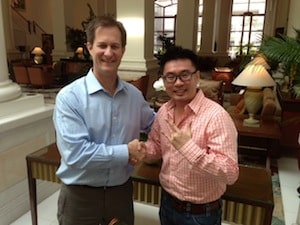
John Weimer (left) and Turochas Fuad
Said Weimer, “It’s all about T, PK (Prashant Kirtane) and the team and the skills set they bring, plus their pan-regional focus and what they’ve built so far.”
Added Fuad, “We share the same vision, same goals. Vacation rental in Asia is booming, we see a lot of synergy and we work well with them.”
The union is not unexpected. It comes a few months after the “engagement” when they signed a distribution partnership and for HomeAway looking to expand its presence in Asia Pacific, the one-year-old start-up is a natural fit.
Under the agreement, HomeAway will acquire a majority control of travelmob in an all-cash transaction (the sum is undisclosed) and travelmob’s management team will retain a 37% share of the company and continue to operate as an independent brand.
Six months after launch, travelmob raised US$1 million funding and the early investors which include Jungle Ventures, Accel Partners and private investors, including Dan Neary, vice president of Asia Pacific at Facebook, have made their exit.
In a press statement, HomeAway said that for the remainder of fiscal 2013, it expects to incur about US$2.0 million in additional expense to further grow the travelmob business.
Some might say it’s a bit too early for travelmob to sell at 12 months of age, but Fuad said “it’s the perfect time if you find the right parter with the same goals and mission and the right conditions”.
It is clear that while travelmob has built a pretty solid business in 12 months, this acquisition is about buying the team and the deal includes “big incentives for the team to stay on”, said Weimer, adding, “We want the entire team to be motivated, and achieve the big objectives.”
He called it a complementary fit in that travelmob’s focus was on travellers in the Asia Pacific region while HomeAway’s was outside the region. “We are not set up with the infrastructure to do what travelmob can do in the Asian market.”
Added Fuad, “We get to operate as an independent brand and the incentives are very aligned. It’s good to be part of a global player because in this space, there are clearly bigger players than us.”
Asked if he had built travelmob with the deliberate purpose of selling to a player like HomeAway, Fuad said, “Frankly not, we always thought we would build the company and be big enough to stand on own two feet. We didn’t build with a deliberate plan to sell, the idea was to scale on our own.”
HomeAway’s investment will enable travelmob to accelerate brand-building – thus far, it has relied on performance marketing but this will allow it to explore above-the-line channels to drive traffic. Fuad calls it “a shiny jet pack” that will allow travelmob to be creative and build the brand and team.
With travelmob, HomeAway gets a player that knows the Asia market and is developing a model that works for the region. Weimer said, “They have been creative with the inventory and while HomeAway has the luxury of focusing on vacation rentals because it is an established industry in the US, here it is new and emerging and it’s evolving differently. It is critical we have people who understand that and can execute to that.”
Fuad said, “We have noticed that as we grow, there is a cultural difference in Asia – the secondary home market a much bigger than the primary home – but rising incomes mean more people will own second homes and a higher propensity to travel and people are looking for alternatives to hotels.”
The site now features over 14,000 Asia Pacific short-term rental listings including luxury villas, urban apartments, houseboats, a private island and even some shared spaces.
travelmob is built on a transaction-based model, earning commissions on transactions, while HomeAway works on a listing model. However Weimer said HomeAway has an online booking transaction model in beta in the US and Europe and would be offering that option to customers.
“We want to work out the kinks before the commercial launch,” said Weimer.
The current HomeAway team in the region, based in Thailand, would continue to sell subscriptions and source content and work independently from Travelmob.
Asked if he was concerned about small-start-up-fitting-into-big-company syndrome, Fuad said, “Of course there will be some learning on both sides – we have to adapt to each other but the good thing is PK and I have worked with Yahoo!, Skype and Microsoft and so we understand the corporate world and we know what to do and what not to do.”
Added Weimer, “It is tricky to find leadership in a start-up company that’s resourceful and yet know the realities of working for a publicly-traded company. That can be a big cultural chasm but T and PK know this – so they get us.”
Weimer says he gives a lot of credit to Priceline for having done it well in terms of global expansion and yet keeping the integrity of localization. “We have kept the You buy a good team, you support them and trust that they know more about the market than you. We have kept the brands we have acquired in Germany, France, Brazil and the US.”
And in case you think the love story is getting too good to be true, it gets even better.
It seems Fuad went to university in Austin, where HomeAway is based, and he and Carl Shepherd, co-founder of HomeAway, went to the same university, abeit at different times.
Ah, destiny …