


Record seat capacity and a runaway success story in Ethiopia can’t mask deep structural fault lines across West, Central and Southern Africa. OAG’s CEO lays out the numbers
African aviation is at a crossroads. On paper, the numbers look promising — 2025 has delivered record seat capacity across the continent, with growth of 3.6% on a compound annual basis since the Covid trough. But peel back the headline figures and a more complicated picture emerges: uneven growth, a shrinking Southern African share, and structural barriers that continue to limit how freely Africans can travel within their own continent.
That was the central message from Filip Filipov, CEO of aviation data firm OAG, who delivered a brisk five-slide regional overview at WiT Africa 2026. His verdict was candid: African aviation risks losing relevance in a global context — unless the industry addresses some long-standing weaknesses head-on.
“There is one seat for every 13 people in the market. This is still a market that is very much in its development.”
Filip Filipov, CEO, OAG
A two-speed continent
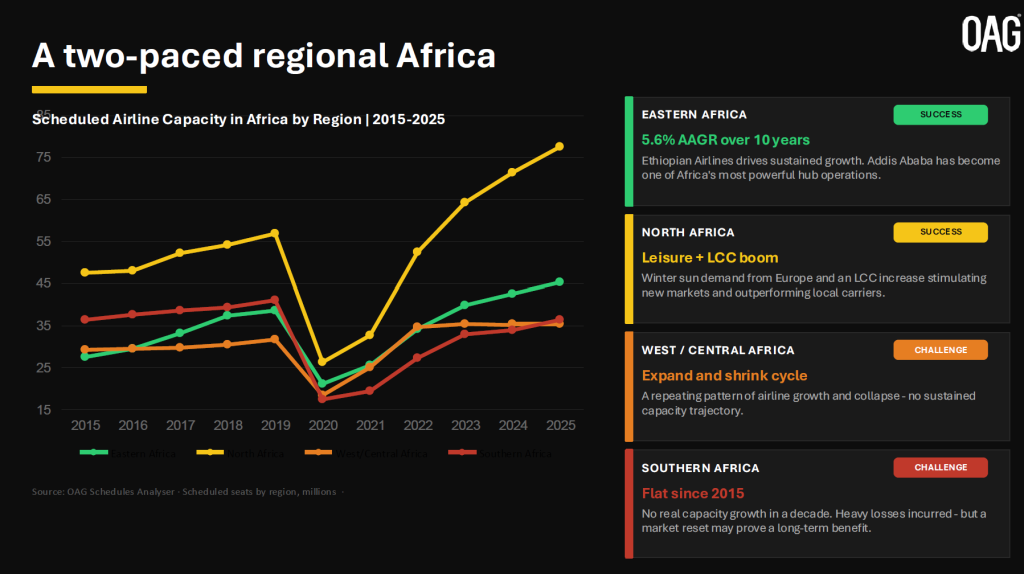
The clearest way to understand Africa’s aviation landscape right now is to divide it in two. Eastern and Northern Africa are flying ahead. Ethiopia has been the standout success story of the past decade — Ethiopian Airlines has more than doubled its capacity in ten years, with 88 aircraft currently on order in what Filipov called the largest fleet expansion on the continent. North Africa, meanwhile, has benefited from a leisure and low-cost carrier boom, with Morocco emerging as the fastest-growing inbound market, driven by short-break demand from European travellers.
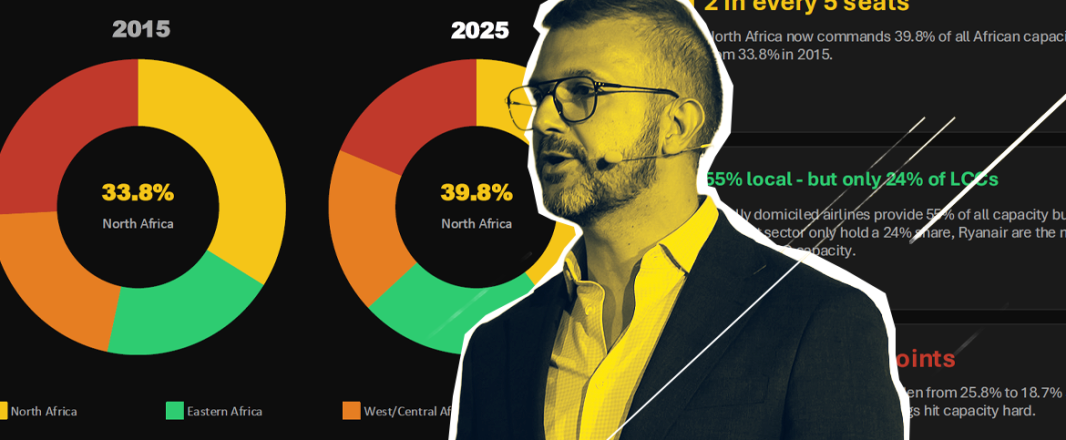
Two in every five seats in Africa now depart from North Africa — a share that has grown substantially, partly at the expense of Southern Africa, whose regional slice has fallen by seven percentage points since 2015. West and Central Africa, by contrast, have been essentially flat since the same year.
The airlines to watch
Beyond Ethiopian Airlines, Filipov highlighted a handful of carriers making meaningful moves. Taff Air has grown from relative obscurity to become Southern Africa’s largest airline over three decades, now sitting at number two on the continent by capacity. Royal Air Maroc is consolidating its position as a mid-sized hub carrier servicing Morocco-Europe corridors. And Egypt Air is on an ambitious expansion path, buoyed by tourism demand that Filipov described as “on the right track” — though he noted the influence of the big three Middle Eastern carriers remains a complicating factor.
Nigeria, despite a notable post-Covid bounce in 2022, has since contracted in terms of seat capacity and has yet to return to the potential many in the industry believe the market holds. Air Algeria, meanwhile, is showing steady domestic growth — a sign of latent demand in one of Africa’s larger but internationally under-connected markets.
“It’s really a story of one airline racing ahead with a few others trying to keep up. I do hope we’ll see some of those airlines becoming global players.”
Filip Filipov, CEO, OAG
The fundamental challenge
Perhaps the most sobering data point Filipov raised wasn’t about any individual market — it was about affordability. Africa’s air travel demand is acutely sensitive to price. “If fares increase in Africa,” he warned, “the consequences on demand could be quite substantial.” That limits the ability of airlines to invest in growth and new routes without risking passenger drop-off — a constraint that doesn’t apply to the same degree in more mature aviation markets.
Despite more than 120 airlines operating across the continent, African aviation remains highly concentrated. The dominance of a single carrier — Ethiopian Airlines — in driving continental growth is both a testament to what’s possible and a reminder of how much work remains to build a truly competitive, multi-hub ecosystem.
The opportunity is real. Regional connectivity remains underdeveloped, and with Africa’s population continuing to grow rapidly, the long-term demand case is compelling. But as Filipov’s data makes clear, turning potential into sustained, broad-based growth will require more than one airline doing the heavy lifting.


